

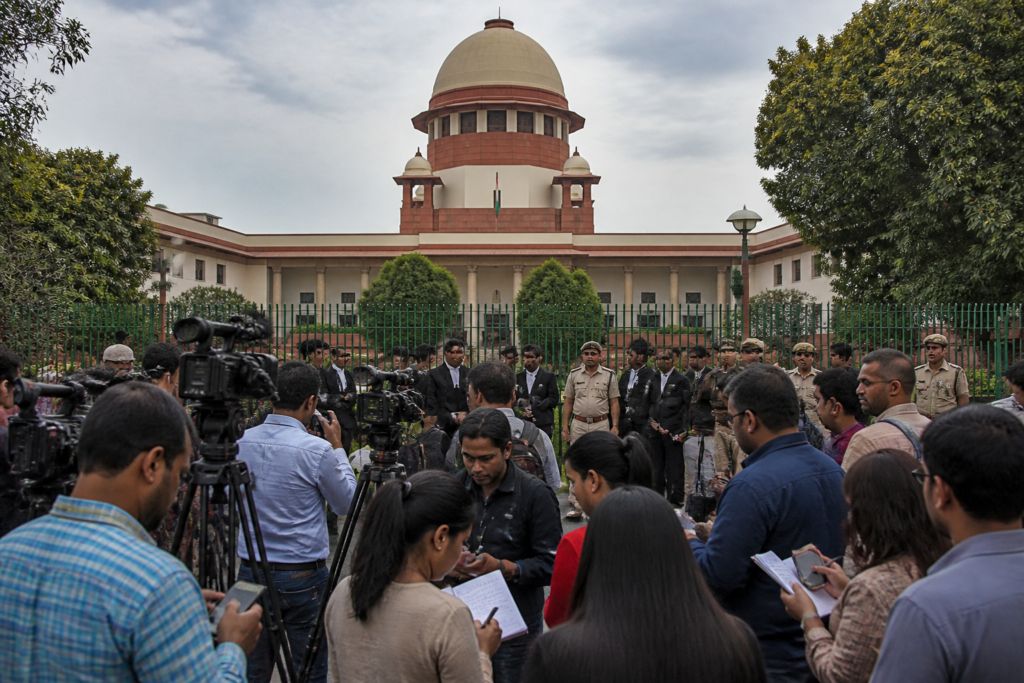
The Supreme Court on Thursday directed that no coercive action be taken against a woman journalist named in an FIR alleging casteist remarks against Assistant Commissioner of Police Vivek Bhagat, while it considered allegations of harassment and violence against women journalists covering protests in Delhi.
A bench comprising Chief Justice of India Surya Kant and Justice Joymalya Bagchi passed the order during a hearing on a petition filed by the Network of Women in Media, India (NWMI). The petition raised broader concerns about violence and sexual harassment faced by women journalists while reporting from protests in the Capital.
Senior advocate Indira Jaising, appearing for NWMI, sought an independent commission to examine allegations against police personnel. She proposed a body comprising predominantly former women judges, IPS officers, eminent citizens and social activists. The court described the allegations as “very serious” and allowed Jaising to submit, in a sealed cover, the identities of women journalists prepared to file written complaints and suggestions for the proposed committee.
“There are allegations against certain police officers. We are considering whether there must be an independent committee to probe them… consequences under the law must follow,” the bench said. The court also stressed that journalists required additional protection and raised questions about how journalistic status should be assessed in the digital era.
Solicitor General Tushar Mehta, representing the police, asked the court to await the police response before deciding whether to establish an independent commission. He also questioned the authenticity of a video submitted by the journalist, suggesting that it could have been generated using artificial intelligence. Jaising sought a standard operating procedure for dealing with harassment of women journalists and said reporters faced violence while covering protests at Jantar Mantar.
Mehta opposed a blanket order and referred to allegations of harassment involving women police personnel as well. During the hearing, senior advocate Gaurav Bhatia separately alleged that a three-month-pregnant journalist had been pushed by Leader of Opposition Rahul Gandhi during an incident at the Supreme Court on October 12. He said she was injured and required hospitalisation. Jaising accused him of politicising the issue, while the court said it could examine the allegation if a petition was filed.
The FIR against the journalist and two others was registered on Tuesday. It invokes provisions of the Bharatiya Nyaya Sanhita relating to obstructing a public servant, defamation and joint liability, along with provisions of the Scheduled Castes and the Scheduled Tribes (Prevention of Atrocities) Act. The case followed allegations that the journalist made casteist remarks against Bhagat.
The journalist has alleged that the FIR was a counterblast to her complaint against the ACP. She said Bhagat touched her inappropriately and pushed her while she was recording the detention of a Left activist on October 3. Bhagat has denied the allegations, and police have referred her complaint to the crime branch for an impartial inquiry.
The Delhi High Court had earlier declined an urgent hearing on the journalist’s plea challenging the FIR but agreed to hear it on Friday. The Supreme Court’s interim direction against coercive action will remain the immediate protection available to the journalist while the related proceedings continue.


