

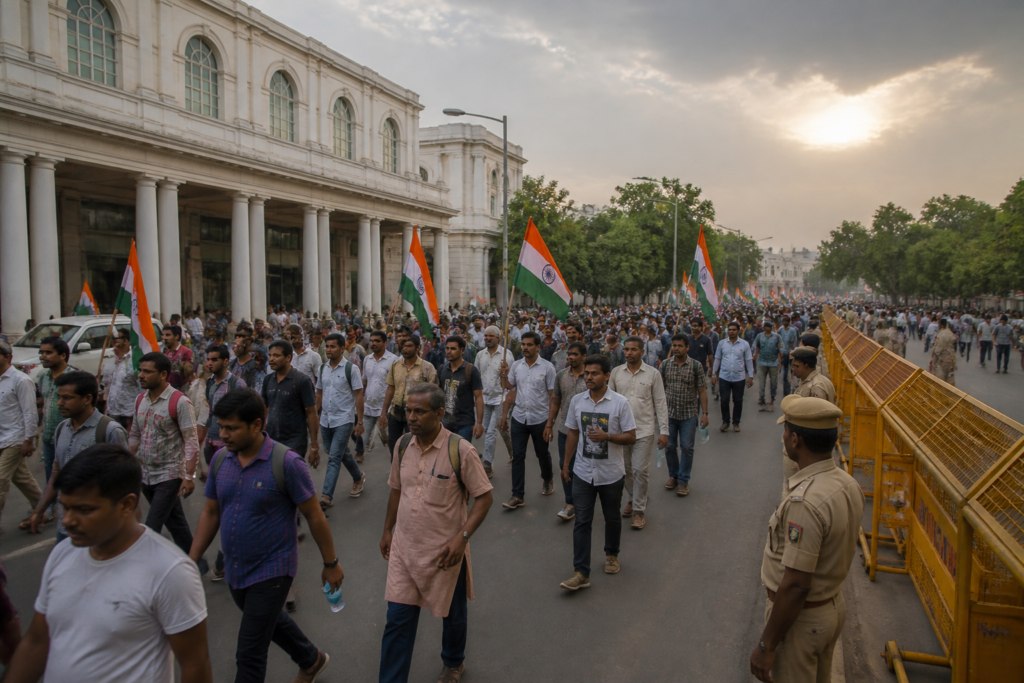
A Tiranga March in central Delhi over the de-notification of Jantar Mantar as a designated protest site and the Special Intensive Revision of electoral rolls ended with around 150 protesters arrested, according to the organisers, the All India Students’ Federation and the All India Youth Federation.
The AISF and AIYF organised the march from Connaught Place towards Jantar Mantar on Thursday. The organisations said their demands included scrapping the SIR exercise, restoring Jantar Mantar as an authorised venue for protests and releasing Centre for Justice and Peace leaders Ashutosh Ranka and Saurav Das, whom they said had been imprisoned for hoisting the Tricolour.
The protest places Jantar Mantar’s role in Delhi’s civic life at the centre of a renewed dispute. The site has historically been used for public demonstrations, allowing groups to bring political, social and administrative grievances to a prominent location in the national capital. Restrictions on where protests can be held determine not only the movement of people and traffic, but also how visibly citizens can present demands to public authorities.
The protesters carried the national flag during the march. The organisations described the removal of Jantar Mantar’s protest-site designation as an attack on the right to peaceful assembly. They alleged that restrictions and police action were being used to suppress dissent.
The march was led by AIYF president Raushan Kumar Sinha, general secretary Sukhjinder Mahesari, AISF Delhi State convenor Aniket Madke and co-convenors Shubham and Mohit. The organisations said approximately 150 people were arrested by Delhi Police during the demonstration. The report does not include an independent police account of the arrests, the sections invoked or the subsequent legal status of those detained.
The second major issue raised by the groups was the Special Intensive Revision of electoral rolls. AISF and AIYF alleged that the exercise could exclude eligible voters from electoral registers and undermine voting rights. The organisations did not provide details in the supplied account about the number of voters affected, the areas covered or the specific procedures they oppose.
The dispute therefore links two different dimensions of urban governance: the management of public space and access to democratic institutions. Jantar Mantar is not only a location for gatherings; its designation determines the formal space available for collective action in a tightly managed central-city area. Electoral-roll revision, meanwhile, affects residents’ ability to participate in elections, although the precise impact of the current SIR exercise was not established in the supplied report.
The organisations’ leadership said the detained CJP leaders should be released immediately and maintained that the protest restrictions and arrests were inconsistent with peaceful democratic participation. No response from Delhi Police, the administration responsible for the protest-site arrangements or the authorities overseeing the electoral-roll revision was included in the report.
The immediate next steps are expected to involve the legal processing of those arrested, clarification of the status of Jantar Mantar as a designated protest venue and further responses from the authorities on the SIR exercise and the organisations’ demands.


