

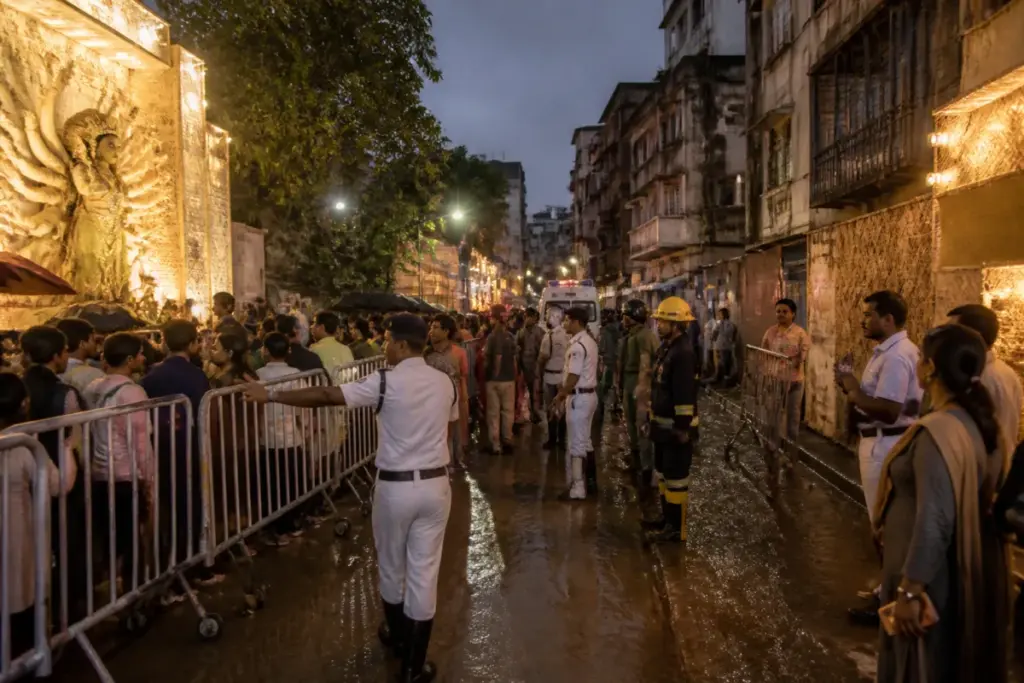
The Kolkata pandal stampede was not caused by crowd size alone. The probe into the Chorbagan Durga Puja tragedy has identified a chain of failures in emergency planning, entry and exit management, public communication, security deployment and coordination between police, private guards and volunteers. Together, these gaps turned heavy rain and a sudden visitor surge into a disaster that killed 19 people and injured around 25.
The incident is significant beyond the question of individual responsibility. It shows how a temporary public venue can become unsafe when its crowd-management arrangements depend on verbal instructions, narrow access routes and improvised decisions rather than a documented operating plan. The investigation has already resulted in the arrest of seven people, including two office-bearers of the Chorbagan Durga Puja committee, in a suo motu case of culpable homicide not amounting to murder. They have been remanded in 10 days’ police custody.
The central urban-safety issue is the absence of a reliable evacuation system. According to a senior Kolkata Police officer quoted in the report, the venue had no properly routed queue system, designated holding areas or adequately planned emergency bypasses. The narrow Radha Madhab Saha Lane became a critical bottleneck, particularly for people who had entered the queue but found little opportunity to leave midway.
This is an important distinction in understanding crowd disasters. A venue may appear to function during normal visitor flows while remaining dangerously fragile when people need to change direction quickly. Entry, circulation and exit are not separate arrangements. They form one system, and a failure at any point can push pressure into the next space. At Chorbagan, the route into the pandal, the waiting area outside and the path towards the exit appear to have become interdependent without sufficient separation or spare capacity.
The weather made that weakness more severe. Heavy rain drove people waiting outside towards the pandal for shelter. At the same time, many visitors already inside reportedly resisted leaving because they did not want to get drenched. This produced opposing movements: people entering or seeking shelter and others trying to exit. Investigators said the resulting collision of incoming and outgoing streams rapidly increased pressure near the exit.
A planned response could have reduced that pressure through measures such as stopping fresh entry, opening alternative evacuation routes and dispersing visitors in controlled phases. These measures are not merely operational details. They determine whether a public gathering can absorb an unexpected change in conditions without forcing hundreds of people into the same narrow passage.
### How communication converted risk into panic
The public-address announcement is now under scrutiny because it may have transformed an already difficult situation into a panic-driven rush. An investigator said an unverified warning that the pandal structure was about to collapse allegedly triggered an immediate movement towards the exit. The report says the announcement urged people to evacuate and caused visitors to rush blindly towards the gates.
Investigators said people stumbled down a flight of stairs and were trampled. The episode illustrates the importance of command discipline during an emergency. A public-address system can provide a controlled response, but an unverified message can remove the time people need to assess their surroundings and follow an orderly route. At a crowded temporary structure, the difference between an instruction to remain calm and an alarm to evacuate immediately can determine how people use limited space.
The reported communication problem was not confined to the announcement. Private security guards allegedly blew whistles and shouted conflicting instructions. When multiple authorities give different directions, visitors cannot easily identify which route is safe or who is in charge. The result is not simply confusion; it is the breakdown of coordinated movement.
The report also raises questions about where security personnel were positioned. Investigators alleged that police presence was concentrated around VIP entrances rather than at general access points where crowd pressure was highest. This suggests a mismatch between the locations receiving security attention and the locations carrying the greatest public risk. The allegation remains part of the investigation, but it points to a broader planning question: whether crowd-control resources are allocated according to actual movement and vulnerability rather than customary or privileged access arrangements.
### Experience, continuity and institutional memory
The Chorbagan arrangements were also affected by changes in the people responsible for crowd management. Organisers said the team handling the puja had changed and that new members lacked experience in managing large crowds in a narrow lane. Several police personnel familiar with previous years’ arrangements had reportedly been transferred to other districts before the festival.
Experience alone cannot substitute for a written plan, but the loss of institutional memory can make temporary events more vulnerable. Experienced personnel may understand how visitor flows change at different times, where queues tend to expand and which routes become difficult during rain. If that knowledge is not documented and transferred, each festival can become a fresh operational exercise.
Organisers expect crowd management to improve after nine senior IPS officers with previous experience of puja crowd control returned to the city. However, the response now being assembled also shows that safety cannot depend only on a few experienced officers. It requires clear responsibility, rehearsed procedures, dependable communication and physical arrangements that remain usable when conditions deteriorate.
### The wider inspection of Kolkata’s pandals
After the tragedy, a high-level inspection team led by special task force director-general Jawed Shamim and fire and emergency services director-general Anuj Sharma began visiting major pandals. The inspections are examining crowd safety, fire preparedness, lighting, ventilation and traffic movement. Police have issued fresh advisories, while traffic arrangements around prominent venues are being reviewed to keep access routes clear for emergency vehicles.
The inspection scope is significant because crowd safety is connected to more than the internal layout of a pandal. Poor lighting can slow movement. Temporary stalls can reduce the width of escape paths. LPG cylinders near an inflammable structure introduce a separate hazard. Blocked roads can delay ambulances and fire tenders even when emergency personnel have been alerted.
The fire and emergency services department issued showcause notices to Ballygunge Cultural Association and Chetla Agrani Club after inspections identified safety deficiencies. The October 18 notices cited inadequate lighting, temporary commercial stalls near entry and exit points, blocked access and LPG cylinders close to inflammable puja structures. Ballygunge Cultural Association was directed to improve illumination and stop commercial activity near entry and exit gates. Chetla Agragni was asked to install lighting, fans and air-conditioning, remove unauthorised temporary structures, particularly shops using LPG cylinders, and submit a compliance report to the local fire station.
These notices show how the safety perimeter extends into the public realm around a venue. A pandal may be temporarily built, but the roads, lanes, stalls, queues and emergency approaches around it determine whether the structure can operate safely at peak demand. Managing the event therefore requires coordination between organisers, police, fire services, traffic authorities and local administration rather than isolated compliance by a puja committee.
### Committees begin changing operations
The response from puja committees has focused on controlling visitor movement and reducing avoidable obstruction. At a meeting organised by the Forum for Durgotsab at Netaji Indoor Stadium, representatives of around 100 committees agreed to station a volunteer or designated club member at every pandal entrance, keep walkie-talkies and make regular announcements discouraging selfies and video recording inside pandals. The forum also arranged raincoats for clubs and ambulances across zones.
Committees were asked to fill road excavations, deploy volunteers more actively and cooperate with the administration. These steps reflect the practical conditions under which crowd movement takes place. Visitors who stop for photographs or videos can slow circulation, while excavations and poorly managed roadside conditions can reduce the usable width of a route. Rain protection and medical access also become essential when large gatherings are exposed to changing weather.
Several venues have adopted specific changes. Santosh Mitra Square opted for staggered entry and increased the number of volunteers and fire tenders after considering, but rejecting, a full closure because organisers feared that shutting the pandal could create greater congestion outside. Tala Prottoy reopened after increasing illumination, deploying more volunteers and expanding the holding area and circulation space. Purvachal Udayan Sangha shut a shop near an exit to clear the passage, while Purvachal Amra Sabai Club allowed visitors to view the idol from outside.
Purvachal Amra Sabai also discontinued VIP entry and converted its VIP gate into an exit for the general public. Purba Putiari Pragati Sangha increased its security personnel from six to 10 and created an additional emergency exit. Allen Park in Park Street cancelled major cultural performances, retaining only religious programmes. These actions indicate that crowd safety decisions affect programming, access privileges, commercial activity and the use of public roads around the venue.
### The unresolved question is whether temporary fixes will last
The immediate measures address visible weaknesses: blocked exits, insufficient lighting, excessive crowd density, inadequate staffing and conflicting access arrangements. The more difficult task is converting these lessons into a repeatable system for every major public gathering.
The Chorbagan investigation has established, according to the supplied report, that the venue lacked a structured emergency evacuation plan and that crowd movement was managed largely through verbal instructions. The wider inspections and committee-level changes show that authorities and organisers are now responding across several locations. What remains to be established is how responsibility will be documented, tested and enforced before the next large gathering.
The tragedy therefore raises a question about the governance of temporary urban events. Durga Puja pandals are seasonal structures, but the crowds they attract require the same seriousness as permanent public venues. Safe operation depends on capacity planning, route separation, emergency communication, trained personnel, clear authority and unobstructed access for responders. The investigation, inspection notices and revised arrangements now underway will determine whether Kolkata’s response remains an emergency reaction or becomes a stronger framework for managing public crowds.


