

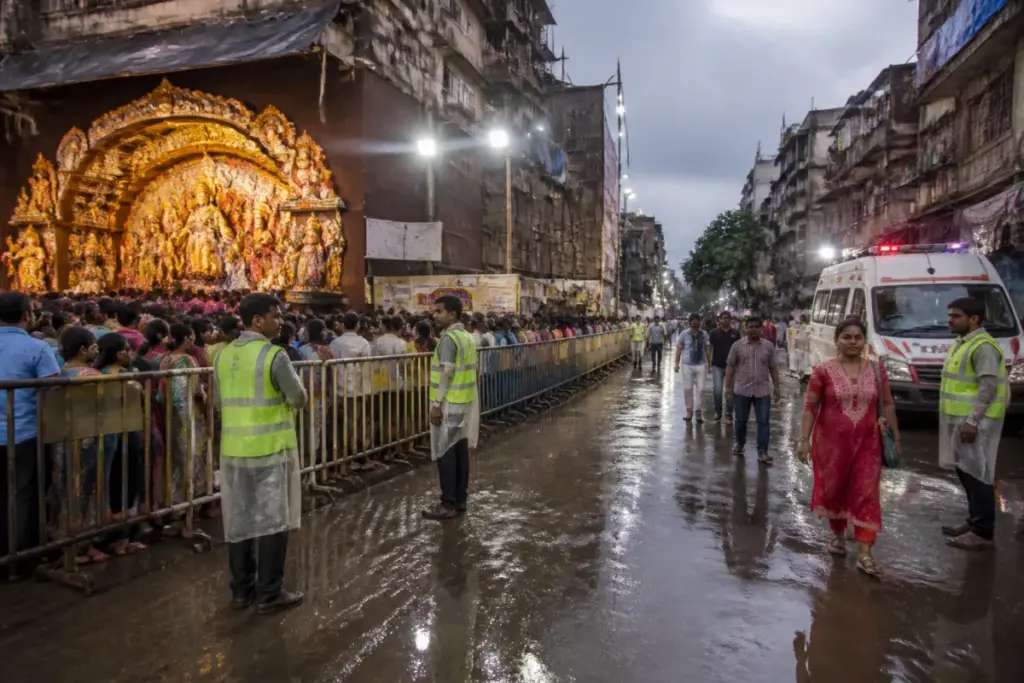
Kolkata’s Durga Puja safety overhaul following the Chorbagan stampede is exposing a problem larger than the arrangements at any one pandal: the city’s festival infrastructure has to manage visitor volumes, narrow movement corridors, commercial activity, emergency access and public behaviour at the same time. The reported death of 19 people and injuries to 25 at Chorbagan Sarbojanin Durga Puja in north Kolkata have prompted organisers across the city to redesign how visitors enter, move through and leave their venues.
The response has been immediate and varied. Organisers have increased illumination, reduced the number of visitors allowed inside at one time, added volunteers and emergency exits, removed obstructions near gates, expanded holding areas and strengthened medical support. Several committees have also cancelled cultural programmes or withdrawn VIP privileges. These steps indicate that crowd safety at large public festivals depends not only on police deployment, but also on the physical layout and daily operating decisions of individual organisers.
The reported changes also show how quickly a festival venue can become an urban crowd-management system. A pandal is often temporary, but the pressures around it are familiar to cities: a large number of people arriving within a short period, limited entry and exit points, nearby shops and stalls, queues spilling into roads, and visitors stopping to take photographs or videos. Once movement slows at one point, the effect can travel backwards through the crowd, particularly if people have limited visibility of exits or cannot move laterally.
The changes at individual pandals provide a useful picture of the operational weaknesses organisers are now trying to address. At Santosh Mitra Square, the committee considered closing the pandal after the Chorbagan incident but decided that a shutdown could create greater congestion outside. It instead adopted staggered entry, increased the number of volunteers and placed more fire tenders on the premises, according to a statement by chief patron Sajal Ghosh.
That decision highlights a central difficulty in managing high-footfall venues: closing an attraction does not necessarily remove the crowd. It can transfer the pressure to streets, queues and adjacent public spaces. Safety therefore depends on managing arrival, waiting and dispersal, rather than focusing only on the number of people inside the pandal.
Tala Prottoy reopened after increasing lighting inside and outside the pandal, adding volunteers and expanding both the holding area and visitor circulation space. At Thakurpukur SB Park, the number of people admitted at one time was reduced from approximately 200-250 to about 100. Visitors are being made to queue farther away from the venue, while oxygen cylinders and water have been kept outside. The committee said that two nurses, male attendants and a junior doctor would remain stationed at the venue each day from 5pm to 5am.
These measures combine capacity control with basic emergency preparedness. Reducing the number of people inside can create more room for movement, but it also shifts the management challenge to the external queue. That is why the holding area, the distance between the queue and the entrance, and the availability of water and medical assistance matter as much as the internal capacity of the pandal.
At College Square, the committee is removing four stalls that had been obstructing an exit gate. At Purvachal Udayan Sangha, a shop close to the exit has been shut to clear the area. These decisions point to the importance of the space immediately outside a venue. An exit is not effective if people emerge into a bottleneck created by temporary stalls, shops, parked vehicles or other obstructions.
Other committees have focused on lighting, security and alternative viewing arrangements. Behala Nutan Dal is increasing illumination at several points, while Ultadanga Bidhan Sangha has installed 70 additional lights and deployed more private security personnel. Sinthi Agragami Sangha is allowing visitors to view the idol from outside the pandal, reducing the need for everyone to enter the same enclosed space. Purba Putiary Pragati Sangha has increased its security personnel from six to 10 and created an additional emergency exit.
The changes reveal that crowd safety is not a single intervention. More personnel may help regulate queues, but they cannot compensate for inadequate exits. Additional lighting can improve visibility, but it does not by itself prevent congestion. An alternative viewing point can reduce pressure inside, but only if visitors can move through the surrounding area safely. The response is therefore being built from several small operational changes rather than one uniform citywide measure.
The decision by Purbachal Amra Sabai Club to discontinue VIP entry is significant because it changes the way space is allocated during peak periods. The gate earlier reserved for VIPs is now being used as an exit for the general public. In practical terms, this converts a privilege-based arrangement into additional circulation capacity. It also shows how crowd safety can require organisers to reconsider arrangements that are treated as customary during major public events.
At Allen Park in Park Street, major cultural performances have been cancelled, with only religious programmes continuing. The scheduled appearances of singer Shankar Mahadevan and actor Govinda have been withdrawn, according to puja secretary Navin Mishra. Such cancellations reduce the attraction’s ability to generate sudden surges at specific times. They also show that crowd management is linked to programming decisions: a performance can transform a religious venue into a concentrated event space, bringing visitors together at a predictable time and location.
The Forum for Durgotsav, a collective representing around 500 major Durga Puja organisers in Kolkata, has responded with measures intended to standardise some aspects of preparedness. Following an emergency meeting, the Forum decided to deploy more volunteers, add manpower at entrances, regulate crowds and make repeated public-address announcements asking visitors not to take selfies and videos. It also decided to station one Forum ambulance in each zone and provide 10 raincoats to each puja committee for volunteers.
The ambulance plan addresses response time, while the raincoats address a less visible operational risk: volunteers may be less able to remain at their posts during rain. The Forum’s emphasis on local knowledge is equally important. Founder Partha Ghosh asked organisers not to depend only on police and hired security personnel, but to use the experience of neighbourhood residents to respond to changing situations. This places responsibility on the organisers who understand the local streets, access points and likely crowd movements.
The reported response also makes clear that public behaviour forms part of the safety system. Repeated announcements asking visitors not to take photographs or make reels are intended to reduce sudden stops within moving crowds. At a busy venue, an individual decision to stop can become a collective obstruction when repeated across hundreds of visitors. Managing behaviour through announcements is therefore being treated alongside physical changes such as wider holding areas and cleared exits.
Large crowds continued to visit popular pandals after the Chorbagan tragedy, including venues near Chorbagan and the morgue where the victims’ bodies were kept. The continued attendance shows why safety planning cannot assume that a tragedy will automatically reduce demand. Some visitors reportedly changed their plans after family members advised them to avoid heavily crowded pandals, but others continued to participate in the festival.
This creates a difficult administrative balance. Organisers must keep public spaces open while preventing the concentration of people from exceeding what the venue and its surrounding streets can safely handle. A complete closure may redirect crowds rather than eliminate them. Keeping a venue open without changing entry and exit procedures may leave the original risk unchanged. The measures reported across Kolkata represent attempts to manage that balance through staggered entry, lower internal capacity, clearer exits, more visible staff and alternative ways to experience the festival.
The evidence supplied in the report does not establish whether the changes will be applied through a common citywide protocol, how capacity limits are being calculated, or which authority will monitor compliance at each venue. It does show that individual committees are making different adjustments in response to the same public-safety concern. The immediate next question is whether these arrangements can operate consistently across the remaining festival period, particularly when crowds, weather and programming conditions change.
Kolkata’s Durga Puja safety overhaul has consequently become a test of temporary urban infrastructure. The issue is not simply whether a pandal has more lights or more guards. It is whether the entire movement system—from arrival and queuing to viewing, emergency access and exit—can remain legible and open under pressure. The city’s organisers have begun addressing those weaknesses, but the Chorbagan tragedy has shown the cost of discovering them only after a crowd becomes unmanageable.


