

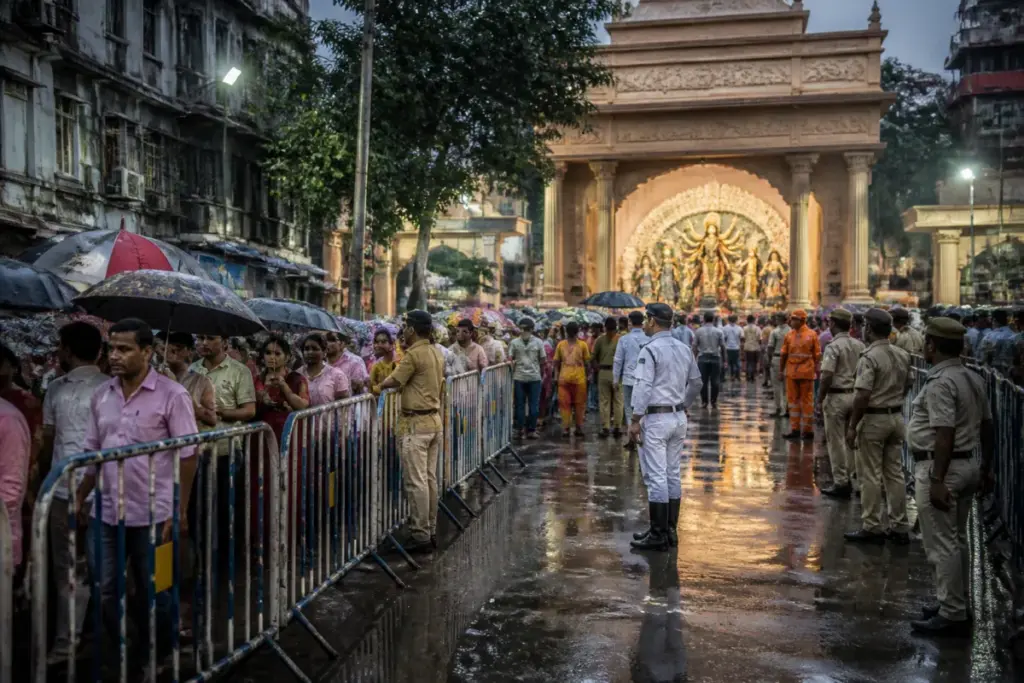
The Kolkata puja stampede at the Chorbagan Durga Puja pandal was not only a night of public celebration that turned fatal; it was also a concentrated demonstration of what happens when large crowds, confined movement routes, rain and an overwhelmed exit interact. Preliminary postmortem reports cited by the Times of India indicate that 19 people died, while 25 others were injured, revealing the physical force of the crush and the high stakes of managing temporary public spaces.
The deaths included 13 women and six minors. The youngest victim was seven-year-old Aayansh Srivastava, who had travelled from Bihar with his family. The victims came from Kolkata, neighbouring districts and other parts of West Bengal. Their identities and ages show that the incident affected a mixed public gathering rather than a narrowly defined group of visitors. Families, teenagers, children and adults were moving through the same festive environment when the crowd surged at the pandal’s exit during evening rain.
That detail is central to understanding the tragedy. A crowd crush is not simply a matter of people being present in large numbers. It is a failure of movement, space and control at a particular point. In this case, the preliminary findings describe injuries consistent with intense compression and falls: crushed chests, multiple fractures, broken ribs that pierced lungs, head injuries, intracranial haemorrhage and cardiac arrest. At least seven victims reportedly died from asphyxiation, while at least six suffered rib fractures severe enough for broken bone fragments to pierce their lungs.
These findings make the exit the critical urban space in the incident. The supplied report does not establish the precise width, layout or capacity of the route, nor does it identify the official crowd-management plan. It does, however, locate the fatal surge at the pandal’s exit and records that it occurred while rain was falling. That combination matters because an exit is both a destination and a pressure point: people leaving, people waiting and people responding to changing weather conditions can converge in the same limited area.
The postmortem evidence also shows why casualty figures alone do not describe the scale of a crowd disaster. Nineteen people died, but the injuries reveal how quickly the physical environment can turn dangerous. Broken ribs, crushed chests and lung injuries indicate that victims were subjected to forces far beyond an ordinary fall or isolated collision. Fractured hands and legs, head injuries and brain bleeding suggest that the crush produced multiple modes of harm at the same time.
The distinction between trauma and asphyxiation is especially important. At least seven victims reportedly died because they could not breathe, while others suffered injuries to the chest, lungs, head and limbs. This indicates that the danger was not limited to the moment when people fell. Compression itself could become fatal, and individuals who remained conscious or were still standing may also have been unable to escape the pressure around them.
The incident therefore raises a broader question about how cities regulate temporary public spaces. Durga Puja pandals are seasonal structures, but their urban function is immediate and substantial: they attract visitors, concentrate movement and create temporary destinations within neighbourhoods. The report does not provide details of the approval process, the planned visitor capacity, the number of entry and exit points, the deployment of personnel or the emergency response chain. Those omissions are not evidence of a specific administrative failure, but they identify the information needed to understand how the event was prepared and managed.
The available account also does not establish whether the crowd size exceeded an approved limit or whether any safety protocol was breached. It says that the crowd surged at the exit during the evening rain, but it does not explain what triggered the surge. That distinction matters. A responsible analysis must separate what the preliminary medical findings demonstrate from the operational questions that remain unanswered. The medical evidence establishes the severity and nature of the injuries; it does not, by itself, establish who was responsible or which specific control failed.
What is clear is that public safety in temporary venues depends on more than the structure that visitors come to see. It depends on the entire route through which people arrive, circulate and leave. A visually prominent pandal may draw attention to design and celebration, while the less visible elements—exit capacity, crowd distribution, barriers, lighting, rain response and access for emergency personnel—determine whether movement remains orderly when conditions change.
The Kolkata case also demonstrates why the discharge and continuing treatment of survivors are part of the urban response, not an administrative footnote. Twenty-five people were injured, with one reported to be in critical condition. Fourteen injured people were moved to a private hospital off EM Bypass after initial treatment at Medical College and Hospital and RG Kar Medical College and Hospital. Nine patients were scheduled to be discharged late on Monday, while two more were expected to leave on Tuesday. Three patients in ITU, ICU and SICU units were expected to remain under observation, with discharge likely on Wednesday or Thursday, according to hospital sources cited in the report.
This sequence shows the pressure placed on the city’s emergency and hospital systems after a mass-casualty event. Patients were initially treated in government hospitals before some were shifted to a private facility. The report does not provide the total number of ambulances, the time taken to reach hospitals, or details of triage and coordination. It does show that the response continued well after the crowd dispersed, with survivors requiring different levels of care and hospitals managing phased discharges.
For urban governance, that creates two linked responsibilities. The first is prevention: identifying how people will move through a temporary venue under normal and adverse conditions. The second is response: ensuring that emergency access, triage, hospital coordination and family communication can function when many people are injured at once. The supplied report offers evidence about the second stage through the movement of patients between hospitals, but it does not establish how the preventive arrangements were designed or reviewed.
The victims’ profiles add another layer to the public-space question. The deceased included children aged seven, 13 and 14, as well as teenagers and adults. This means that crowd-safety arrangements must account for people with different heights, physical strength and ability to respond to pressure. Children and families may be less able to move quickly through a dense crowd, while rain can reduce visibility and change how people use an exit. These are physical and operational considerations, not merely questions of individual behaviour.
The preliminary nature of the postmortem reports is significant. The findings provide an early account of the injuries, but the report does not say that a final medical or administrative inquiry has been completed. Nor does it report an official determination of the cause of the surge, the venue’s capacity or the adequacy of its crowd-management arrangements. Those facts remain necessary before responsibility can be assigned.
The evidence nevertheless establishes the scale of the public-safety failure in human terms. Nineteen people died, seven reportedly from asphyxiation and others from severe traumatic injuries. Twenty-five were injured, and at least one remained in critical condition when the report was published. The concentration of deaths at a festive venue, involving residents and visitors from several parts of the region, shows how a temporary gathering can become a citywide emergency within minutes.
The larger urban question is whether event safety is being treated as a design requirement from the beginning or as a response after something goes wrong. The supplied material cannot answer that question for Chorbagan. It does show why the answer matters. A crowd’s safety is shaped by the relationship between the venue, the exit, the weather, the surrounding street network, personnel and the medical system waiting beyond the site.
The Kolkata puja stampede therefore demands attention beyond the immediate postmortem findings. The medical evidence confirms that the crowd was subjected to fatal compression and severe trauma. The hospital updates show the continuing burden on emergency care. What remains to be established is how the crowd was managed, what caused the surge, whether the venue’s arrangements matched the number of visitors and which official next steps will follow. Those findings will determine whether the incident is recorded only as a tragedy or examined as a preventable failure in the management of urban public space.


