

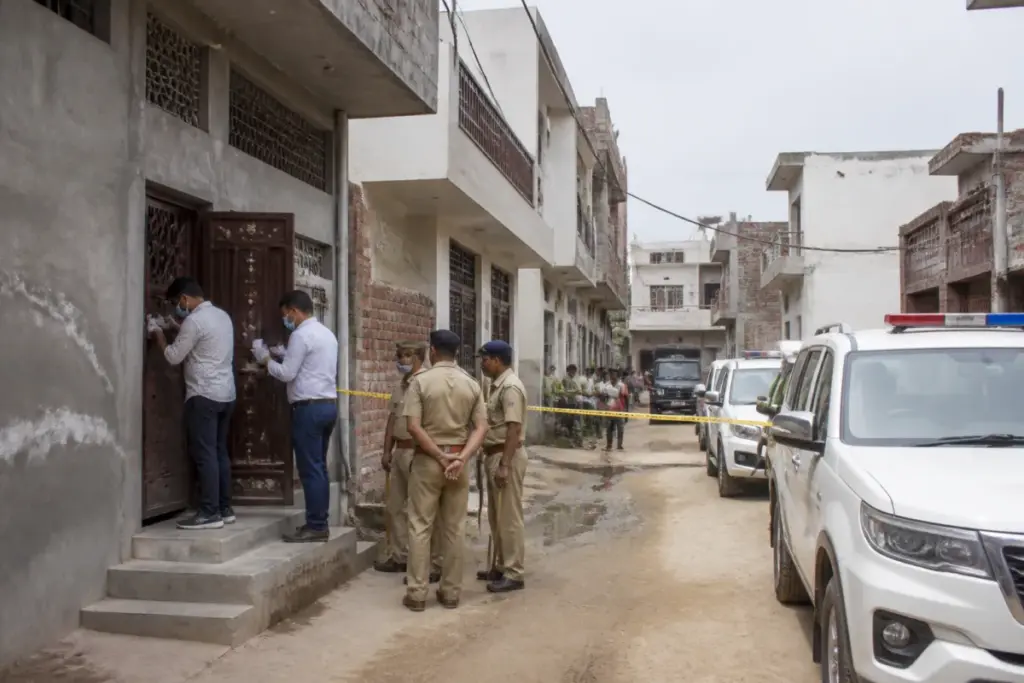
The reported discovery of an illegal synthetic-drug laboratory in Greater Noida’s Rabupura area has raised questions about how rented homes in expanding urban fringes are being used and monitored. Navbharat Times – Noida reported that the Narcotics Control Bureau (NCB) found possible links to Mexico’s Cartel de Jalisco Nueva Generación, but the central cartel connection has not been independently established in the supplied material.
The NCB action took place near Kadhalpur village in Rabupura under what the report described as Operation Crystal Hunt. Two people were arrested: foreign national Destiny Abraham Dambiri and Mizoram resident Lallawmajuali, also known as Olivia Lalchawimawi. According to the report, Dambiri identified himself as a Nigerian citizen, while immigration records reportedly showed that he entered India in January 2020 under the name Francis Kalokoh as a citizen of Sierra Leone.
The report also said that Olivia had been arrested in March 2026 at Goa’s Dabolim airport in a heroin-related case. The supplied account does not provide the sections of law invoked in the Rabupura case, the quantity or chemical composition of substances seized there, or the current status of the arrests before a court. Those details are important for establishing the scale and legal position of the case.
The most significant claim in the report is that questioning after the arrests revealed a possible connection between the facility and the Mexican cartel known as Cartel de Jalisco Nueva Generación, or CJNG. The report attributes this information to sources and says investigators believe foreign criminal groups may be setting up production facilities in India to reduce the risk of large consignments being intercepted during trafficking.
That claim requires careful distinction from the confirmed event described in the report: an NCB operation and arrests linked to an alleged synthetic-drug manufacturing facility. The supplied material does not include an NCB statement explicitly confirming a CJNG connection, nor does it provide a court document, charge sheet or official investigation note identifying the cartel as an established participant.
The report places the alleged activity within a wider geography covering Delhi, Noida, Greater Noida, Faridabad, Ghaziabad and nearby areas. It says investigators suspect that residential properties are being rented in densely populated locations or areas slightly away from city centres so that suspected laboratory activity is less likely to attract attention. The account further says that people may present themselves as students while renting homes through foreign nationals or people from the Northeast.
These allegations point to a practical enforcement problem in rapidly urbanising districts. Greater Noida combines planned sectors, industrial areas, villages, new housing developments and transport links to Delhi and other parts of the National Capital Region. Such mixed urban edges can make it difficult for authorities, landlords and property intermediaries to distinguish ordinary short-term rental activity from unlawful use of residential premises. The report, however, does not establish how many properties were involved or whether a coordinated rental network has been formally identified.
The NCB has appealed to landlords and property dealers to report suspicious activity through the national narcotics helpline, 1933. The appeal places property owners and intermediaries within the preventive framework used against illicit drug production. It also indicates that investigators are seeking information from people who may observe unusual activity at rented premises before a case reaches the stage of a raid.
The report refers to a previous NCB action in October 2024 at an illegal synthetic-drug laboratory in Greater Noida’s Kasna Industrial Area. It says 95.5 kilograms of synthetic drugs were seized in that operation. This earlier case provides a documented point of comparison within the supplied report, but it does not by itself prove that the Rabupura facility was part of the same network or that drug laboratories are expanding across the region.
The financing allegations also remain unverified in the supplied material. According to sources cited by Navbharat Times – Noida, money for the alleged activity was sent from Dubai through cryptocurrency and hawala channels. No transaction record, agency statement or other documentary evidence is provided in the report. These claims therefore need confirmation from the NCB, financial-intelligence authorities or court filings before they can be treated as established facts.
The Rabupura case raises questions about coordination between narcotics enforcement, immigration authorities, local police, municipal administration and the rental-property market. Establishing the identity of tenants, verifying documents, maintaining accurate rental records and responding to complaints can involve several institutions. The supplied report does not state which local authority was responsible for property verification in the case or whether any landlord or property dealer has been questioned.
It also highlights the limits of treating drug enforcement only as a border-control issue. If illegal production is taking place inside rented residential or semi-urban premises, enforcement depends on local intelligence, chemical evidence, tenancy information and financial investigation. However, the available report does not provide enough evidence to determine whether the Rabupura facility was an isolated operation, part of a broader regional pattern or connected to an international cartel.
For residents, the immediate concern is the potential presence of hazardous chemical activity in ordinary neighbourhoods. Synthetic-drug production can involve substances and processes that may create risks beyond narcotics trafficking, including fire, contamination and exposure. The supplied report does not state whether any such hazard was found at the Rabupura property, whether nearby residents were evacuated or whether environmental testing was conducted.
The case therefore has two separate dimensions. The first is the reported NCB action, the arrests and the alleged discovery of an illegal manufacturing facility. The second is the broader network theory involving CJNG, rental homes, international identities and Dubai-linked finance. The first dimension is the basis of the reported enforcement operation; the second remains a claim requiring documentary and official verification.
The next significant developments will be the NCB’s formal account of the seizure, the charges filed against the arrested individuals, any court proceedings and evidence regarding the alleged international links. Confirmation of the cartel connection, the financing route and the number of properties involved would determine whether the case represents an isolated laboratory or a wider urban enforcement challenge.


