

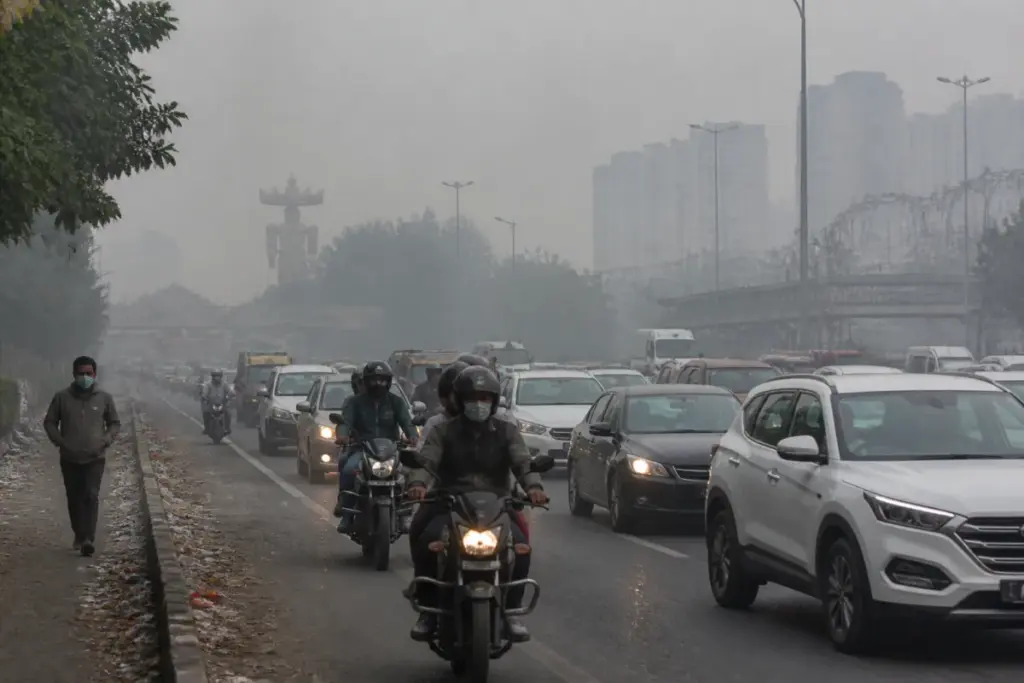
Delhi-NCR’s air quality deteriorated after Dussehra celebrations, with Delhi’s Air Quality Index (AQI) reported at 284 on Wednesday morning and several surrounding cities recording higher readings. The deterioration followed Ravan-burning events, fireworks, heavy traffic and large public gatherings across the region.
According to Jagran, Delhi’s AQI stood at 284 on Wednesday morning, raising concern about worsening pollution in the days ahead. The report said Dussehra celebrations across Delhi-NCR included Ravan burning and extensive fireworks, while traffic congestion kept vehicles moving slowly at several junctions late into the night.
The report also recorded significant variation across the region. In Noida, the AQI was reported at 315 after celebrations, while Ghaziabad’s reading reached 388, according to data displayed by the AQI.in website. The figures indicate that pollution levels were not uniform across the National Capital Region, with some urban areas recording substantially higher readings than Delhi.
Gurugram and Manesar also saw a rise in pollution. At 7.05 am on Wednesday, Gurugram’s AQI was reported at 205 and Manesar’s at 235. Jagran said Gurugram’s reading had been 132 two days earlier, representing a 73-point increase over that period. The report described the Gurugram and Manesar readings as being in the ‘poor’ category.
The deterioration came after a night of large-scale celebrations. In Gautam Buddh Nagar, police arrangements covered Ravan-burning events at 35 locations and immersion-related activity at 200 locations. The district had deployed 250 fire personnel and 26 fire tenders for fire-safety duties. The report said roads remained active until late at night as residents attended celebrations and travelled across the city.
Jagran attributed the worsening conditions to a combination of fireworks, smoke from celebration-related fires and emissions from traffic congestion. The report also noted that October rainfall had kept the AQI somewhat better than the previous year before the latest deterioration. However, it did not provide a detailed official assessment separating the contribution of fireworks, local emissions, weather conditions or regional pollution transport.
The post-Dussehra readings arrive ahead of Diwali, when pollution levels in Delhi-NCR traditionally become a major public concern. The latest figures show how quickly air-quality conditions can change across the region after a single night of concentrated outdoor activity. The immediate next step will be continued monitoring of AQI readings across Delhi and the neighbouring urban centres as authorities assess whether pollution levels rise further.


