

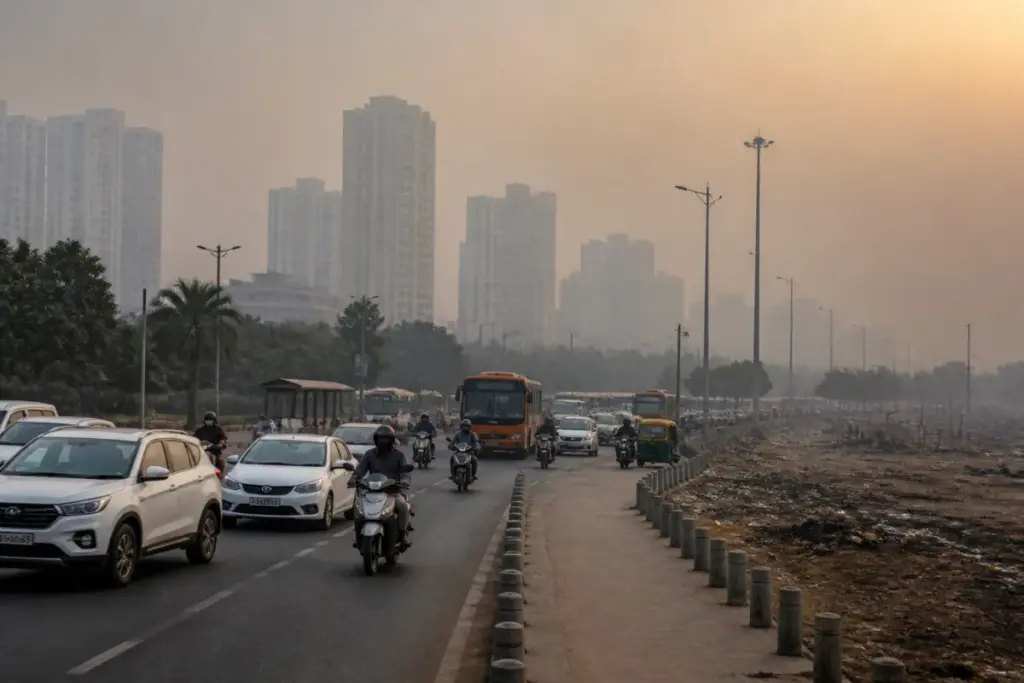
Delhi-NCR’s air quality is expected to deteriorate after Dussehra, with the Air Quality Early Warning System forecasting that Delhi’s Air Quality Index could enter the ‘poor’ category from Wednesday. The worsening conditions come as the capital prepares to implement its winter action plan from 1 November.
Delhi recorded air quality in the ‘moderate’ category on the day of the Dussehra celebrations, according to the report. The forecast indicates that the city’s AQI may rise to between 201 and 300, the range classified as ‘poor’ by the Central Pollution Control Board.
Under the CPCB’s classification, an AQI from zero to 50 is considered ‘good’, 51 to 100 ‘satisfactory’, 101 to 200 ‘moderate’, 201 to 300 ‘poor’, 301 to 400 ‘very poor’ and 401 to 500 ‘severe’. The categories are used to communicate the severity of pollution and its potential effect on public health.
The deterioration follows Dussehra celebrations across Delhi-NCR, including the burning of effigies at multiple locations. The report attributes an immediate impact on air quality to the celebrations, while the early warning system’s forecast points to a further decline from Wednesday.
The winter action plan announced for Delhi is scheduled to come into effect from 1 November. Its measures include the ‘no PUC, no fuel’ rule, under which vehicles without valid pollution-under-control certificates are not expected to receive fuel. Restrictions on construction work are also part of the measures outlined for the winter pollution period.
The plan additionally provides for restrictions on vehicles below the BS-VI emission standard entering Delhi from other states. These measures are intended to address pollution sources linked to vehicles, construction activity and emissions entering the capital from outside its administrative boundaries.
Delhi’s air quality generally worsens during the colder months. The report also identifies stubble burning in Punjab and Haryana as a factor that can contribute to severe pollution episodes in the capital, although the intensity of its effect can vary. This year, October air quality was described as somewhat better than last year’s, with rainfall cited as one reason.
The Delhi government is also working with the Indian Institute of Technology on measures to control pollution, according to the report. The next immediate milestones are the expected shift in Delhi’s AQI from Wednesday and the scheduled implementation of the winter action plan on 1 November.


