

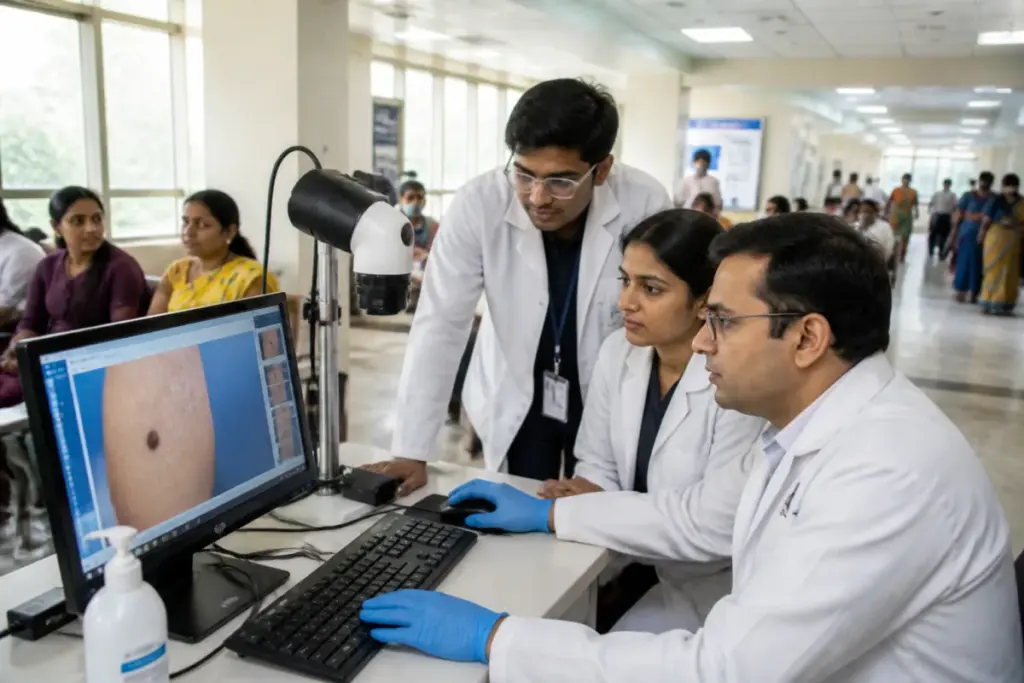
AIIMS and Google have developed two artificial intelligence tools, IndusDerma and Aarogyam, to support skin-disease identification and prioritise patients in outpatient departments, with pilot projects currently underway at AIIMS in New Delhi.
IndusDerma is designed to help doctors assess possible skin conditions using photographs of a patient’s skin along with information such as age, symptoms and the duration of the illness. The tool has been developed with Indian skin tones and diseases found in India in mind, according to a report by Jagran citing information from AIIMS.
The system is intended to assist doctors in understanding the likely condition, deciding whether further testing may be required and determining whether a patient should be referred to a specialist. It could also support healthcare workers in locations where access to dermatologists is limited. The tool is not intended to replace clinical examination or treatment decisions, which will remain with doctors.
The second tool, Aarogyam, is designed for use in outpatient departments. It will use patients’ initial medical information and test results to help doctors assess which cases require earlier attention. The stated objective is to help prioritise patients with serious conditions and reduce the time they spend waiting for care.
According to information attributed to AIIMS in the report, the Google initiative aims to reduce the waiting time before a patient sees a specialist by up to 40 per cent. The two tools are also being developed with a capacity to assess the status of up to 15,000 outpatients each day. The report does not provide a separate implementation schedule or details of the hospitals where the tools may be deployed beyond the ongoing AIIMS pilot.
The project places artificial intelligence within a practical public-health setting: the first point of contact between large numbers of patients and an overstretched outpatient system. In this arrangement, the technology is being positioned as a decision-support layer that can help organise clinical information and referrals before a specialist consultation, rather than as an autonomous diagnostic system.
For patients, the immediate significance will depend on how the pilot performs in routine clinical conditions and how doctors use its recommendations. The supplied report does not provide accuracy figures, details of the number of patients enrolled in the pilot, or information on how the tools will handle cases where image quality or symptoms are unclear.
The IndusDerma and Aarogyam pilots are continuing at AIIMS. Further details on their clinical performance, deployment plans and the timeline for wider use were not specified in the report.


