

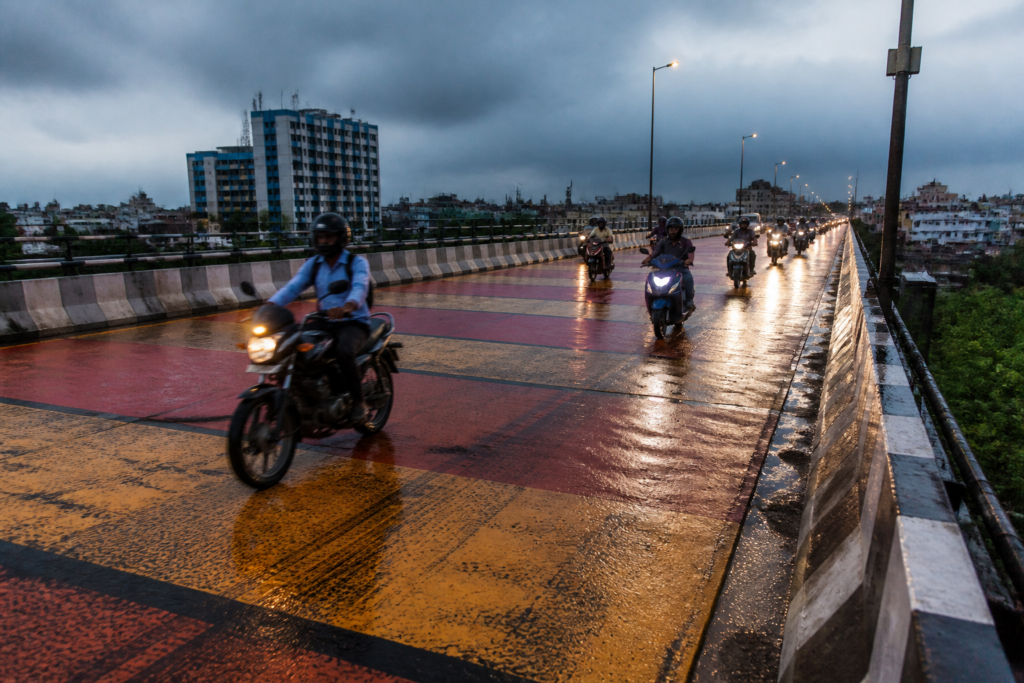
A viral video allegedly showing several motorcycles skidding on the rain-wet Chingrighata flyover in Kolkata has triggered questions about road safety and the use of coloured road treatments, although the footage and the precise circumstances of the reported incident have not been independently verified.
The video was posted on Facebook on Wednesday by Sayandeep Lahiri and appeared to show three motorcyclists falling in succession in front of a vehicle fitted with a dashboard camera. Its caption questioned why riders had lost control on what was described as a well-finished road. Anandabazar reported that it had not independently verified the authenticity of the video or confirmed that the footage was recorded at Chingrighata.
The incident has become part of a wider debate over roads and flyovers in Kolkata that have been painted as part of pre-Durga Puja beautification work. Some motorcyclists have alleged that the painted surfaces become slippery when wet, while others have complained that bright colours create glare in sunlight. The supplied report does not establish whether the road treatment caused the falls shown in the video.
Urban Development and Municipal Affairs Minister Agnimitra Paul said the matter had been referred to the police and administration for examination. According to the report, Paul said one motorcycle had fallen and then collided with another, but that the reason for the first fall was not known. She said the paints used on the roads were anti-skid and that, in principle, they should not create a risk of vehicles slipping.
Paul also acknowledged that she had heard complaints about glare from the coloured surfaces. She said the government would examine the issue and consider an alternative arrangement if the road treatment was causing inconvenience to residents. Her comments indicate that the review is expected to cover not only skid resistance but also the visibility and visual performance of the treatment under bright conditions.
Chief Minister Suvendu Adhikari, responding to questions about the reported incident, said he had no information showing that accidents were occurring because of road painting. He questioned whether similar accidents had been reported across the several flyovers that had been painted. He also said he would not comment further without complete information about the incident.
The competing positions underline the need for an evidence-based road-safety assessment rather than a conclusion drawn from a single social-media video. Such an assessment would need to establish the video’s location and date, inspect the surface condition, identify the product used, examine application and curing conditions, and determine whether rain, speed, braking, vehicle condition or another factor contributed to the falls. None of those findings is included in the supplied report.
The case also raises an administrative question about how urban beautification works are assessed before being applied to carriageways used by two-wheelers. A treatment that is visually effective in dry weather may require separate scrutiny for wet-weather traction, glare and night-time visibility. The minister’s statement indicates that police and administrative officials are examining the matter, but no inspection report, engineering assessment or corrective timetable had been reported at the time of publication.
Until those checks are completed, the video can support a public-safety query but cannot by itself establish that the coloured road surface caused the accidents. The next confirmed development is expected to come from the police-administration inquiry and any decision on whether the painted surfaces require modification or replacement.


