

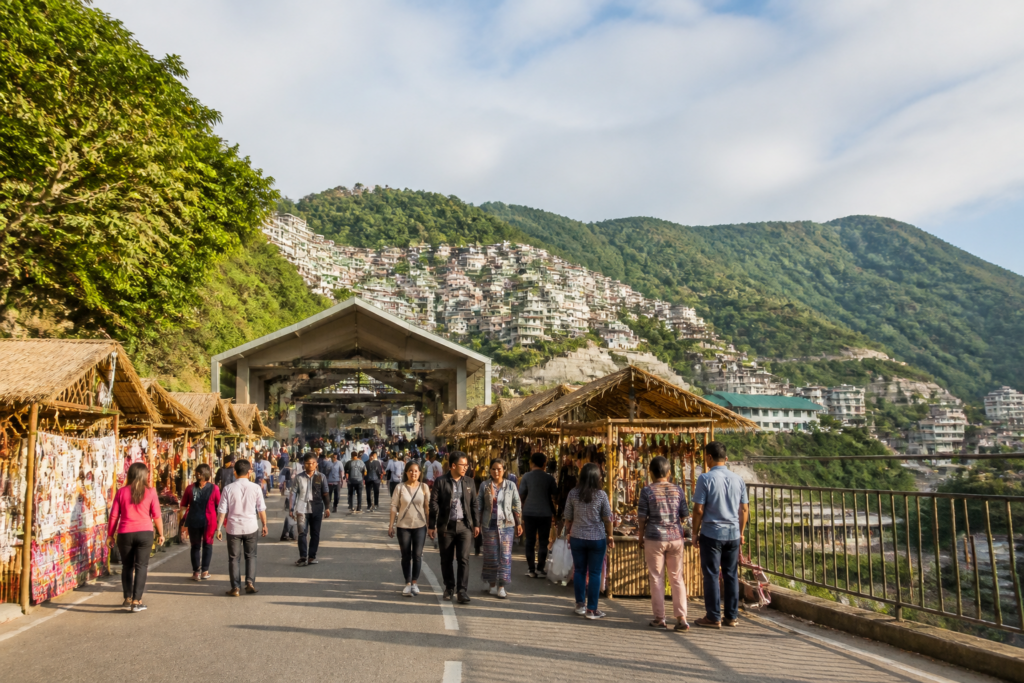
Mizoram’s effort to build year-round tourism is moving beyond festival promotion and into a broader test of how a remote, ecologically sensitive state can connect new visitors with local livelihoods. A three-day travel festival that opened in Aizawl on Tuesday has brought government agencies, tour operators, homestay associations, culinary professionals and other tourism stakeholders together to develop partnerships and position the state as a destination beyond its traditional seasonal peaks.
The immediate numbers explain the urgency behind the initiative. Mizoram recorded more than 6.7 lakh visitors between January and August 2026, according to the report, representing a 51% increase over the corresponding period in 2025. Tourist arrivals had also risen by around 97% between 2024 and 2025. These figures indicate a rapid expansion in demand, but they do not by themselves establish whether the state’s accommodation, transport, waste, water and public-space systems are growing at the same pace.
That gap between visitor growth and urban capacity is central to the significance of the festival. Tourism does not operate only at attractions. It depends on the reliability of roads and railways, the availability of rooms and homestays, food and sanitation services, digital and physical connectivity, public safety, and the ability of towns to manage pressure during festivals and other high-demand periods. In Mizoram, the tourism strategy is therefore also an infrastructure and local-governance question.
The travel festival has been organised jointly by the Mizoram tourism department and the Union tourism ministry. Its opening-day discussions covered eco-tourism, community-based tourism, homestays, adventure activities, connectivity and destination promotion. The participating organisations include the Association of Tour Operators in Mizoram, the Indian Association of Tour Operators, Homestays of India and the Mizoram Culinary Association.
Tourism minister Lalnghinglova Hmar framed the policy objective in explicitly distributive terms. “Tourism is not simply about bringing visitors into Mizoram. It is also about ensuring that the benefits reach the people who make Mizoram special,” he said. The minister also said tourism should generate employment and income for local communities while protecting Mizoram’s culture and natural environment.
Those statements establish the intended direction, but the supplied report does not specify how benefits will be measured or distributed. It does not identify targets for local employment, the share of tourism spending expected to remain within communities, or the standards that will govern homestays, construction and environmental management. The policy ambition is clear; the operational framework remains less visible in the reported material.
Connectivity is one of the main reasons the tourism outlook has changed. The report links improved access to the opening of the Bairabi-Sairang railway line in September 2025. The railway connection has strengthened the state’s tourism prospects by improving its relationship with wider travel markets. This is important because visitor growth depends not only on what a destination offers, but also on the time, cost and reliability involved in reaching it.
Rail connectivity can also alter the geography of tourism. A destination that was previously dependent on more limited access may receive a wider range of visitors, while towns along travel routes can gain new demand for accommodation, food, transport and retail services. However, the report does not provide passenger numbers, journey-time comparisons, station-area development plans or evidence showing how the railway has changed the distribution of visitors within Mizoram. Those are important indicators for assessing whether connectivity is producing broad-based economic activity or concentrating it in a few established locations.
The state has mobilised nearly Rs 680 crore in tourism investment since 2023, the report said. This includes 11 major projects sanctioned at a total cost of Rs 608.38 crore. The listed projects include tourist facilities and attractions worth Rs 250 crore, a Rs 127-crore PM Ekta Mall, a Rs 99.71-crore conference centre at Thingsulthliah and a Rs 34.50-crore ropeway project at Thenzawl-Buangpui.
These investments show that Mizoram’s tourism policy is being expressed through physical projects as well as marketing and events. Tourist facilities, a mall, a conference centre and a ropeway each create different demands on land, transport, utilities and maintenance. They can also influence where visitor activity is concentrated and what kinds of enterprises are able to participate in the tourism economy.
At the same time, the reported investment figures need to be read carefully. The nearly Rs 680 crore refers to investment mobilised since 2023, while the 11 major projects have a stated sanctioned cost of Rs 608.38 crore. The supplied material does not clarify the amount already spent, the implementation status of each project, the funding shares of the state and Union governments, or the expected completion dates. Without those details, the figures describe the scale of the pipeline rather than its completed impact on visitors or communities.
The project mix also raises a planning question about how tourism infrastructure is defined. A ropeway may improve access to an attraction and become an experience in itself. A conference centre can support business and institutional travel beyond peak holiday periods. A mall may provide a formal commercial setting for local products and services. But each facility will depend on supporting systems such as roads, parking, water supply, waste management, electricity and public transport. The report does not establish whether these linked requirements have been assessed as part of the projects.
Mizoram’s stated visitor targets are ambitious. The state aims to attract 12 lakh tourists annually by 2030 and 20 lakh by 2047. It also plans to develop 10 Culture, Adventure and Nature tourism circuits connecting 40 destinations by 2047. These targets indicate an attempt to move from isolated attractions towards a networked destination model, in which visitors travel across multiple places and spend more time within the state.
The numbers also illustrate the scale of the proposed expansion. The 2030 target of 12 lakh annual visitors is higher than the 6.7 lakh recorded in the first eight months of 2026, although the two figures are not directly comparable because one is a partial-year count and the other is an annual target. The 2047 target of 20 lakh would represent a still larger visitor economy. The supplied report does not provide a baseline annual figure for 2025 or a monthly breakdown for 2026, so it is not possible to determine from the available evidence whether the state is on a steady trajectory towards these targets or whether recent growth reflects a short-term surge.
The proposed 10-circuit model could help spread tourism beyond Aizawl, but the report does not identify the 40 destinations or explain how they will be connected. Destination networks require more than branding. They require consistent visitor information, safe and dependable access, accommodation capacity, emergency services, local guides, waste systems and institutions capable of coordinating across districts. The festival’s focus on connectivity and destination promotion recognises part of this requirement, while the implementation details remain to be established.
The community dimension is particularly important in a state where tourism is being linked to homestays, local food and cultural festivals. The participation of homestay and culinary associations suggests that the government and industry are seeking to include smaller enterprises rather than relying only on large formal facilities. This can create a wider base of beneficiaries, but the report does not state how many homestays are operating, where they are located, what standards apply to them or how revenues are currently distributed.
The environmental question is equally central. The minister’s reference to protecting culture and the natural environment places a condition on the growth strategy: more visitors should not be treated as the only measure of success. Eco-tourism and community-based tourism were among the festival’s discussion themes, but the supplied material does not provide carrying-capacity assessments, ecological safeguards, waste data or monitoring arrangements. It therefore confirms the policy intent without establishing how environmental performance will be evaluated.
The festival’s calendar illustrates the attempt to extend demand across the year. The Leitlangpui music festival is scheduled in Lunglei from November 11 to 13, Aizawl’s Winter Festival from December 15 to 23, and the Hnahsin Kut, or Cosmos Festival, in Champhai continues until October 16. These events are being positioned alongside natural attractions and local enterprises to support winter and off-peak travel.
This approach could make tourism activity less dependent on a single season, but the available evidence does not show whether the events have the accommodation, transport and public-service capacity required to support larger visitor volumes. Nor does it establish whether local communities are involved in event planning, whether temporary infrastructure is provided, or how crowd, traffic and waste pressures are managed. Those questions will become more important if festivals are used as anchors for a year-round tourism market.
The second day of the Aizawl festival will focus on investment opportunities and sustainable tourism development, with business-to-business meetings planned among tour operators, accommodation providers, restaurants and other tourism service providers. This indicates that the event is intended to produce commercial partnerships rather than function only as a cultural showcase. The outcome, however, will depend on whether these meetings lead to projects and services that are geographically distributed, locally owned or locally linked.
Mizoram’s tourism push therefore sits at the intersection of access, investment and governance. The state has reported strong visitor growth, new rail connectivity, a substantial project pipeline and long-term destination targets. It is also presenting tourism as a route to employment and income while acknowledging the need to protect culture and the environment. What remains unclear is how the authorities will translate these principles into measurable local benefits and infrastructure standards.
The developments to monitor are the implementation of the 11 sanctioned projects, the performance of the Bairabi-Sairang railway connection, the identification and servicing of the proposed 40 destinations, and the mechanisms used to assess community participation and environmental protection. Mizoram’s central challenge is no longer only attracting visitors. It is building a tourism system in which higher numbers can be absorbed by towns and destinations without weakening the local assets on which that growth depends.


