

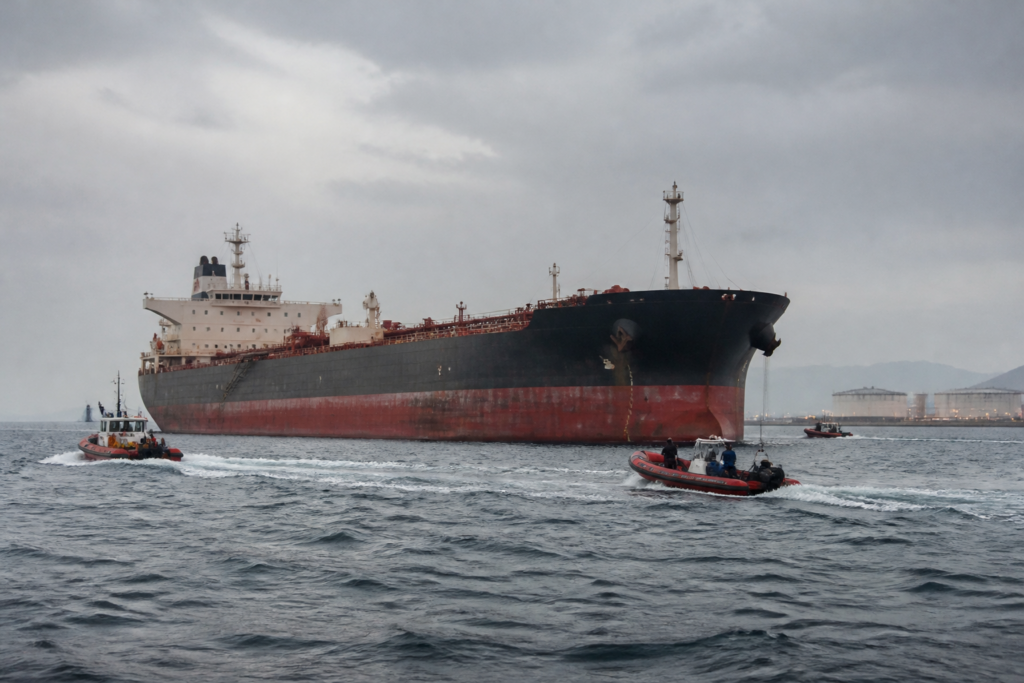
The disappearance of two Uttar Pradesh seafarers after a drone attack on the Nicaragua-flagged tanker MT Petro Dolphin near Oman’s Sohar port has developed into a wider test of maritime emergency response. Families allege that the vessel was evacuated without a sufficient search for the missing crew members, while an Indian embassy communication conveyed the captain’s account that rescued fishermen circled the vessel twice before returning to shore because of the risk of an explosion.
The competing accounts do not establish what happened to Bir Bahadur Yadav, 26, of Deoria, and Amit Singh, 20, of Kushinagar. They do, however, identify the operational questions that arise when a commercial ship is attacked: whether the crew was properly accounted for, whether emergency systems remained usable, who controlled the search after evacuation, and how quickly authorities could coordinate a response across national and institutional boundaries.
According to the report, the attack took place on October 11. Yadav was serving as a trainee engine rating and Singh as an ordinary seaman. Their families said both men were working near the same section of the vessel when the attack occurred. More than 70 hours had passed when the Forward Seamen’s Union of India called for stronger search-and-rescue action, making the case an urgent humanitarian issue as well as a question of maritime safety governance.
The families’ allegations focus on the period immediately after the attack. Ravindra Singh, Amit’s uncle and a second officer in the merchant navy with 20 years of experience, alleged that the captain did not conduct a proper headcount or search for sailors who could have been injured or unconscious on board. He also alleged that the vessel’s two main generators and emergency generator were non-functional. According to his account, the only operational generator shut down after the drone strike, leaving the ship in blackout conditions.
These claims remain allegations, but they point to the importance of redundancy in shipboard emergency systems. A commercial tanker operating in a high-risk area depends on power for firefighting equipment, communications, navigation and the search for crew members. If the generators were unavailable as alleged, the incident would raise questions about maintenance, inspection and the readiness of systems intended for use during precisely such emergencies. The supplied report does not include an independent technical assessment of the generators or the vessel’s emergency arrangements.
The account conveyed through the Indian embassy in Oman presents a different sequence. It said that after the attack, the crew called for assistance and nearby fishing boats arrived. Ten crew members, including one Bangladeshi national, were evacuated. According to the captain’s statement cited in the communication, the rescued crew asked the fishermen to return to the vessel because the two missing seafarers might still be nearby. The fishing boat reportedly circled the tanker twice and called out, but received no response. The fishermen then returned towards shore because they feared a possible explosion.
The same communication said that arrangements were being made to send a team aboard the vessel to search for traces of the missing sailors. It also said the shipping management was arranging payment of outstanding salaries and facilitating the early repatriation of nine crew members to India and one to Bangladesh. That account indicates that a search was contemplated after the evacuation, but the report does not establish when the team boarded the tanker, what it found or whether a coordinated search of the surrounding waters was conducted.
This uncertainty is central to the families’ demand for accountability. In a maritime emergency, responsibility does not end with getting some crew members off a damaged vessel. The first operational task is to establish who is present, who is missing and where the missing people were last seen. The next steps depend on the vessel’s condition, the threat of fire or explosion, weather and sea conditions, the availability of rescue craft and the authority responsible for coordinating the search. The report records conflicting descriptions of the evacuation but does not provide the ship’s muster records, emergency log, crew list, voyage data or an official investigation report.
The case also exposes the layered nature of responsibility in commercial shipping. The vessel is registered in Nicaragua, the incident occurred near Oman, the captain is Indian, the missing sailors are Indian, and the crew included a Bangladeshi national. The shipping company, the flag state, coastal authorities, the Directorate General of Shipping, the Indian embassy and international maritime institutions may each have different roles. For families, however, these distinctions can become an obstacle when information is dispersed across agencies and no single institution provides a complete account.
That is why the Forward Seamen’s Union of India urged the International Maritime Organization to coordinate with Gulf countries, deploy high-intensity search-and-rescue teams and create a single-window mechanism for families. The demand is significant because it shifts attention from the incident alone to the structure of crisis response. Families need timely information about the missing person’s last known location, the vessel’s condition, the search area, the agencies involved and the next operational step. Without a clear coordination channel, they may depend on recruitment agents, crew members or informal messages rather than verified updates from the authorities managing the response.
The report also links the crisis to labour protections. Amit’s uncle alleged that several months of salary had not been paid, while Amit had messaged his sister shortly before the attack to ask whether his pending salary had been credited. The embassy communication said the shipping management was arranging payment of outstanding salaries. The report does not establish the amount owed, the contractual terms or whether the alleged arrears violated applicable maritime or employment rules. It does show that financial insecurity can remain part of a seafarer’s vulnerability even during a life-threatening emergency.
Yadav’s family said he was on his first assignment after joining the vessel about five months earlier and had spoken of concerns about attacks on ships in the region. The family had understood that he was working under a nine-month contract and was planning to return home before his marriage. These details place the incident within the ordinary human geography of maritime labour: workers from smaller towns and districts join globally operating ships through recruitment channels, while their families remain far from the vessel, the coastal authorities and the institutions handling the emergency.
The immediate facts remain incomplete. Two seafarers are missing; ten crew members were evacuated; the vessel’s emergency systems and the adequacy of the search are disputed; and the Indian embassy has conveyed an account based on coordination with the shipping company. The Directorate General of Shipping has been approached for intervention, coordination with Omani authorities and a detailed account of the rescue operation. The next meaningful evidence will be an official search update, the vessel’s emergency records, an account of the technical condition of its generators and a formal finding on how the evacuation and headcount were conducted.


