

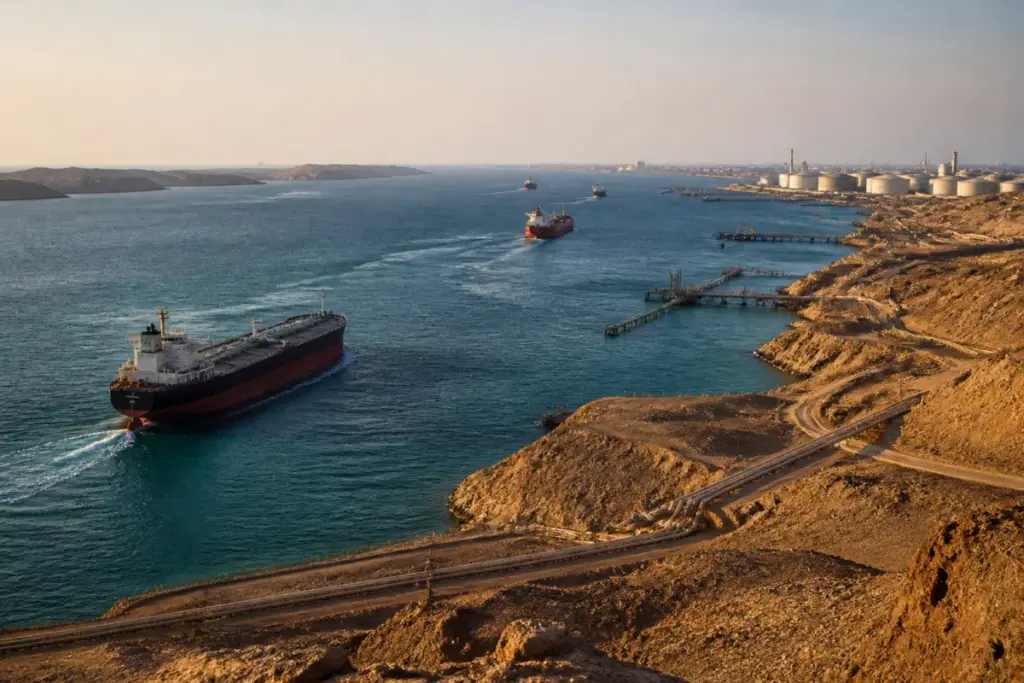
The Strait of Hormuz has long functioned as a critical link between Gulf energy producers and global markets. Now, the conflict involving Iran is prompting Gulf states to consider whether that dependence can be reduced through new pipelines, ports and logistics routes. HSBC Group CEO Georges Elhedery has said the investment response could make the waterway “redundant” within five years, turning a geopolitical vulnerability into a major infrastructure question.
Elhedery made the remarks at the HSBC Future Forum event in Dubai, where he said the Gulf region could recover from the impact of the conflict through investment in alternative logistics routes. His statement was not an announcement of a single project or a formal regional policy. It was a forecast about how governments and businesses could respond to the risks exposed by disruption around the Strait of Hormuz.
That distinction matters. The Strait is not simply a maritime passage. It is part of a wider system connecting energy production, pipelines, export terminals, ports, shipping markets and national budgets. When a narrow waterway carries a substantial share of global energy trade, any threat to its operation affects more than ships at sea. It raises questions about the location of infrastructure, the resilience of supply chains and the cost of maintaining economic activity across the Gulf.
The source report said that about a fifth of global oil and liquefied natural gas trade previously passed through the Strait of Hormuz. That figure explains why the waterway has strategic importance far beyond its physical size. It also explains why alternative infrastructure would require more than a short-term rerouting exercise. A meaningful reduction in dependence would involve connecting production areas to ports through energy pipelines and other logistics systems capable of handling large and sustained flows.
The infrastructure response described by Elhedery is therefore about creating redundancy. In network terms, redundancy means having alternative routes when a principal link is disrupted. For the Gulf, that could involve moving a greater share of energy through pipelines to ports outside the immediate dependence on the Strait. It could also require expanded port capacity and supporting logistics infrastructure, although the supplied report does not identify specific projects, locations or construction schedules.
The scale of investment already being discussed is significant. HSBC said in a report that the Middle East, North Africa and Turkey have $872 billion in individual project packages, forming part of a broader $1.4 trillion infrastructure pipeline that is planned but not yet awarded. The figures, based on data from Dubai-based construction industry market intelligence platform MEED, describe a large pool of potential projects rather than completed infrastructure.
That distinction is central to understanding the Gulf’s infrastructure moment. A project pipeline does not automatically become physical capacity. Projects must move through financing, approvals, procurement, construction and commissioning. They also need to connect with one another. A pipeline to a port has limited value if the port cannot handle the resulting volumes, while additional port capacity cannot by itself replace a maritime route unless the wider energy and logistics network is integrated.
The conflict has made this question more immediate, according to the report. Elhedery said the disruption was forcing Gulf nations to direct resources towards energy pipelines leading to ports. His argument is that such investment could allow the region to withstand the fallout from the conflict and continue growing. The statement links resilience to capital expenditure: the ability of cities, ports and national economies to function depends partly on whether infrastructure can provide alternatives when a strategic corridor becomes difficult to use.
This is also an institutional question. The proposed shift would involve multiple layers of decision-making, including national governments, energy companies, port authorities, logistics operators, lenders and international investors. No single actor can create a substitute for the Strait on its own. The economic value of an alternative route depends on coordination between energy production, transportation infrastructure and export markets.
HSBC’s role in the discussion is itself relevant. The bank is both a major financial institution and a business with a stated commitment to the Gulf Cooperation Council region. Elhedery reaffirmed that commitment during the Dubai event. His comments should therefore be read as an on-record assessment from a global bank executive with an interest in the region, not as an official declaration by Gulf governments or a confirmed timetable for replacing the Strait.
The report also cited an HSBC survey of more than 1,600 business leaders and about 820 global institutional investors. The survey found that respondents continued to view the Gulf as an attractive investment hub. That finding suggests that conflict-related risk has not eliminated investor interest in the region, at least among those surveyed. It does not establish that all planned infrastructure projects will be funded or that investor confidence will remain unchanged.
The economic outlook cited in the report is more uneven. The World Bank had forecast growth of 3.3% in 2025, followed by a contraction of 1.3% in the Middle East, North Africa and Pakistan region in 2026 because of the war. It expected a strong but uneven rebound in 2027. These figures place the infrastructure pipeline against a difficult economic backdrop: governments and companies are considering large investments while the region is also dealing with a sharp near-term contraction.
That combination creates a practical funding challenge. Infrastructure is often justified by its long-term value, but it requires capital during periods when revenues, public finances and investor risk assessments may be under pressure. The source material does not specify how the $1.4 trillion pipeline would be financed, which projects have secured funding or how the costs would be divided between public and private actors. Those unanswered questions are as important as the headline figure.
The postponement of Saudi Arabia’s flagship investment conference also illustrates the operating environment. The conference, where Elhedery was expected to be among global financiers, was postponed to 2027 after deadly strikes in Riyadh by Yemen’s Iran-backed Houthis, according to the report. The postponement does not prove that investment plans have been cancelled, but it demonstrates how security events can interrupt the forums and transactions through which major projects are promoted and financed.
For Gulf cities and ports, the potential consequences extend beyond energy security. Large infrastructure programmes can alter industrial locations, logistics corridors and the demand for supporting services. New pipelines and port connections may concentrate activity in some places while reducing the strategic importance of others. However, the supplied evidence does not identify the cities, ports or communities that would gain or lose from such changes.
The key urban question is whether resilience will be designed as a connected system or treated as a collection of individual projects. The source report points to pipelines, ports and alternative logistics routes, but it does not establish how these elements would be coordinated. The difference is significant. A resilient network requires capacity across the full chain, along with institutions capable of planning, funding and operating infrastructure over time.
The Strait of Hormuz is therefore unlikely to become “redundant” simply because alternative routes are discussed. Elhedery’s five-year timeframe remains a forecast, and no project list or implementation plan in the supplied material confirms that the proposed shift will occur at that speed. What the evidence does establish is that the conflict has exposed the cost of dependence on a single strategic waterway and is strengthening the case for infrastructure designed around multiple routes.
The developments that warrant monitoring are the conversion of the reported project pipeline into awarded contracts, the identification of specific energy corridors and ports, the financing arrangements behind them, and the response of Gulf governments and operators. Until those details emerge, the Strait of Hormuz remains central to global energy movement, while the Gulf’s search for alternatives remains a large but still partly prospective infrastructure programme.


