

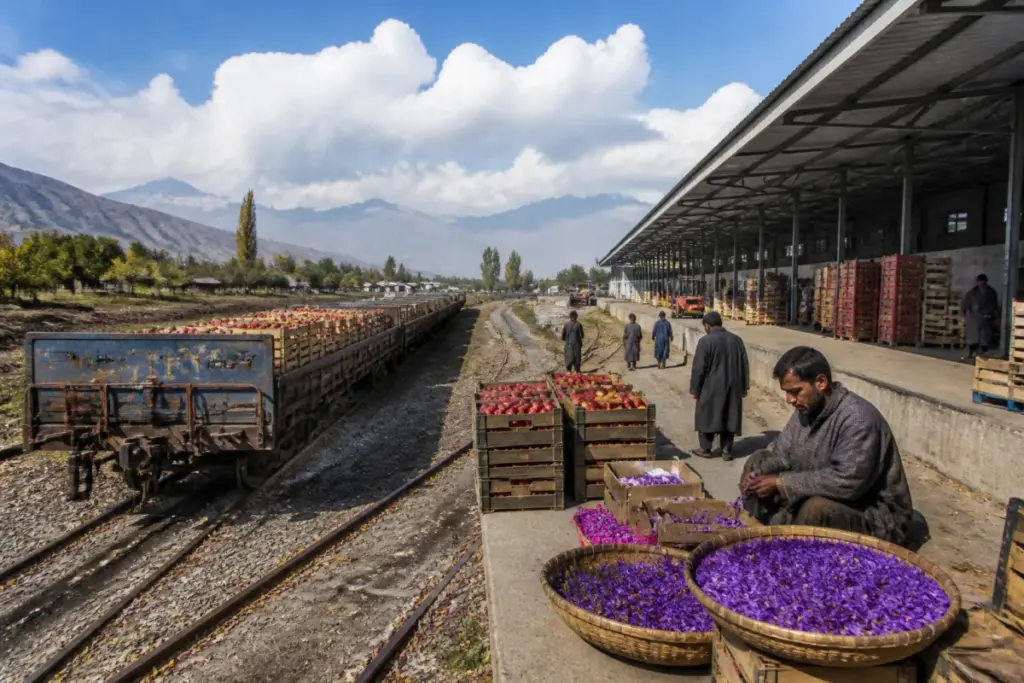
Northern Railway has invited tenders to develop warehouses near Anantnag and Pampore railway stations in Kashmir, a move intended to improve storage, strengthen rail freight and help apple growers and saffron traders reach larger markets more efficiently. The facilities will be developed and operated by private investors under the Railways’ Cargo Related Facility policy.
The proposed warehouses are expected to provide storage infrastructure close to railway stations, reducing the distance between agricultural production, storage and freight loading points. According to the report, the arrangement could lower loading and unloading costs while helping minimise post-harvest losses for local produce.
The Jammu railway division has invited private investors to participate in the development and operation of the facilities. The warehouses will be offered on a lease period of 25 years, officials said. The tendering process places the projects within the Railways’ broader effort to use station-linked cargo infrastructure to support the movement of goods.
Anantnag and Pampore are important locations for the region’s agricultural economy. Apples are a major produce category in Kashmir, while Pampore is widely associated with saffron cultivation and trade. For these commodities, storage capacity is closely linked to the ability of growers and traders to manage the period between harvest and sale.
The proposed facilities are intended to support the movement of produce to major markets by combining warehousing with access to the railway network. This could provide growers and traders with an alternative to relying entirely on road-based transport, although the report does not specify the warehouses’ planned capacity, construction timelines, investment value or the markets they will serve.
The projects also represent a shift from treating railway stations only as passenger or freight-handling points towards developing them as logistics nodes. By locating warehouses near stations, the Railways is seeking to integrate storage and transportation functions. The effectiveness of that model will depend on the completion of the tender process, the eventual operators and the facilities’ ability to handle the volume and timing of local agricultural produce.
With the proposed projects, Jammu and Kashmir will have three such warehouse facilities under the reported plan. The third is planned at Bari Brahmana, on the outskirts of Jammu city. Together, the three sites are intended to create additional storage and freight-handling capacity across the region, linking production areas in Kashmir with the Jammu logistics network.
Northern Railway’s tender invitation is the immediate next step. Further details about the selected private investors, construction schedules, warehouse capacities and operating arrangements will emerge as the tendering and implementation process moves forward.


