

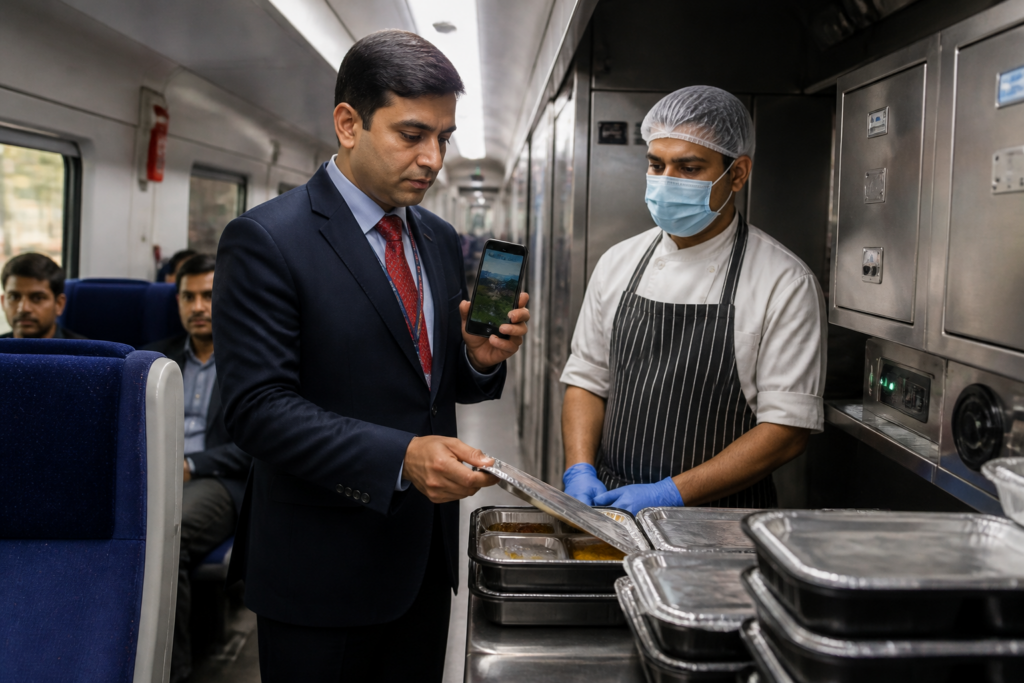
Train food quality audits will now involve an independent third party after the Indian Railway Catering and Tourism Corporation (IRCTC) signed an agreement with the Quality Council of India (QCI) to monitor catering services on trains and at railway stations.
The audit system will cover food preparation, handling and serving across IRCTC-managed catering units. It will use digital evidence, geo-tagging, time-stamping and photographs to make inspections traceable. Inspection reports will have to be submitted within 24 hours, allowing corrective and preventive action to be initiated quickly.
The system is expected to cover catering services on 1,453 trains, including Vande Bharat, Rajdhani and Tejas services, as well as railway station food units managed by IRCTC. QCI will establish quarterly and half-yearly inspection arrangements for trains and stations and deploy trained professionals for the audits.
The inspections will be conducted against statutory rules set by the Food Safety and Standards Authority of India (FSSAI), along with international culinary standards. Inspectors will use a dedicated mobile application that requires geo-tagging, time-stamping and photographic evidence. The digital infrastructure is intended to prevent manipulation of inspection records and improve transparency in the audit process.
The agreement comes as railway catering handles a large volume of food service. During 2025-26, more than 600 million meals were served at railway stations and on trains, with approximately 1.8 million meals distributed every day, according to the details reported by Jagran. The scale of operations makes consistency in food safety, hygiene and service quality difficult to maintain across multiple locations and catering providers.
Passenger complaints remain a significant part of the challenge. In 2024-25, 6,645 complaints related to catering were received. Over the past three years, fines exceeding Rs 26 million were imposed on service providers in more than 1,300 cases. More than 2,995 caterers received strict warnings, while corrective directions were issued in over 1,500 cases.
IRCTC has already introduced an artificial intelligence-based monitoring system as part of its response. More than 800 kitchens have been connected to over 23 AI-enabled cameras. A monitoring war room at IRCTC’s headquarters in the World Trade Centre at Nauroji Nagar, New Delhi, oversees kitchen activity across the country.
The new third-party audit is intended to strengthen monitoring beyond the existing internal systems. QCI’s inspections will cover the chain from cooking to delivery to passengers, while the requirement for evidence-backed reports within 24 hours is designed to reduce the delay between identifying a violation and taking action.
The next operational step is the establishment of the quarterly and half-yearly inspection framework, including the deployment of trained auditors and rollout of the digital inspection process across the covered trains and station catering units.


