

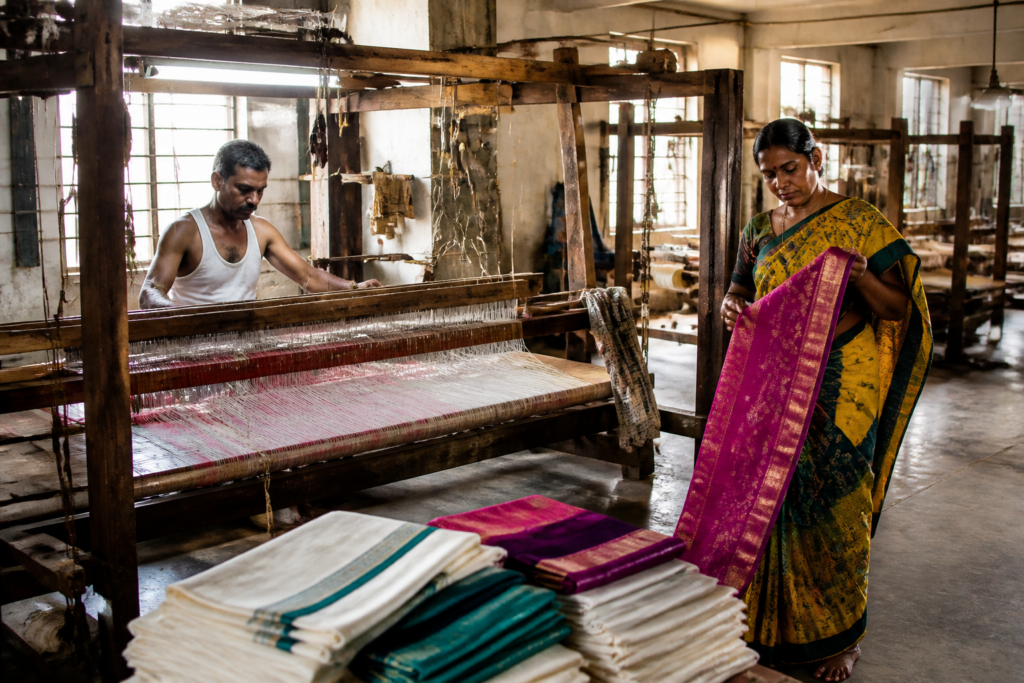
Tamil Nadu has increased the weaving wages paid for dhotis and sarees produced for its Pongal free distribution programme, with revised rates applicable to both pedal-loom and powerloom production. The decision was announced by the state Handlooms Department as preparations continue for the next production cycle.
The department said the government has allocated Rs 300 crore as the first instalment towards the cost of distributing free dhotis and sarees for the Pongal festival. Production targets have been fixed for the period from August to December, covering the manufacturing window for the garments to be supplied under the programme.
According to a statement issued by Handlooms Department Secretary Lilly, demands had been received for higher weaving wages because dhotis and sarees in new varieties were being introduced for the programme. A field study was conducted in connection with the request, after which a wage-fixation committee submitted its recommendations.
Under the revised rates, pedal-loom weavers will receive Rs 125.27 for producing one saree and Rs 49.99 for producing one dhoti. For powerloom production, the revised weaving wages have been fixed at Rs 54.81 per saree and Rs 23.34 per dhoti.
The order links the wage revision to the production requirements of a state-funded distribution programme rather than to a general wage change across the textile sector. The department’s statement specifically attributes the new rates to the committee’s recommendations following the field assessment and to the introduction of new garment varieties.
The Pongal dhoti and saree programme combines public expenditure, procurement and textile production across the state. The Rs 300 crore first instalment will support the programme’s expenditure, while the August-to-December production schedule sets the period in which the targeted garments are to be manufactured.
The revised rates also distinguish between pedal-loom and powerloom work, reflecting the two production systems used for the programme. Pedal-loom weaving will attract the higher per-piece rates announced by the department, while powerloom production will be paid at separate rates for dhotis and sarees.
The immediate implementation timeline is the production period already fixed by the department, running from August through December. The state government’s next operational steps will involve producing the targeted dhotis and sarees under the revised wage schedule and meeting the requirements of the Pongal distribution programme.


