

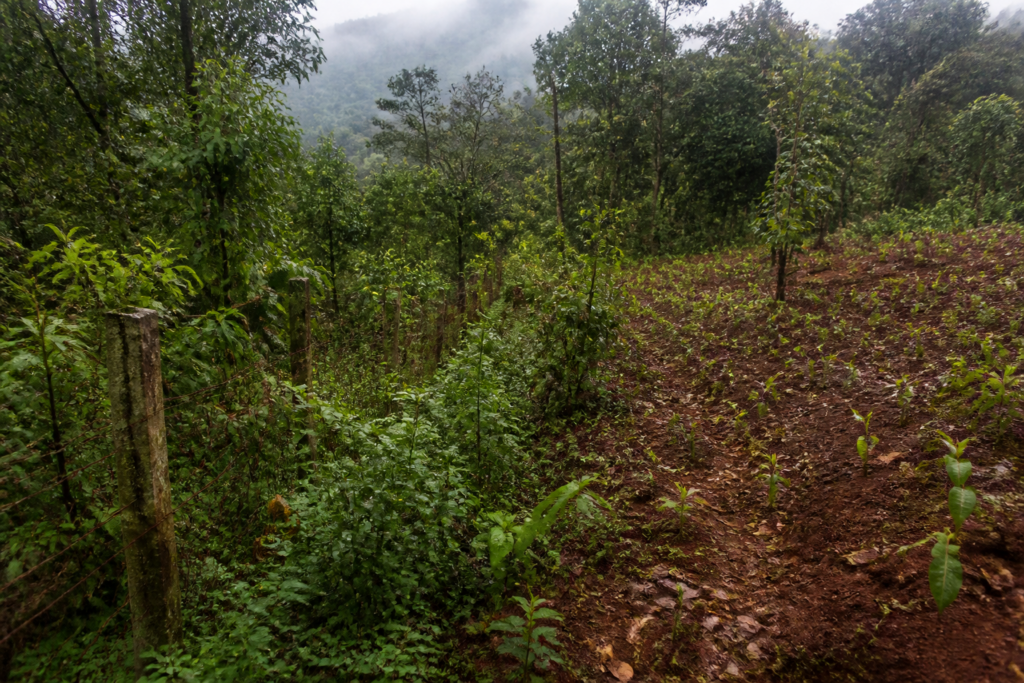
Karnataka’s afforestation debate is increasingly being framed around a difficult question: can forest restoration succeed when existing vegetation is cleared, fenced and replanted through standardised schemes? In an analysis published by Prajavani, author Shivanand Kalave argues that parts of the Forest Department’s approach have become too dependent on plantations, fencing and mechanical interventions, while overlooking natural regeneration, local knowledge and community participation.
The article is based partly on the author’s observations of forest work in Uttara Kannada and on examples he says he encountered over several years. Its central claims require verification through departmental records, project documents, expenditure data and responses from the Karnataka Forest Department. But the questions it raises are important for a state where forest management affects wildlife habitat, farming communities, fire control and the long-term use of public funds.
Kalave recalls visiting the Chanagar area near Ankola in Uttara Kannada district in October 2011. He describes seeing large stretches of lower vegetation cleared before a plantation project, with wire fencing installed around the site. According to the article, departmental staff told him that the area would be replanted with forest species. The author questioned whether protecting existing vegetation would have been more appropriate than removing it and starting a new plantation.
The article says that, when the author revisited the location about 15 years later, the plantation could no longer be identified clearly. It claims that the fencing had rusted and become covered with soil, while shoots had regenerated from the roots of the vegetation that had earlier been cut. These observations are presented as evidence of a possible mismatch between plantation-based targets and the ecological capacity of a site to regenerate naturally. The condition of the site and the expenditure involved would need to be established through field verification and official records.
A recurring concern in the article is the use of measurable physical outputs as a substitute for ecological outcomes. The author says that forest protection is often assessed through fencing, trenches, concrete posts or the number of saplings planted, rather than through the survival of trees, the recovery of native vegetation or the return of habitat functions. He also refers to a fencing programme in Uttara Kannada that, according to his account, involved about 500 kilometres of wire fencing in an area that already had substantial forest cover. This figure and the programme’s stated objectives require confirmation from official project data.
The criticism points to a wider administrative problem. Plantation programmes are easier to record than natural regeneration. A department can count saplings, pits, poles or kilometres of fencing within a financial year. Measuring whether a forest floor has recovered, whether wildlife has regained access to habitat or whether a mixed native ecosystem has become more resilient is slower and more complex. The difference between these two forms of measurement can influence how schemes are designed, funded and reviewed.
The article also questions the consequences of introducing or expanding plantation species without sufficient attention to local ecology. It refers to the spread of acacia in parts of the coastal and Malnad regions after plantations were established around the mid-1980s. The author cites seed-production estimates and plantation densities to argue that some species can spread aggressively when conditions allow. These biological claims, including the figures cited in the article, should be checked against forestry research and departmental records before being treated as established evidence.
Another example concerns teak cultivation and the difficulties faced by farmers seeking permission to fell trees. Kalave recounts the case of a farmer near Ripponpet in Shivamogga district who, according to the author, became frustrated with delays in obtaining permission and began burning teak trees. This is a personal account rather than an independently documented case. It nevertheless raises a governance question: when tree-growing regulations are difficult to navigate, do they discourage private cultivation and undermine confidence in forestry programmes?
The author further refers to a proposal to control forest undergrowth mechanically and to the use of mini excavators for digging pits. He compares such interventions with earlier practices in which soil was mechanically disturbed before plantations were established. The article argues that treating naturally occurring vegetation as weeds can damage habitat and disturb the ecological processes that sustain wildlife. Whether specific current schemes use the equipment and methods described would need confirmation from tender documents, departmental circulars and field-level orders.
The habitat question is central because lower vegetation is not simply visual undergrowth. Shrubs, grasses, fallen material and regenerating plants can provide food, cover and breeding space for insects, birds and other animals. Removing them may alter the conditions on which larger wildlife depends. The article links habitat disturbance to increasing conflict between wildlife and farmers, but it does not provide incident data or an official assessment establishing that connection. Such a relationship should be examined through crop-loss records, wildlife movement data and local studies rather than assumed from individual observations.
The analysis also calls for a stronger role for communities in forest protection. According to Kalave, the department has moved away from sustained engagement with residents and towards administrative measures such as fencing and formal plantation work. Community participation, however, is not only a question of consultation. It also involves clear responsibilities, timely payment of frontline workers, access to grievance mechanisms and recognition of local ecological knowledge. The article alleges administrative weaknesses in some of these areas, including delays affecting daily-wage forest watchers, but those allegations require documentary and official confirmation.
For Karnataka’s Forest Department, the institutional challenge is to distinguish between plantation activity and forest restoration. A plantation may involve a defined site, a fixed number of pits and a procurement process. Restoration requires a longer assessment of soil, water, native species, wildlife use, fire risk and community dependence. It also requires monitoring after the initial planting period, when funding and administrative attention often decline. The article’s account of deteriorated fencing and untraceable plantations illustrates this concern, although the specific site should be independently inspected.
The funding implications are equally important. Fencing, concrete posts, nurseries, sapling procurement, machinery and plantation maintenance all create visible expenditure lines. If a project is poorly matched to the site, public money may be spent first on removing existing growth and later on recreating a landscape that was already capable of regenerating. Establishing whether this has occurred in particular Karnataka projects requires scheme-wise expenditure statements, plantation survival audits, geo-tagged records and independent ecological assessments.
The article places these issues within a longer history of forest intervention. It refers to an 1887 Bombay government record concerning the expansion of grasslands for cattle grazing and the subsequent spread of lantana. That historical reference is used to argue that interventions intended to solve one land-use problem can create another ecological challenge. The document and its interpretation should be reviewed by specialists before being used as evidence for a broader state-wide conclusion.
What the supplied material establishes is that a published analysis has challenged the Karnataka Forest Department’s reliance on mechanical clearing, plantation targets and fencing. It also records the author’s personal observations and several claims about forest schemes, species spread, administrative practice and wildlife habitat. What it does not establish is the official scale of these practices, their costs, their survival rates or their measured ecological effects.
Those gaps are not minor. They determine whether the issue is one of isolated poor implementation or a systemic weakness in how forest restoration is planned and evaluated. The next step should be verification through departmental responses, project files, field inspections, plantation survival data and independent ecological evidence. Until then, the article’s strongest contribution is to ask whether Karnataka’s forest policy is measuring the presence of planted trees—or the health of forests themselves.


