

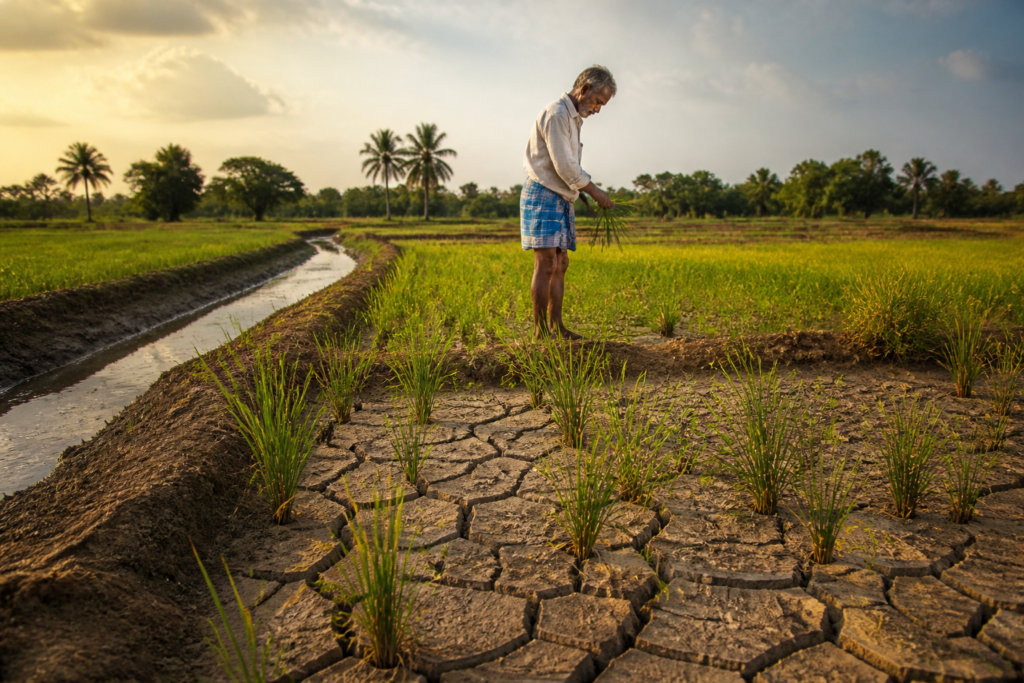
Karnataka’s rice and tur dal markets are showing how a shortage of water can travel through the food system—from fields and reservoirs to mills, shops and household budgets. A report by Prajavani says rainfall deficits, delayed or inadequate irrigation releases and adverse weather have reduced crop prospects across the state, while lower arrivals and thinner inventories are pushing up procurement costs.
The immediate concern is concentrated in Karnataka’s main paddy-growing areas, including Ballari, Raichur, Gangavathi, Koppal, Shivamogga, Mysuru and Mandya. These districts depend on a combination of rainfall and irrigation for a crop that requires substantial water. The report says farmers and market participants fear paddy losses could cross 50% in key producing districts if adequate water is not available.
That risk is not limited to farm incomes. Rice is a staple consumed across urban and rural households, and any sustained reduction in local production can affect the amount of grain reaching mills and markets. The report says Karnataka has about 700 rice mills. With stocks in the market reported to be low, mill owners are having to buy paddy at higher prices, increasing the cost of processing and putting upward pressure on retail rice prices.
The reported movement in procurement prices illustrates the speed of that pressure. Mill owners told Prajavani that paddy which was being purchased at approximately ₹3,500 per quintal two months earlier was costing between ₹4,600 and ₹4,700 per quintal at the time of the report. The increase does not automatically translate into higher returns for every farmer. It raises the cost base for rice production, while the benefit of a stronger market price depends on whether a farmer has produce available to sell and what costs were incurred during cultivation.
The situation is also unfolding in Karnataka’s tur-growing districts, particularly around Kalaburagi. Traders and mill owners cited in the report said soil-moisture shortages and extreme heat had delayed flowering in tur plants, creating risks for both yields and quality. Maharashtra, Gujarat and Karnataka are identified as major tur-producing states, meaning weather conditions across this production belt can influence the availability of tur dal beyond a single district or market.
Kalaburagi’s current crop concerns also sit alongside damage attributed to flooding in the region last year. The report says tur dal mill owners viewed that earlier disruption as one factor behind current price increases. This combination is important: agricultural supply does not respond to a single weather event in isolation. Previous crop damage can reduce stocks, while a new season’s rainfall deficit can limit the replenishment that markets normally depend on.
The result is a supply chain under pressure at several points. In the field, inadequate moisture can reduce plant growth, flowering and yield. At the storage and procurement stage, lower output can mean fewer arrivals and stronger competition among buyers. At the milling stage, higher raw-material costs affect processing economics. At the consumer end, the burden appears as higher prices for rice and pulses—items that households cannot easily remove from their food basket.
The report also makes a distinction that is often lost in headline price data: higher market prices do not necessarily mean better conditions for farmers. Farmers who stored produce from the previous season may be able to benefit from current prices. Those who have suffered crop losses in the present season may have little or no produce to sell. Their income can therefore fall even as the commodity becomes more expensive for consumers.
This divide exposes the different positions occupied by producers, millers and households in the same market. A farmer with unsold stocks may gain from a price increase, while a farmer facing crop failure may face debt, replacement costs and lost revenue. A mill must pay more for paddy or tur to keep operating, and a household must pay more for food. The market price records the shortage, but it does not show how evenly—or unevenly—the consequences are distributed.
Water management is central to this chain. The report says water was not released from reservoirs for agriculture when it was needed in some areas. That does not establish that every crop loss resulted from reservoir operations, but it identifies the institutional link between water allocation and farm output. In water-dependent agricultural regions, the timing of a release can matter as much as the total volume eventually supplied, because crops require water at specific stages of growth.
Rainfall remains another critical variable. Prajavani reports that better rain in late October and November could help stabilise rice and tur dal prices, while continued weakness could push prices higher. This is an assessment attributed to traders rather than a confirmed forecast. It also underlines the narrow margin available to the market: when inventories are already low and current-season output is uncertain, even a limited improvement or deterioration in weather can influence expectations and procurement behaviour.
For cities, the issue is not simply an agricultural story occurring outside urban boundaries. Urban food markets depend on rural production, transport, storage, milling and wholesale networks. A disruption at the production end can appear in city budgets after passing through these linked systems. Low-income and middle-class households are particularly exposed because food absorbs a larger share of their regular expenditure, while rice and pulses are basic items with limited scope for substitution.
The episode also shows why food inflation cannot be understood only through retail prices. The reported rise in paddy procurement costs provides an earlier signal of pressure within the supply chain. Crop damage, reduced arrivals and low inventories are upstream conditions; retail prices are the downstream outcome. Tracking only the final price can obscure whether inflation is being driven by production losses, storage shortages, processing costs or demand conditions.
The available report does not provide a state-wide crop-loss assessment, official reservoir-release data, retail price series, or a confirmed estimate of the final rice and tur output for the season. It also does not establish how much of the reported price increase has already reached consumers in different cities. Those gaps matter because the reported risk of losses above 50% applies to concerns in major paddy-growing districts, not necessarily to the entire state.
What the evidence does establish is a connected pressure on production and supply. Rainfall shortages and inadequate or untimely irrigation have affected paddy-growing areas; adverse weather has affected tur prospects in Kalaburagi; market participants report reduced arrivals and inventories; and paddy procurement prices have risen sharply over two months. The report further indicates that the burden is likely to be distributed unevenly, with consumers facing higher food costs while farmers with current-season losses may not receive the benefit of those prices.
The larger urban question is how resilient the food system is when water stress, crop damage and low stocks occur together. Karnataka’s cities are not separate from this chain: their food affordability depends on the ability of farms, reservoirs, mills and markets to keep functioning through uncertain seasons. The next signals to watch are rainfall in late October and November, water availability during critical crop stages, arrivals in producing markets and whether rice and tur dal prices stabilise or continue rising.


