

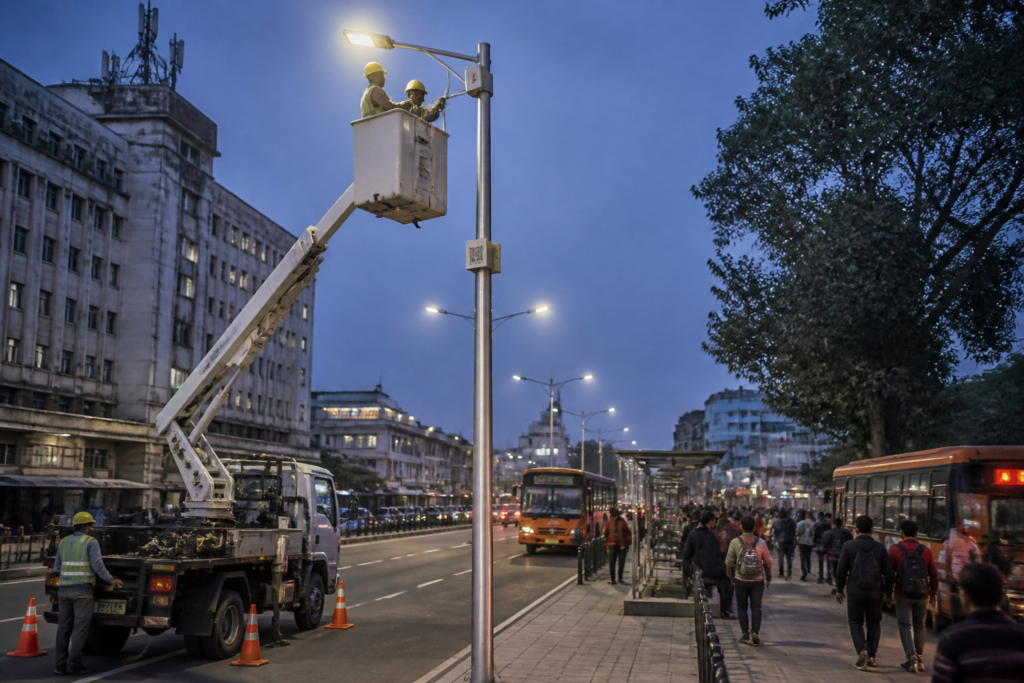
Delhi Chief Minister Rekha Gupta has launched a project to install one lakh smart LED street lights across the Capital, beginning at the Andrews Ganj bus stop, with the stated aim of reducing dark spots and improving women’s safety and public convenience.
The initiative follows concerns raised by female students during Gupta’s recent interaction at Delhi University. The project is intended to expand lighting coverage in locations where inadequate illumination affects how residents use streets and public spaces, particularly after dark.
The new lights will be monitored in real time through a central command centre, according to the details released about the project. Each light will also carry a QR code that citizens can use to access information and register complaints about the installation or its functioning.
The administration has set a target of 99 per cent functionality for the network. Faulty lights are required to be repaired within 48 hours of a complaint, creating a defined response timeline for a service that is often dependent on residents reporting failures through municipal channels.
Agencies that miss the repair deadline will face a penalty of Rs 2,000 per light per day. The penalty provision links the city’s lighting performance to an enforceable service standard rather than treating street-light maintenance only as a routine operations issue.
The first installation is being undertaken at the Andrews Ganj bus stop. The project’s wider rollout is expected to cover locations across Delhi, although the material available on the launch does not specify the installation schedule, agency-wise responsibilities or the total project cost.
Street lighting is a core urban service because it shapes how roads, bus stops and other public areas function after sunset. For commuters, students and pedestrians, the reliability of individual lights can influence the safety and usability of routes even when broader infrastructure is in place. The project’s use of real-time monitoring and citizen-linked QR codes is designed to make faults more visible to authorities and easier for residents to report.
The 48-hour repair requirement will make implementation dependent on more than the installation of new fixtures. It will also require agencies to identify faults quickly, assign responsibility, respond to complaints and record completed repairs. The daily penalty provides an administrative consequence when that chain breaks down.
The project’s stated 99 per cent functionality target and the public complaint mechanism will be the key measures of its performance as the rollout expands. Further details on the number of lights installed at each location, the agencies responsible for maintenance and the timeline for completing the one-lakh-light target were not available in the launch information.


