

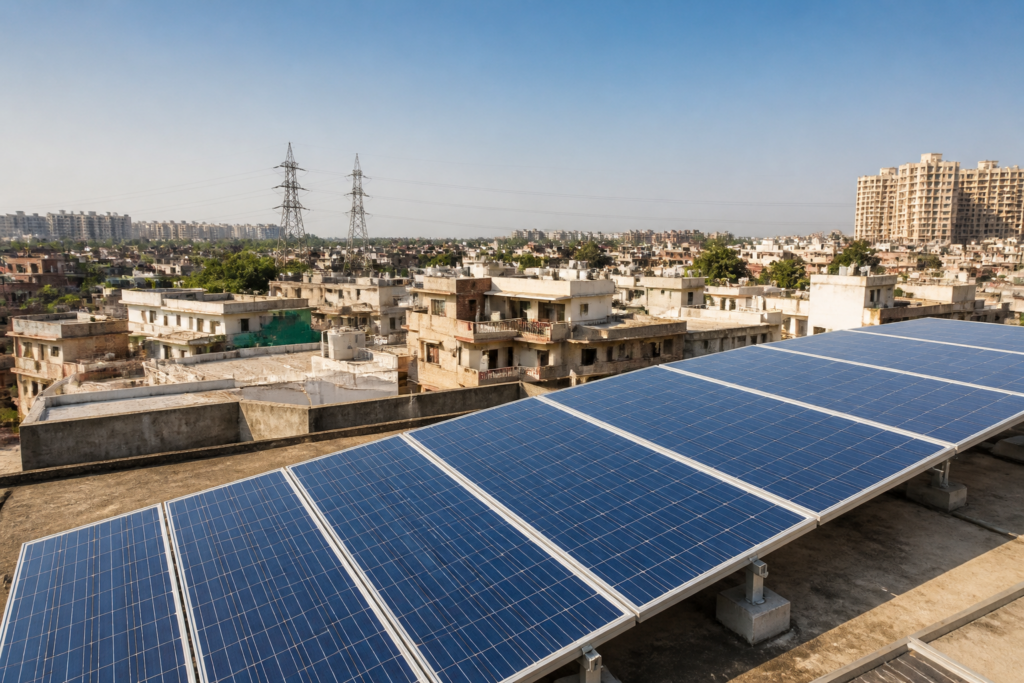
Delhi’s rooftop solar drive has attracted 77,614 registrations within weeks of the government opening its portal, signalling broad interest in decentralised power across the Capital. But the more important measure of the programme will not be the number of applications. It will be whether those registrations become installed, commissioned and functioning systems before the government’s March 31, 2027 target.
The registration figures, reported by Millennium Post, show a relatively even spread across Delhi’s three major electricity distribution companies. BSES Yamuna Power Limited recorded 27,197 applications, Tata Power Delhi Distribution Limited received 26,788, and BSES Rajdhani Power Limited recorded 23,925. The gap between the two highest totals was only 409 applications.
That distribution matters because it suggests that interest is not confined to one electricity network or one narrow part of the city. Delhi’s rooftop solar policy is therefore being tested as a city-wide programme rather than as a limited intervention in a particular discom territory. The response also includes registrations from rural areas and unauthorised colonies, which Power Minister Ashish Sood described as particularly encouraging.
The registration portal was launched on September 21, and the reported total had reached 77,614 applications by October 9. The government is targeting 2.30 lakh rooftop solar installations by March 31, 2027. The current registration figure represents a substantial start towards that goal, but it is not equivalent to completed installations. The next stage will involve technical assessments, approvals, installation, commissioning and connection to the electricity network.
That distinction between demand and delivery is central to understanding the programme. A household can register interest without yet having a technically suitable roof, completing the required process or receiving an operational system. The government’s own stated challenge is therefore not simply to generate awareness. It must coordinate households, installers, distribution companies and subsidy mechanisms well enough for applications to move through the entire project pipeline.
The potential addressable base is large. Delhi had around 61 lakh domestic electricity consumers in 2024-25, according to the figures cited in the report. This does not mean every consumer is eligible for rooftop solar. Building form, roof access, structural suitability, electricity consumption, ownership arrangements and network conditions can all affect whether a system can be installed. Nevertheless, the size of the consumer base shows why rooftop solar has become an urban infrastructure question rather than a niche household upgrade.
The revised Delhi Solar Energy Policy attempts to lower the upfront financial barrier for eligible domestic consumers. Households with average monthly consumption of up to 400 units can receive rooftop solar systems of up to 3 kW without paying the installation cost upfront, subject to the scheme’s conditions. The Centre provides a subsidy of up to Rs 78,000, while the Delhi government has announced an additional subsidy of up to Rs 78,000. Together, the support can reach Rs 1.56 lakh for eligible systems.
This structure places affordability at the centre of adoption. Rooftop solar often requires households to make a decision based not only on environmental benefits but also on the timing of savings, the initial capital requirement and confidence that the system will be maintained. By combining central and state assistance, the policy seeks to reduce the upfront cost that can prevent households from participating.
However, subsidies alone do not determine whether a city-wide rooftop programme works. The administrative experience of applying, obtaining approvals, arranging installation and securing grid connectivity can be just as important. The Delhi government has said that the time required for residential net metering will be reduced from around 75 days to 25 days. If delivered, that reduction would address one of the operational frictions that can discourage applicants after registration.
Net metering is significant because it allows consumers to manage the relationship between their rooftop generation and electricity consumption, including the sale of surplus power to distribution companies under applicable arrangements. For households, the value of the system will depend on whether the expected reduction in electricity bills and any surplus-power arrangements are realised after installation.
The policy also extends beyond individual homes. Group housing societies can receive support for rooftop systems serving common facilities. The Delhi government has increased its subsidy for such systems from Rs 2,000 to Rs 11,000 per kW, up to 500 kW, while eligible projects may also receive central assistance. This creates a separate implementation pathway for apartment complexes, where the decision-making process may involve resident welfare associations, common-area electricity consumption and shared roof space.
Group housing is an important test of how rooftop solar fits into Delhi’s built form. Independent houses may have clearer control over their roofs, while apartment buildings must resolve questions of ownership, allocation of benefits and the use of common infrastructure. A subsidy for common facilities can help address part of that challenge, but the policy’s reach will ultimately depend on whether housing societies can organise and execute projects within the available framework.
The government has also provided for five years of free maintenance. That provision recognises that installation is only the beginning of an asset’s operating life. Rooftop systems require ongoing performance monitoring and maintenance if their expected energy and bill-saving benefits are to continue. The maintenance commitment may also make the programme more acceptable to households that are unfamiliar with managing distributed power equipment.
Delhi’s rooftop solar push reflects a broader change in how urban electricity systems are being imagined. Instead of relying only on large, centralised generation and a one-way flow of electricity through the distribution network, rooftop solar places a portion of generation closer to consumers. This can give households a more active role in the power system while expanding clean-energy capacity through existing buildings.
At the same time, decentralised generation does not remove the role of the distribution companies. BYPL, TPDDL and BRPL are the points through which applications, approvals, metering and grid connections must be handled. The relatively even registration numbers indicate that all three discoms will be part of the implementation challenge. Their capacity to process applications consistently may influence whether the programme develops evenly across the Capital.
The figures also raise a basic measurement issue. Registrations are an early indicator of public interest, but they do not reveal how many households have completed technical evaluation, received approvals, had panels installed or begun generating electricity. The March 2027 target makes those later indicators more important than the initial registration count. A programme can show strong demand at the portal stage and still face delays further down the chain.
The difference between registrations and operational systems is particularly relevant in a dense and varied city such as Delhi. The programme must work across formal neighbourhoods, group housing societies, rural areas and unauthorised colonies. The minister’s statement that registrations from rural areas and unauthorised colonies have been encouraging indicates that the policy is reaching areas with different built forms and administrative conditions. The implementation data will show whether those areas can progress from interest to installation at the same pace.
The government’s stated objectives are to expand rooftop solar access, help households reduce electricity expenses and encourage decentralised clean-energy generation. Those objectives overlap, but they are not identical. A system may add clean-energy capacity without reaching households with the greatest affordability pressures. It may reduce bills for participating consumers without becoming accessible across different forms of housing. It may attract registrations without adding capacity if approvals and commissioning lag behind.
For that reason, the next phase should be assessed through a wider set of outcomes: the number of approved applications, installations completed, systems commissioned, capacity added, net-metering timelines and the participation of different discom areas and housing types. The source material does not establish how many of the 77,614 registrations have moved beyond the application stage. That remains the key information gap in judging the programme’s progress.
Delhi’s rooftop solar programme has clearly cleared its first public-interest hurdle: it has generated a large and geographically distributed response. The harder test now lies in administration and delivery. Whether the Capital reaches 2.30 lakh installations by March 31, 2027 will depend on how efficiently the subsidy promise, discom processes, technical feasibility checks, maintenance support and commissioning systems work together. The next milestones will be the conversion of registrations into installed systems and the capacity those systems add to Delhi’s electricity network.


