

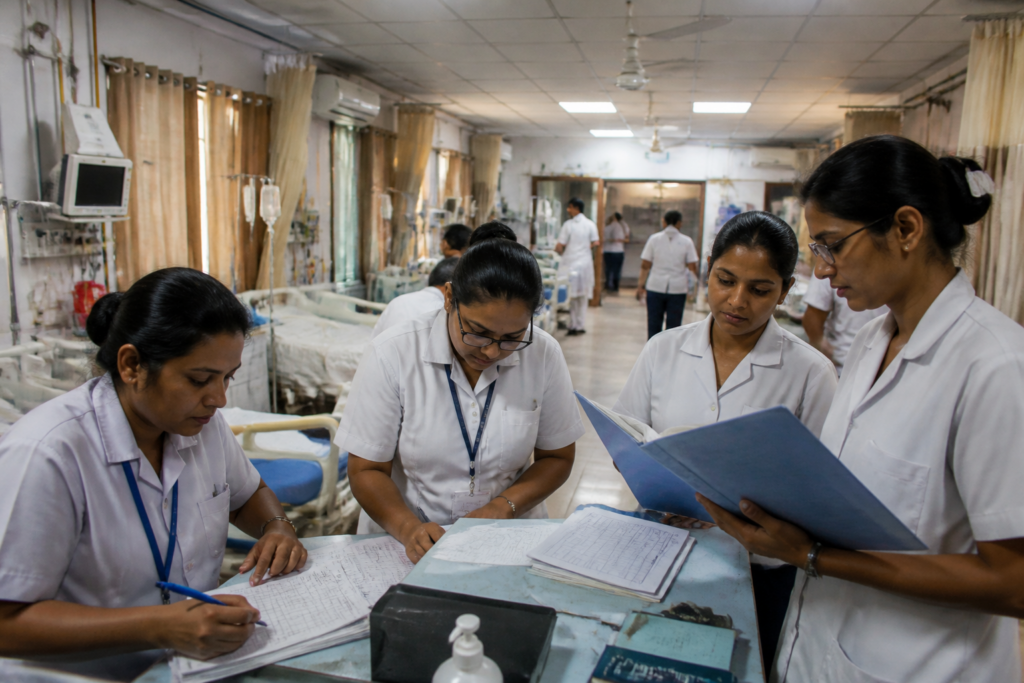
The decision by nurses at Delhi’s Hindu Rao Hospital to end their protest on October 8 did not resolve the hospital’s central problem. It only moved the issue from public demonstration to administrative implementation. The Municipal Corporation of Delhi (MCD) has assured the nurses that steps will be taken to address the shortage, including meeting 50 to 80 per cent of the staff requirement within 60 days. The scale of the gap, however, shows why the dispute became a hospital-wide concern rather than a routine recruitment matter.
Hindu Rao Hospital has 300 sanctioned nursing posts, but only 62 nursing officers were working when the nurses began their protest, according to a report by Millennium Post – Delhi. That left 238 posts vacant. In practical terms, the hospital had filled just over one-fifth of its sanctioned nursing strength, while nearly four out of every five posts remained unoccupied. The figures provide the clearest measure of the institutional problem: the hospital’s approved staffing structure and its functioning workforce had diverged sharply.
The protest was led by nurses seeking the filling of vacant positions and relief from the workload placed on existing staff. The Delhi Nurses Union president, Vibha Singh, said some wards had around 40 to 50 patients with only one nursing officer available to attend to them. The report also said she described the workload as affecting the health and family lives of nurses who continued to work despite the shortage. These details connect the staffing deficit to two linked pressures: the hospital’s ability to provide care and the sustainability of the workforce expected to provide it.
The sequence of the protest is also important. Nurses first held a black ribbon demonstration from September 28 to October 4 while continuing their duties. From October 5, they began a two-hour agitation that was scheduled to continue until October 11. They had warned that a total strike would begin on October 12 if their demands remained unaddressed. The protest was called off on October 8 after an assurance from an MCD Additional Commissioner, preventing the escalation that had been announced for the following week.
That assurance created a temporary administrative settlement. The nurses agreed to withdraw their protest after being told that between 50 and 80 per cent of the staff requirement would be met within 60 days. The recruitment process is to begin through posts handled by the Delhi Subordinate Services Selection Board, or DSSSB. The report states that the MCD official also assured the nurses that steps would be taken to address the shortage by December.
The language of the commitment matters. The assurance does not mean that all 238 vacant posts will be filled immediately. At the upper end of the stated target, meeting 80 per cent of the requirement would still leave a portion of the shortage unresolved, depending on whether the requirement refers to the sanctioned posts or the operational requirement identified by the administration. At the lower end, 50 per cent would represent a substantial improvement over the reported strength of 62 nursing officers, but it would not restore the hospital to its sanctioned staffing level. The supplied report does not clarify the exact number of appointments promised, the number of posts to be advertised or whether recruitment means selection, joining or deployment within the 60-day period.
This distinction is central to understanding the dispute. A sanctioned post is an approved staffing position, but it does not itself place a nurse on a ward. The route from an approved vacancy to a working nursing officer involves identifying posts, initiating recruitment, conducting the selection process and ensuring that successful candidates join the hospital. In this case, the proposed DSSSB recruitment process is the administrative bridge between the MCD’s assurance and the staffing levels experienced by patients and nurses. Until that process produces working staff, the reported workload remains unchanged.
The episode also reveals how service delivery can become dependent on the difference between formal capacity and available personnel. Hindu Rao Hospital had 300 sanctioned nursing posts, but the nurses’ account described only 62 nursing officers working. The hospital therefore possessed an approved institutional structure that was not matched by an equivalent workforce on the ground. For patients, the relevant measure is not the number of posts listed in an establishment plan but the number of nursing officers available in wards during a shift.
The reported ward-level ratio makes the problem more concrete. One nursing officer attending to 40 to 50 patients indicates that the shortage is experienced as a distribution and workload issue, not only as a vacancy statistic. The supplied material does not provide ward-wise staffing norms, shift rosters, patient volumes, bed occupancy or the reasons why the posts remained vacant. It therefore cannot establish whether the reported ratios applied across the hospital or only to some wards. It does establish, however, that the union considered the pressure severe enough to organise a phased protest while nurses continued their duties.
The administrative structure behind the dispute involves at least two institutions. Hindu Rao Hospital operates under the MCD, whose Additional Commissioner provided the assurance recorded in the report. Recruitment is expected to begin through the DSSSB, indicating that the hospital’s staffing response is not solely an internal managerial decision. The process depends on coordination between the municipal authority responsible for the hospital and the recruitment body expected to handle the posts. The report does not specify the exact division of responsibilities, but the proposed route shows that the nurses’ demand has moved into a formal recruitment channel.
That institutional chain creates a measurable test for the December commitment. The first question is whether the recruitment process begins as promised. The second is whether the identified posts are advertised and processed within the stated timeline. The third is whether selected candidates actually join and are deployed in sufficient numbers to reduce the workload in wards. These are not separate administrative details; together they determine whether the October assurance becomes a change in hospital operations.
The timeline also places pressure on the MCD’s communication with the nurses. The protest was called off because the administration gave a time-bound assurance. A time-bound assurance is different from an open-ended statement that the issue will be examined. It creates an expectation that progress can be assessed against the 60-day period and the December target. The supplied report does not include a written order, recruitment notification or subsequent appointment data, so the status of implementation remains unestablished in the available evidence.
The case raises a broader urban governance question without requiring assumptions about Delhi’s entire healthcare system: how should municipal institutions maintain essential services when approved staffing and working strength differ so widely? The immediate answer at Hindu Rao Hospital is being pursued through recruitment. But the reported figures show that recruitment is not merely a human resources exercise. It is tied to ward functioning, the distribution of care work and the ability of a public hospital to serve patients without placing disproportionate pressure on the staff who remain.
For now, the documented outcome is limited but significant. Nurses ended their protest after the MCD assured them that recruitment steps would begin and that 50 to 80 per cent of the staff requirement would be met within 60 days. The underlying shortage, measured against 300 sanctioned posts and 62 working nursing officers, remains the central fact. The next evidence will come from the recruitment process, the number of posts formally taken up and the number of nursing officers who ultimately join Hindu Rao Hospital.


