

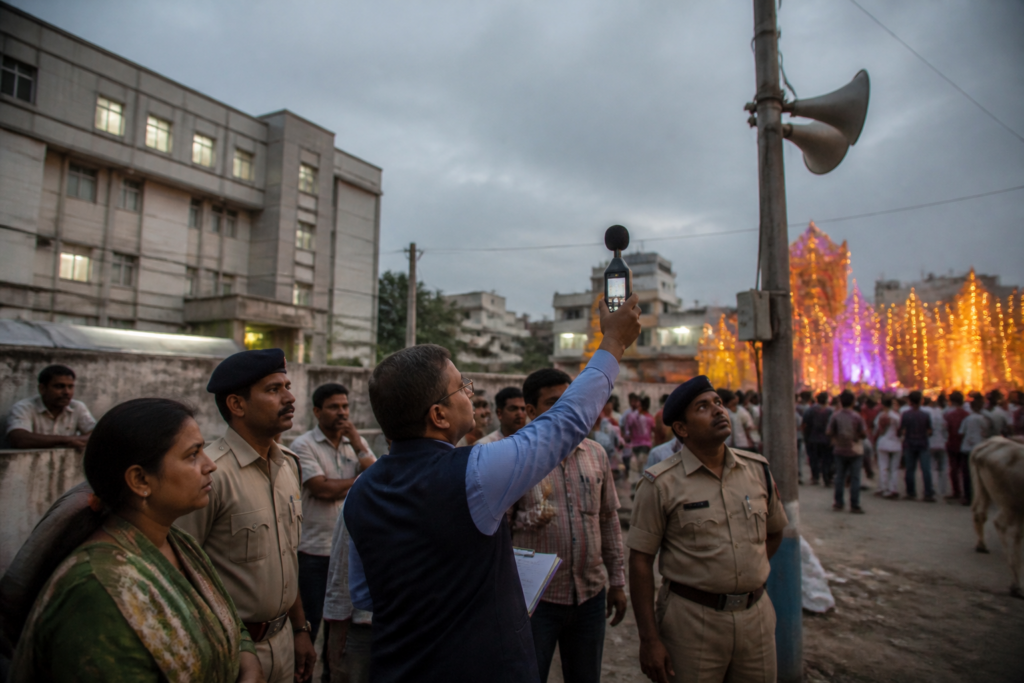
The Gujarat High Court has asked the state government to conduct surprise checks and enforce noise-control rules strictly during Navratri, after hearing a petition concerning DJs and loudspeakers allegedly being used in violation of notifications in silent zones. The court has also directed authorities to submit a detailed account of the action taken, noting that the issue extends beyond Veraval and concerns the entire state.
The matter was heard by a division bench in connection with an application about noise pollution during the nine-day festival. According to the report submitted during the hearing, the court observed that the problem becomes more serious during Navratri and cannot be treated as a localised issue. The state government sought two days to submit a further response.
The Gujarat Pollution Control Board placed a report before the court on the applicable noise-control framework. Under a 2000 notification of the Environment Ministry, the use of loudspeakers and DJs is prohibited in silent zones. These zones include areas around hospitals and other locations where lower noise levels are required for public health and safety.
The GPCB told the court that loudspeakers cannot be used at night without permission. It also clarified that loudspeakers may be used at private venues such as banquet halls and party plots only within the prescribed decibel limits. For public use, prior police permission is mandatory, according to the submissions recorded in the report.
The report stated that the night-time noise limit in silent zones is 45 decibels. Around hospitals, the permissible level during the night is required to remain below 45 decibels. These limits are intended to protect areas where residents, patients and other vulnerable groups may be particularly affected by amplified sound.
The state government told the court that inspections are being carried out to ensure that noise stops before midnight in 75 per cent of cases. The submission did not indicate that enforcement had fully resolved the issue. The court has sought information from all relevant authorities on the measures already taken and the action proposed during the festival period.
During the hearing, the court also briefly directed that its microphones be switched off to facilitate a necessary conversation with the petitioner. The incident underlined the practical nature of the issue being considered: the use of amplified sound is not only a question of permissions, but also of whether noise limits can be monitored and enforced at the street and venue level.
The state’s detailed response is expected after the two-day period requested by the government. The court’s direction for surprise checks and the forthcoming submission will determine the next stage of the proceedings.


