

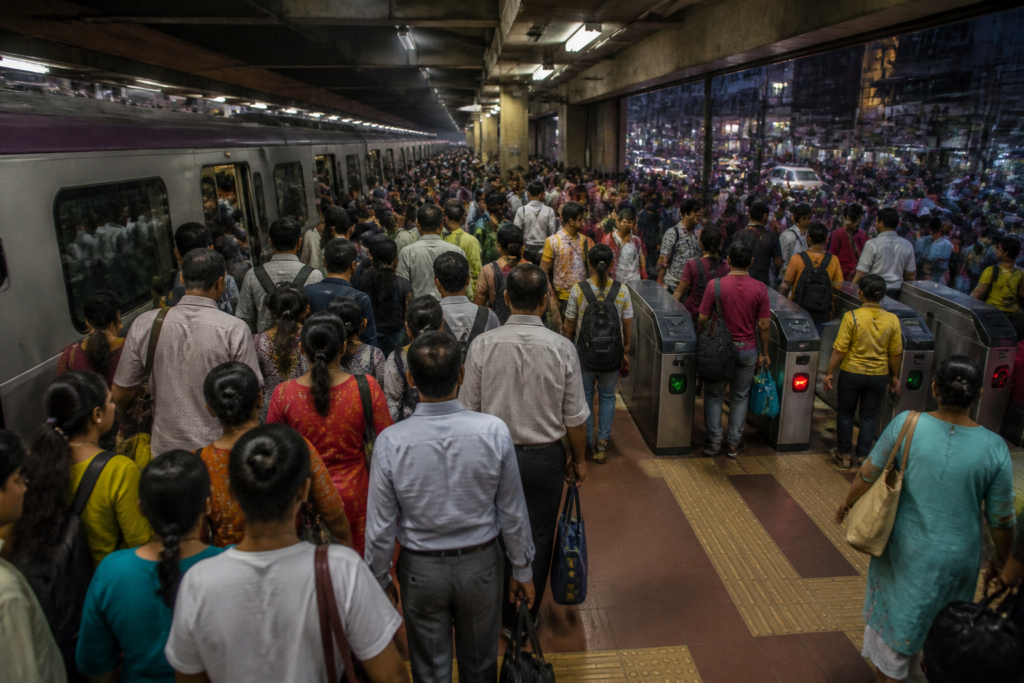
Kolkata’s public transport system came under severe pressure on Panchami, with reduced bus services, disappearing autos, overcrowded Metro trains and scarce app-based cabs and bikes leaving commuters facing long waits and sharply higher fares, according to a report by the Times of India.
The disruption affected both office-goers and festival travellers. Metro commuters reported difficulty boarding trains in the morning, while evening services became so crowded that compartment doors could not close properly. Passengers were seen pushing their way in and out at stations, with some stepping onto platforms before forcing their way back into packed coaches.
Saikat Banerjee, a resident of Kudghat, told the Times of India that the crowding made him fear he would suffocate. He said he had to step out at stations and then push his way back into the train. Waiting times at Sealdah and Esplanade stations for baggage checks and card swiping also rose to almost three times the usual duration, the report said.
The shortage of road-based transport added to the pressure on the Metro system. App cabs and bikes were difficult to book, while fares rose substantially because of limited vehicle availability and slow traffic. Tanima Mondal, who works on Park Street, said she could not board a Metro train at Rabindra Sarobar in the morning. A cab booking to her office showed a fare of Rs 430, compared with her usual cost, while an app bike eventually cost her Rs 180.
Another commuter, Mithun Ghosh, said he waited for more than 30 minutes for an app bike before booking a cab at a much higher fare. He paid Rs 475 for a ride from Behala Chowrasta to Rabindra Sadan, according to the report.
The Online Cab Operators Guild attributed the shortage partly to festival demand. Indranil Banerjee, the organisation’s general secretary, said traffic was slow and many drivers had reserved their vehicles for pandal-hopping, making it difficult for commuters to secure rides.
Bus services were also affected. City Suburban Bus Service operator Titu Saha said several workers refused to operate because they feared being requisitioned by police. Sources cited in the report, however, said several routes had either shut down or were running skeletal services because of disputes involving puja bonuses. As a result, most minibuses remained off the roads, while private buses operated at roughly 50% to 60% of their normal strength.
The reduced service was visible on routes connecting southern Kolkata. Sandhya Banerjee, travelling with her 10-year-old daughter, said she waited 55 minutes for a bus between Gariahat and Tollygunge. During that period, she saw three private buses and two government buses arrive, all carrying passengers who were already hanging out of the doors.
The Panchami disruption followed similar commuter difficulties reported on Chaturthi. The episode exposed how quickly Kolkata’s mobility network can become overloaded when regular bus capacity falls, festival travel rises and Metro services absorb additional passengers. For commuters, the immediate consequence was a choice between unsafe crowding, prolonged waits and substantially higher travel costs.


