

India’s satellite internet debate is being framed as a dispute between Elon Musk and Indian business interests, but the evidence presented by Aaj Tak Business points to a wider institutional question: whether the country’s approval system can bring multiple operators into the market through a transparent and predictable process. Bharti Enterprises chairman Sunil Bharti Mittal has said Airtel applied to begin satellite-based internet services five years ago and has had its ground network ready for three years. His statement suggests that Starlink is not the only company waiting for permission to operate.
That distinction matters because satellite internet is not simply another commercial telecom product. It is part of the infrastructure layer through which connectivity can reach areas where mobile towers and fibre networks are difficult to build. The report identifies mountain regions, remote villages and areas with limited internet access as potential use cases. The market’s development will therefore depend not only on the strength of individual companies, but also on how the government manages licensing, security clearance and spectrum allocation.
The immediate dispute began after Musk questioned the delay in Starlink’s Indian entry on X and suggested that the dominance of large domestic companies could be obstructing his company’s approval. He referred to Reliance Industries chairman Mukesh Ambani while asking whether Ambani was the “real boss” of India. Congress leader Rahul Gandhi responded to Musk, while the government rejected the suggestion that the process was being shaped to favour particular businesses.
The government’s stated position, as reported by Aaj Tak Business, is that the process for satellite communication services is fair. It has said that Jio Satcom and Bharti Airtel-backed Eutelsat OneWeb applied before Starlink and that these companies also have to complete security checks and spectrum-related procedures. This is a crucial detail in understanding the dispute. The question is not merely whether Starlink has been delayed, but whether all applicants are being assessed under the same administrative framework and whether that framework is clear enough for companies to plan investment and service launches.
Mittal’s intervention adds a different perspective to the public argument. Speaking at the Bloomberg New Economy Forum 2026, he said Airtel had applied five years earlier, that its ground network had been ready for three years and that he believed he was “quite ahead” of Musk in the queue. He also said that his company’s satellites had been present above India for five years, but services could not begin without permission. Mittal added that he would be pleased if Airtel received approval a few days before Starlink.
These remarks do not establish that Airtel should automatically receive priority, nor do they resolve the government’s approval process. They do, however, show that the market is not waiting for a single foreign entrant. Airtel’s position is linked to Eutelsat OneWeb, while Reliance is pursuing Jio Satcom and Starlink is seeking entry as another major operator. The presence of several applicants makes the design and administration of the rules more important than any individual corporate confrontation.
The policy architecture described in the report has at least two distinct components. The first is security scrutiny. Satellite communications can have implications beyond consumer broadband, making the government’s assessment of operators and their systems a central part of the approval process. The second is spectrum allocation. Satellite services require access to radio frequencies, and the government has said that allocation will follow a transparent and non-discriminatory method. BJP vice-president Ram Madhav made this argument while responding to Musk and Rahul Gandhi, saying that Jio and Airtel were also waiting and that the government would decide through an appropriate process.
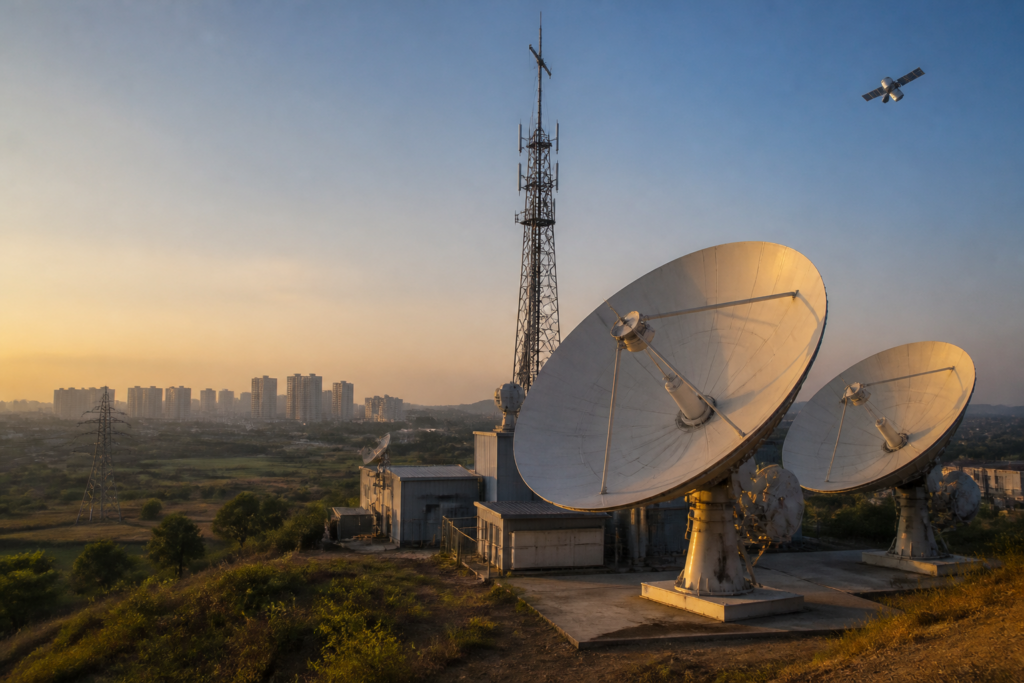
For operators, the distinction between a licence, security clearance and spectrum access is commercially significant. A company may have satellites in orbit and ground infrastructure ready, but that does not mean it can provide services to customers. The report’s account of Airtel’s prepared network illustrates this gap between physical readiness and regulatory permission. Infrastructure can be built in advance, but it remains commercially inactive until the relevant approvals are completed.
This also creates a planning challenge for policymakers. If the process takes years, companies may commit capital without a clear launch timetable. If the rules are insufficiently explained, delays can become a source of public suspicion, particularly when the applicants include powerful domestic groups and a globally visible entrepreneur. The government’s assertion that the process is transparent will therefore need to be matched by a process that is understood as consistent by all applicants and stakeholders. The supplied report does not provide a detailed timeline for each application or identify the precise stage reached by each company, so the comparative status of the applicants remains unclear.
The infrastructure question is equally important. Satellite connectivity is often presented as a solution for places where terrestrial networks are difficult to deploy. The report refers to remote and mountainous areas and villages with limited internet access. Those locations may benefit from an alternative connection system, but the report does not establish how many users will be served, what prices operators may charge or how satellite services will interact with existing mobile and fibre networks. The promise of wider coverage is therefore clear, while the eventual scale and affordability of access remain unestablished in the supplied material.
The market is also connected to a broader expansion of digital infrastructure. The report says Airtel is preparing to increase its data-centre capacity from about 300 megawatts to one gigawatt, with expansion planned in southern India, Mumbai and the Delhi region. It is also pursuing sovereign cloud services for Indian companies, government agencies and defence forces, with emphasis on data security and national control. These details place satellite internet within a wider corporate and institutional push around connectivity, computing capacity and data sovereignty.
That wider context matters for cities as well as remote regions. Urban digital systems increasingly depend on data centres, cloud platforms and communications networks, while rural and difficult terrain may depend more heavily on alternative connectivity systems. The report does not claim that satellite internet will replace fibre or mobile networks. Instead, it presents satellite services as one part of a layered infrastructure system in which different technologies address different geographic and operational constraints.
The dispute also demonstrates how telecom regulation can become a public governance issue. Musk’s criticism, Gandhi’s response and the BJP’s defence have turned an administrative process into a political and corporate controversy. Yet the evidence supplied in the report supports a narrower conclusion: several companies are waiting for approvals, and the government says the same security and spectrum-related requirements apply across the field. Whether that framework is implemented consistently will matter more than the rhetoric surrounding any one company.
For citizens, the practical question is when satellite internet services will actually become available, where they will be offered and at what cost. For companies, the question is whether regulatory decisions can be anticipated sufficiently to justify infrastructure investment. For government, the challenge is to balance security and spectrum management with the need to expand connectivity. The report confirms the existence of competing applicants and prolonged waits, but it does not establish a final approval date for Starlink, Airtel-linked Eutelsat OneWeb or Jio Satcom.
India’s satellite internet story is therefore not only about Musk’s confrontation with Indian business leaders. It is also a test of how the country administers a new infrastructure market in which space assets, telecom networks, spectrum, security and digital access intersect. The next decisive developments will be the completion of pending approvals, the government’s spectrum decisions and the point at which any operator receives permission to begin commercial services.


