

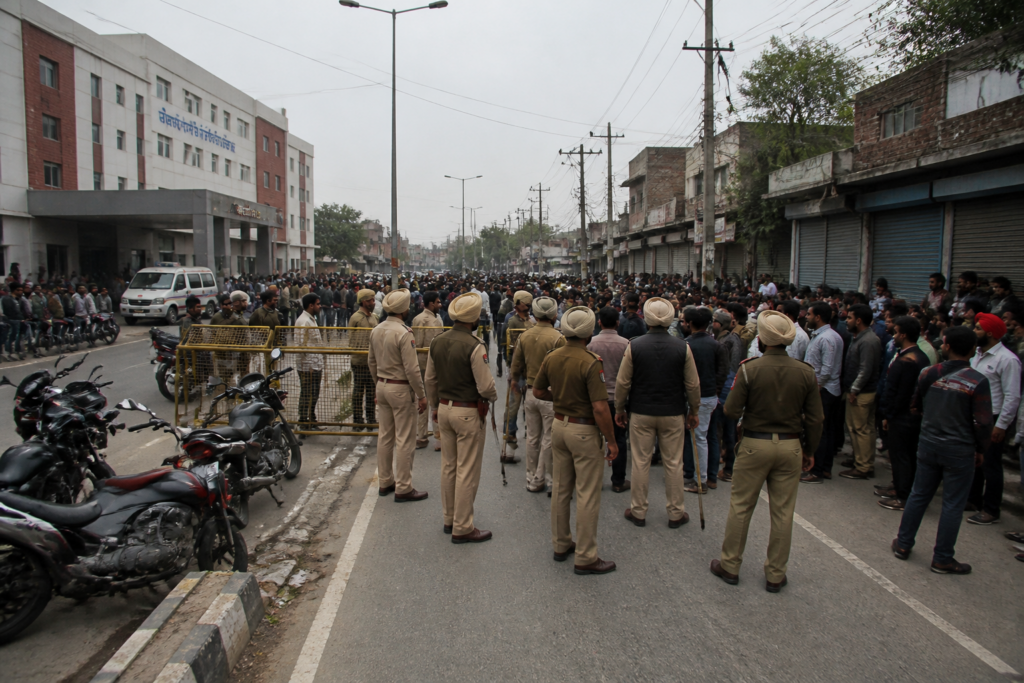
The killing of Punjab anti-drug activist Parminder Singh Jhota during a confrontation at a medical store in Mansa has become more than a murder investigation. It has exposed the difficult space where drug control, public safety, political accountability and local civic order meet. Protests have shut businesses and blocked the Barnala-Sirsa Road, while the refusal of Jhota’s father to cremate his son until the alleged killer is arrested has turned the case into a wider test of institutional credibility.
According to the Times of India report, Jhota was shot dead on Monday morning by chemist Ashwani Kumar, whom he suspected of selling synthetic drugs, commonly referred to locally as chitta. The confrontation was broadcast live on Facebook. The footage reportedly showed Kumar following Jhota as he moved into the street and took refuge in a shop before firing repeatedly. Jhota suffered three bullet wounds and died at Mansa Civil Hospital. Four other people were injured by bullets or splinters.
The immediate facts establish a breakdown of public safety at a commercial premises in a town that has now become the centre of a major law-and-order confrontation. The incident was not described as a random attack. Police said Jhota and Kumar had a bitter history, including an earlier confrontation in 2023 when Jhota allegedly paraded Kumar through a bazaar with a garland of shoes while accusing him of selling drugs. Cases were registered against both men. Jhota was arrested on charges including assault, trespass and rioting, and was later released after the complainant approached the court to withdraw the complaint.
That history matters because it shows how a dispute connected to alleged drug sales moved through several different systems without reaching a settled institutional resolution. The earlier case involved police action, the courts, public protest and the release of the accused activist. The current case has again brought all those institutions into view, but after lethal violence. The supplied report does not establish whether any authority had formally adjudicated the allegations against Kumar before the shooting. It does state that the case against him over the alleged sale of prohibited substances remained pending.
Jhota’s activism also appears to have operated partly outside formal enforcement structures. The report says he continued raising concerns about medical stores allegedly selling intoxicating pills and synthetic drugs. On the morning of the shooting, he had reportedly met an elderly man who had bought synthetic drugs from a medical store and brought him to Kumar’s pharmacy to question the chemist. The confrontation then escalated, with Jhota going live on social media before Kumar allegedly pulled out a pistol.
This sequence raises a central governance question: what happens when citizens attempt to perform a public enforcement role because they believe formal systems are not responding adequately? The report does not prove that authorities ignored complaints or that the state failed to act in this particular case. It does, however, document a pattern in which allegations about drug availability, public confrontation, protest and policing became intertwined. The result was not only a death but also a public crisis involving roads, markets, hospitals and political institutions.
The response at Mansa Civil Hospital illustrates how quickly a criminal case can become a civic-order issue. A crowd gathered at the hospital and clashed with police while demanding that Jhota’s body be taken to the protest site. Businesses shut down and protesters blocked the Barnala-Sirsa Road. These actions affected the functioning of public space and movement beyond the immediate location of the shooting. A hospital, a commercial market and a major road were drawn into the dispute, demonstrating how local conflicts can disrupt essential urban and regional systems.
The police response has so far been framed around the promise of rapid arrest. Bathinda DIG Harjit Singh said the murder stemmed from personal enmity and promised that the accused would be arrested within 24 hours. Police detained Kumar’s cousin for allegedly helping him escape. The report says Kumar fled after returning to his shop after the shooting. These details make the investigation’s first test clear: whether the police can establish the sequence of events, secure evidence from the live broadcast and crime scene, identify the alleged escape assistance, and present a legally sustainable case.
The distinction drawn by police between personal enmity and the anti-drug campaign is also politically significant. State finance minister Harpal Singh Cheema and AAP Punjab president Aman Arora condemned the murder and described it as stemming from personal enmity. Opposition parties, however, connected the killing to broader concerns about the government’s law-and-order record and its Yudh Nasheyan Virudh anti-drug campaign. Congress Leader of Opposition Partap Singh Bajwa also referred to the recent suicide of Gulzar Singh and the suicide attempt by Jagseer Singh, alias Jagga, arguing that these cases should be viewed in the context of concerns over drug availability in Punjab.
Those political claims should not be treated as established findings about the killing. The supplied report does not provide independent evidence linking the other cases to Jhota’s death, nor does it establish the scale of drug sales alleged by the activist. But the political reaction shows why the case has acquired significance beyond Mansa. A government campaign against drugs is judged not only by arrests or public messaging, but also by whether residents believe complaints can be made safely, whether suspected illegal activity is investigated through lawful channels, and whether public institutions retain control over disputes.
The case also demonstrates the limits of social media as a substitute for institutional process. Jhota’s confrontation was broadcast live, making the violence visible and allowing the public to see part of the sequence. That visibility can preserve evidence and accelerate public attention. It can also turn a volatile dispute into a public performance, with an audience, immediate political reaction and pressure for action before the investigation is complete. The report does not establish Jhota’s intentions in going live or the circumstances in which the confrontation escalated. It does show that a conflict which might once have remained local became instantly accessible to a much wider audience.
For city and district administrations, the immediate challenge is not limited to arresting the alleged shooter. The authorities must also manage the consequences in public spaces, protect hospitals and transport routes from confrontation, and communicate clearly with the family and protest groups. The report records a clash at the hospital and a blockade of the Barnala-Sirsa Road, but it does not detail the administration’s broader crowd-management plan or whether traffic diversions were put in place. Those omissions matter because public trust is shaped by what citizens see after a crisis: whether institutions appear coordinated, transparent and capable of maintaining essential services.
The institutional responsibilities in this case are divided. The police must investigate the shooting and alleged escape assistance. The courts must deal with the earlier cases and any new prosecution according to evidence. Health authorities treated the injured and documented the fatal wounds. The political executive must answer questions about the anti-drug campaign and law and order. Local administration must manage protests and prevent disruption to public services. The incident becomes a governance test precisely because no single institution can resolve all of these dimensions alone.
The available evidence confirms the killing, the injuries, the protests, the earlier dispute and the political responses attributed in the report. It does not establish whether the alleged drug-sale claims were true, whether the killing was legally connected to the anti-drug campaign, or whether broader claims about drug availability in Punjab can be substantiated from this case. Those questions require investigation, documentary evidence and judicial findings. Treating allegations as proven would undermine the same rule-of-law process that the protests are demanding.
The next stage will therefore be defined by official action rather than public statements. The promised arrest, the investigation into the alleged escape route, the treatment of the four injured people, the handling of the pending case against Kumar and the administration’s engagement with Jhota’s family will determine whether the state can move the matter from street confrontation to due process. For Mansa, the deeper issue is whether citizens can trust formal institutions to address drug-related complaints before private enforcement, public anger and violence fill the vacuum.


