

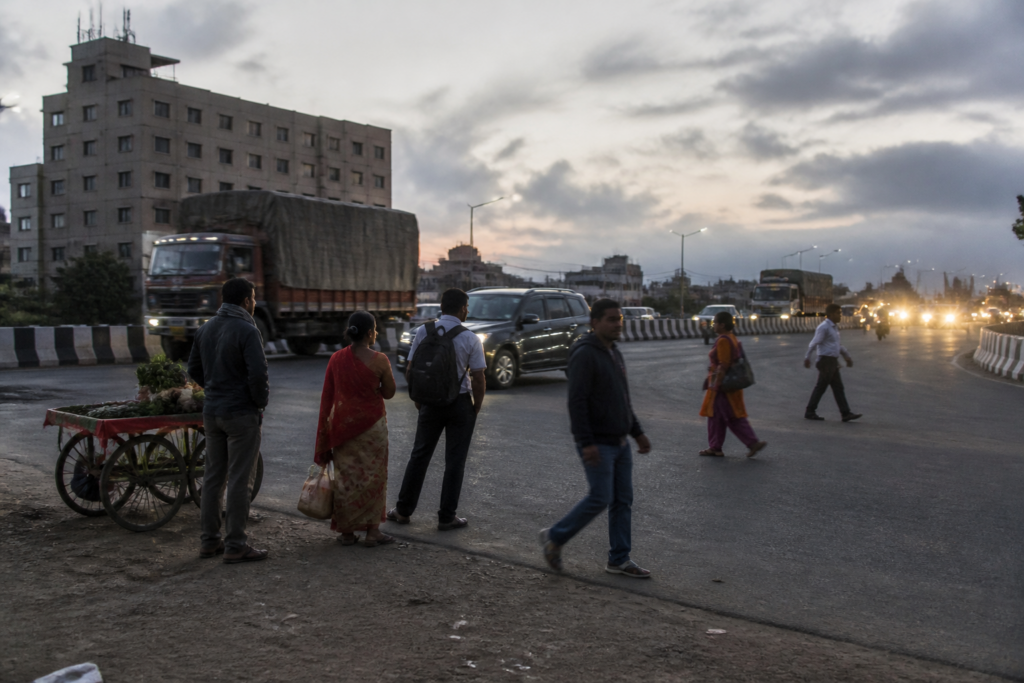
The death of 62-year-old vegetable vendor Latabai Dattatray Raskar after she was hit while crossing the Pune-Solapur Highway near Loni Kalbhor exposes a basic urban safety failure: a major transport corridor is also being used by people who need to cross it on foot to earn a living and reach nearby settlements. The available account records the collision, the victim’s treatment and the subsequent police complaint, but it also leaves important questions about pedestrian protection and road design unanswered.
The accident took place at around 7 pm on October 4 in front of Shaurya Hostel at Loni Kalbhor. Raskar, a resident of Malimal, was crossing the highway with a security guard when a white Tata Curvv EV travelling from Pune towards Solapur allegedly struck her. She suffered serious injuries to her chest and both knees and was taken first to Shantai Hospital in Loni Kalbhor. After her condition remained critical, she was shifted to Shivam Hospital in Phursungi on October 5 and later taken to Sassoon Hospital in Pune, where doctors declared her dead at about 10.45 pm.
The sequence matters because the crash was not simply an interaction between two vehicles. It occurred at a location where a pedestrian and a security guard were attempting to cross a highway in the evening. The report does not state that the site had a pedestrian crossing, foot overbridge, signalised junction, median refuge or other dedicated arrangement. It also does not record whether the road was illuminated, whether warning signs were present or whether traffic-calming measures existed near the hostel. Those details are not minor omissions. They determine whether a road has been planned only for vehicle movement or also for the people who live, work and move alongside it.
### What the Pune-Solapur Highway accident reveals
The victim’s occupation adds another layer to the incident. Raskar sold vegetables to support her family. For street vendors and other informal workers, mobility is part of the livelihood system: they must reach markets, customers, storage points and homes, often using roads that were designed primarily for faster through-traffic. The supplied report does not establish where Raskar had been selling vegetables or why she was crossing at that precise location. It does, however, establish that a local resident and worker was using the highway as part of ordinary daily life.
This is the central planning tension. A highway can perform its regional transport function while still cutting through populated areas. Once hostels, homes, shops, workspaces or informal markets develop along the corridor, people need to cross it regardless of how the road is classified. If safe crossing infrastructure does not keep pace with that settlement pattern, pedestrians are left to judge gaps in moving traffic. The risk is then treated as an individual failure, even though the underlying problem may involve the design and management of the corridor.
The account identifies the vehicle as a white Tata Curvv EV with registration number MH 16 DW 9107. The victim’s family alleged that the driver ignored traffic rules and drove negligently. Loni Kalbhor police are investigating the case against the driver, who was described in the report as unidentified at the time of the complaint. These allegations remain subject to investigation and should not be treated as established findings before the police process is completed.
### The significance of the nine-day delay
A complaint was filed at Loni Kalbhor police station on October 13, nine days after the crash and after the family had completed the funeral and other rituals. The delay does not by itself establish negligence by the family, police or driver. The source does not explain why the complaint was filed later, whether the driver had been traced earlier, or whether any preliminary report was recorded immediately after the collision.
But the timeline is institutionally important. In a road-death investigation, the period immediately after a crash can be critical for identifying the vehicle, locating witnesses, examining the site and preserving available evidence. The supplied report says citizens took Raskar to hospital, but it does not say whether police reached the spot, whether CCTV footage was collected, whether the highway operator was contacted or whether an eyewitness account was formally recorded at the time.
The complaint names the registration number of the car. That could provide investigators with a direct lead, but the source does not state whether the vehicle or driver has been located, whether the car has been inspected, or whether a case has been registered under specific provisions of law. Those are the next factual milestones that will determine how the incident is officially classified and pursued.
The delay also points to the difference between a road crash and a road-safety case. A crash is an event. A road-safety case requires a chain of actions: emergency medical response, police documentation, vehicle identification, scene examination and review of the location itself. When the investigation focuses only on the driver’s conduct, the physical conditions that made the collision possible may receive less attention. The available report does not indicate whether authorities plan to examine the crossing point as a recurring hazard.
### A corridor used by different kinds of road users
The Pune-Solapur Highway carries regional traffic, but the reported location also serves people on foot. The presence of Shaurya Hostel and the involvement of a security guard show that the road is embedded in a lived environment rather than isolated from surrounding activity. The report does not provide traffic counts, speed measurements or a history of previous crashes at the site, so it is not possible to determine from the supplied evidence whether this was a recurring black spot.
That information gap is itself relevant. Without a site-level assessment, authorities cannot establish whether the collision was an isolated incident or part of a broader pattern. A proper review would need to clarify the crossing demand, the location of nearby pedestrian generators, road lighting, lane configuration, visibility, vehicle speeds and the availability of alternative crossings. None of these facts is provided in the source, and they should not be inferred from a single fatality report.
The incident also illustrates why pedestrian safety cannot be assessed only through vehicle technology. The car involved was an electric vehicle, but the source does not connect the vehicle’s powertrain to the crash or identify any technical defect. The relevant documented issues are the collision, the alleged speed and negligent driving, the location and the absence of reported details about pedestrian facilities. The focus should therefore remain on road-user behaviour, enforcement and corridor design rather than on the vehicle being electric.
### What remains for authorities to establish
Loni Kalbhor police are conducting further investigation. Their work will need to establish the circumstances of the collision, identify and question the driver, examine the vehicle and collect available witness or camera evidence. The investigation may also clarify whether the car’s registration details were correctly recorded and whether any action was taken immediately after the crash.
For the road-owning and traffic authorities, the next question is whether the crossing point requires a safety audit. The supplied material does not identify the agency responsible for the stretch, so responsibility cannot be assigned here. However, the location should be assessed in relation to pedestrian movement, especially because the incident occurred near a hostel and involved a local vendor crossing in the evening.
The evidence currently confirms one fatal collision, a serious injury sequence ending in death, a complaint filed nine days later and an ongoing police investigation. It does not establish the driver’s final liability, the precise speed of the vehicle, the condition of the road or whether the site had adequate pedestrian infrastructure. Those facts must come from the investigation and any official road-safety assessment.
The larger urban question is whether people living and working along highways are being treated as legitimate road users. Until that is answered at locations such as Shaurya Hostel, pedestrian crossings will remain informal decisions made in moving traffic, while accountability will begin only after another death has occurred.


