

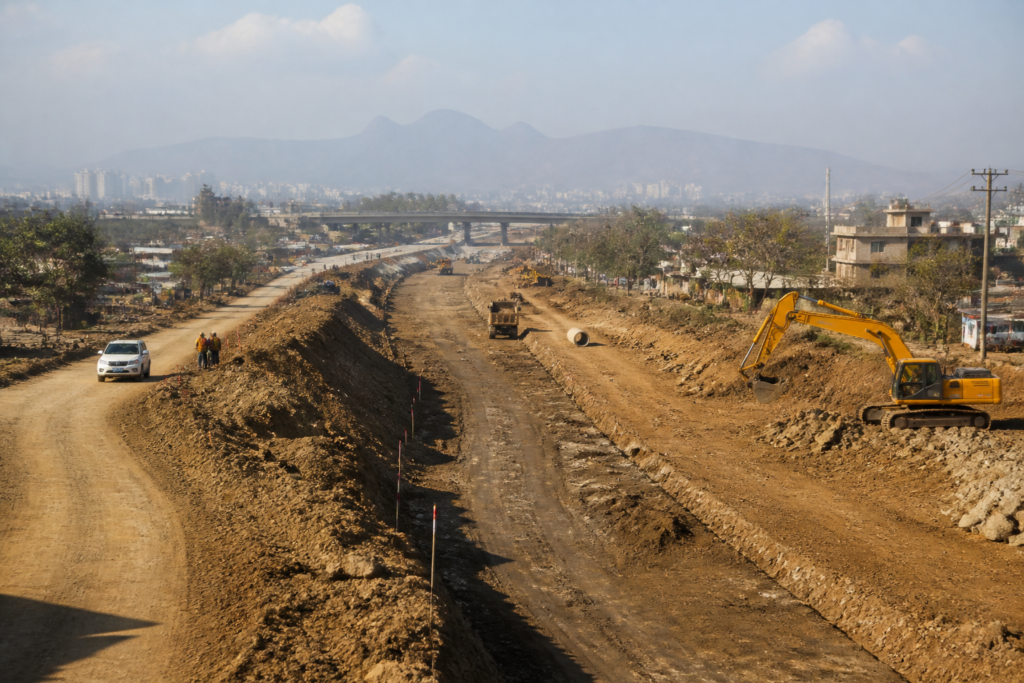
The Pune Ring Road has become more than a transport project delayed by institutional priorities. With Maharashtra transferring a key stretch from the National Highways Authority of India (NHAI) to the Maharashtra State Road Development Corporation (MSRDC), the project’s estimated cost is set to rise to Rs 53,213.39 crore. The decision reveals how the state’s plans for relieving congestion are increasingly tied to questions of who will build the road, who will acquire the land and how much fiscal space remains to pay for it.
The Cabinet sub-committee on infrastructure approved a revised administrative sanction of Rs 10,502 crore on August 18, 2026, for civil works and land acquisition. The additional amount follows the transfer of a package that had originally been assigned to the NHAI. According to the government resolution cited in the report, the NHAI had not taken up the stretch on a priority basis, while the MSRDC was already incurring expenditure on land acquisition.
The stated logic is administrative as well as operational. The state government has argued that the remaining land acquisition and construction must proceed through the MSRDC so that the ring road can be completed in the configuration approved by the Centre. The resolution also refers to the financial viability of the project and the need to fulfil the ring road’s intended objective. In effect, the state has chosen to assume a larger financial and implementation role rather than leave the package tied to an agency that had not prioritised it.
That decision changes the character of the project. The Pune Ring Road was conceived as a system of eastern and western stretches intended to ease traffic congestion in and around the city. It is not a single short urban road but a large-scale regional mobility project involving multiple connections to major highways and roads. The eastern stretch runs from Urse on the Mumbai-Pune Expressway to Solu on the Alandi-Markal road, and from Solu to Sortapwadi on the Pune-Solapur road. The western stretch runs from Urse to Varve Budruk on the Pune-Satara road.
The project’s cost history shows how quickly the financial scale has expanded. In September 2021, the 68.19-km eastern stretch was estimated to cost Rs 10,159.82 crore. By 2024, its length had been revised to 72.335 km and its estimated cost had risen to Rs 19,932.98 crore. The western stretch’s estimated cost increased from Rs 12,176 crore in September 2021 to Rs 22,778.05 crore in 2024. A separate cost escalation approved by the state Cabinet in 2024 had already taken the overall project cost to Rs 42,711.03 crore. The latest sanction adds another Rs 10,502 crore.
These figures do not describe only ordinary construction inflation. The source links the latest increase to a change in institutional responsibility, with the MSRDC taking on land acquisition and construction for the transferred package. The project therefore illustrates a recurring administrative problem in large infrastructure: a road’s final cost is shaped not only by its physical length and engineering requirements but also by the division of responsibility between agencies.
Land acquisition is particularly important in this case because the MSRDC is already spending on acquiring land for the stretch. The road cannot serve its intended function if only some packages move ahead while the transferred section remains unresolved. At the same time, taking responsibility for land and construction places a larger burden on the state corporation and, ultimately, on the state’s public finances. The government resolution’s reference to financial viability indicates that the project is being considered not just as a traffic solution but as a financial undertaking whose costs must be justified against its intended benefits.
The alignment also overlaps with another major transport proposal. A 31.805-km stretch is shared by the proposed Pune-Chhatrapati Sambhajinagar Greenfield Expressway and the eastern ring road. The NHAI alignment intersects the eastern ring road at Valti village near Sortapwadi and terminates near Shivare village on National Highway 48. This shared section means that decisions on one corridor have implications for the other. It also makes coordination between agencies central to the project’s delivery, because separate road proposals are connected through a common alignment.
The Pune Ring Road’s urban significance lies in its intended relationship with the city’s growing traffic system. Its eastern and western connections are designed to provide an alternative route around Pune and its surrounding areas. The source, however, does not provide traffic counts, projected diversion figures or a revised completion schedule. What it does establish is that the government considers completion necessary for the ring road to serve its approved purpose. The available evidence therefore confirms the project’s strategic role but does not establish how much congestion will be reduced or when residents can expect the full benefits.
The fiscal setting makes the new sanction more consequential. Maharashtra’s outstanding public debt is projected to reach Rs 11.02 lakh crore in 2026-27, while the revenue deficit for the year is estimated at Rs 40,552 crore. The state has projected a fiscal deficit of Rs 1,50,491 crore, or 2.8 per cent of Gross State Domestic Product, and a revenue deficit of 0.7 per cent of GSDP.
These numbers do not mean that the ring road’s approval is financially impossible, nor does the supplied material establish how the additional expenditure will be financed. They do show that the project is being advanced alongside substantial competing commitments. The state has cited the Majhi Ladki Bahin scheme, which provides Rs 1,500 per month to eligible women; the Punyashlok Ahilyadevi Holkar farm loan waiver scheme; and assistance of Rs 5,000 per farmer in 304 of Maharashtra’s 358 tehsils where a drought-like situation has been declared.
That combination highlights the distinction between capital infrastructure and recurring or relief-oriented expenditure. A ring road requires large upfront commitments for land and construction, while welfare and agricultural support schemes create demands on the state budget through other channels. The source does not quantify the share of the Rs 53,213.39-crore project cost that has already been spent or specify the annual payment schedule. It does, however, place the latest approval within a budget environment where infrastructure competes with social and rural commitments.
The transfer from NHAI to MSRDC also raises a question about the governance of regional infrastructure in Maharashtra. NHAI involvement can connect a state road project to national highway planning, while MSRDC is a state-level implementing agency already involved in the ring road’s land acquisition. The change may allow the state to move a stalled package through an agency already active on the ground. But it also concentrates more responsibility for delivery and expenditure within the state’s institutional framework.
The government’s stated justification is therefore centred on execution: NHAI did not take up the stretch on a priority basis, MSRDC was already incurring land-acquisition expenditure, and the ring road’s approved configuration needed to be completed. The evidence does not establish whether the transfer will produce faster construction, lower future costs or a revised deadline. Those questions will depend on subsequent land-acquisition progress, construction contracts and implementation decisions, none of which are detailed in the supplied report.
The project’s history shows why administrative decisions matter to citizens even when they appear as budget revisions. For residents and businesses around Pune, a ring road is ultimately experienced through travel times, freight movement, access to highways and the pattern of development around new corridors. Yet before those effects can occur, the project must pass through land acquisition, alignment coordination, agency responsibility and funding decisions. The latest sanction addresses one institutional blockage by assigning the work to MSRDC, but it also increases the state’s exposure to the project’s rising cost.
The central fact is clear: Maharashtra has approved an additional Rs 10,502 crore and raised the expected Pune Ring Road outlay to Rs 53,213.39 crore after shifting a key NHAI package to MSRDC. The larger significance is that Pune’s congestion-relief infrastructure is now also a test of state capacity to coordinate agencies and sustain major capital commitments while managing a projected debt burden, revenue deficit and competing public programmes. The next developments to monitor are land-acquisition progress, construction mobilisation, coordination on the shared 31.805-km alignment and any official timeline for completing the transferred stretch.


