

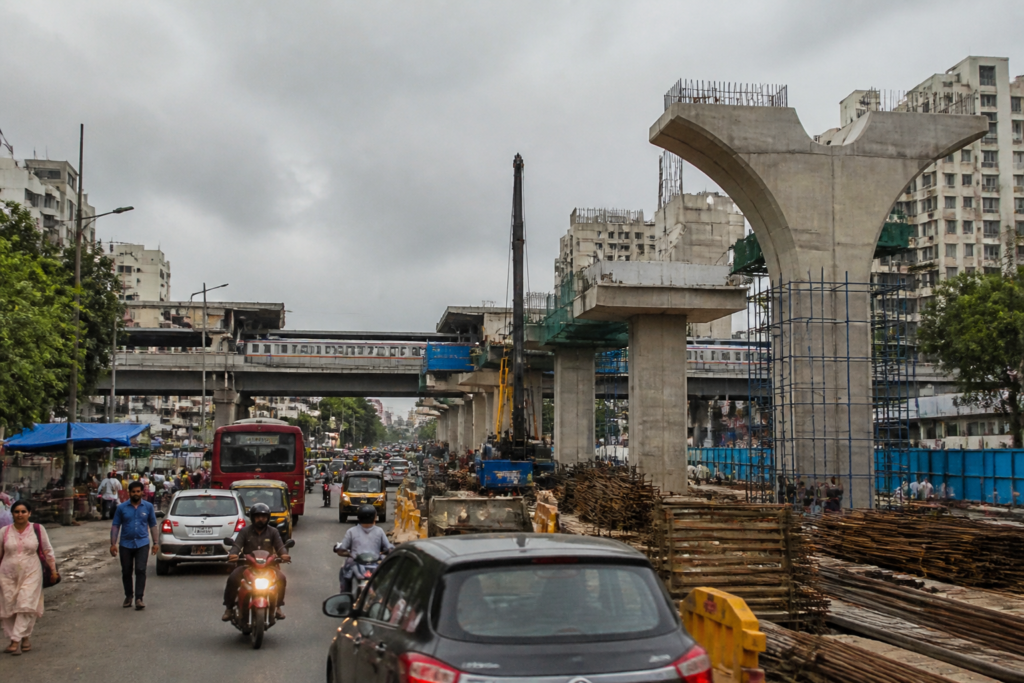
Mumbai’s JVPD flyover is being built around a simple promise: reduce a peak-hour journey through one of the western suburbs’ most congested areas from about 45 minutes to 20. But the project’s significance lies beyond that headline figure. By linking the end of the CD Barfiwala flyover with the Juhu Versova Link Road, the proposed structure is intended to bypass five traffic junctions and reorganise how vehicles move through Juhu, Vile Parle West, Andheri West and Versova.
The Brihanmumbai Municipal Corporation rolled out plans for the flyover in 2022 to address traffic congestion around the Juhu Vile Parle Development Scheme circle. The project is now expected to be commissioned for vehicular use by December 2027. Its current deadline is December 31, 2027, revised from the earlier March 31, 2028 target.
That timeline places the project in the category of long-duration urban construction rather than a quick junction improvement. For commuters, the promised benefit will arrive only after the structure, approach connections, utility relocations and work around existing infrastructure are completed. Until then, the same corridor will have to accommodate construction activity alongside daily traffic.
The proposed alignment begins at the end of the CD Barfiwala flyover and runs up to the Juhu Versova Link Road. According to the details reported by The Indian Express, it will bypass the JVPD circle and four other congested traffic junctions. The stated objective is to remove repeated stops from the route rather than improve only one intersection.
This is an important distinction in a built-up urban corridor. Traffic delays are often produced not by one isolated crossing but by the cumulative effect of several junctions, turning movements and constrained road space. The BMC’s stated estimate suggests that removing these interruptions could reduce the total peak-hour travel time by roughly 25 minutes. The estimate, however, is presented as an expected outcome after completion, not as an operating result that has already been demonstrated.
The project also shows why flyover construction in Mumbai is rarely limited to placing a deck above an existing road. The structure will be 15.10 metres wide and includes a 72-metre-long bridge at the 90-feet junction. It will require the installation of girders beneath a metro station using special technology, as well as a long span at Juhu Circle with minimal pillars.
These design requirements reflect the constraints of an already occupied transport corridor. A long span with fewer pillars is intended to reduce obstruction at the junction below, while work beneath a metro station requires construction to be coordinated with existing urban infrastructure. The supplied project details do not specify the technology being used or the metro station involved, but they indicate that the flyover’s engineering is being shaped by infrastructure that is already in place.
Drain relocation is another major component. The project requires the relocation of 600 mm and 900 mm diameter drains over 400 metres. A 1,200 mm diameter drain is to be relocated through microtunnelling. These works are not visible in the final road profile, but they are central to whether the flyover can be constructed without leaving conflicts between the new structure and underground civic utilities.
The utility work also reveals a less visible aspect of Mumbai’s transport projects. A flyover may be judged by its length, width or traffic capacity, but its delivery depends on coordinating road engineering with drainage infrastructure and existing transit facilities. The project’s deadline therefore represents not only a construction target for the bridge but also a target for resolving these underground and above-ground interfaces.
The BMC has linked the flyover to a wider road network. An arm is proposed to connect it to the upcoming Versova Bandra Sea Link, offering direct connectivity to the coastal road. The available project information does not establish the construction status, opening schedule or final operating arrangements for that connection. What it does establish is that the JVPD flyover is being planned as part of a larger sequence of western-suburb links rather than as a standalone crossing.
That network role is central to understanding the project’s potential effect. The flyover is expected to connect two busy routes and remove five junctions from the path of vehicles travelling from the western suburbs. Its usefulness will therefore depend on how efficiently traffic enters the structure, exits towards the Juhu Versova Link Road and connects with the wider road system. The supplied information provides the travel-time estimate but does not include traffic-volume projections, lane allocation, pedestrian arrangements or details of how congestion might shift to the approaches.
Those omissions matter because bypassing a junction does not automatically eliminate congestion across a corridor. The project’s stated purpose is to make movement through the JVPD area more efficient, but the available material does not provide a post-completion traffic model or a before-and-after assessment framework. It is therefore possible to establish the intended benefit, but not yet to measure how traffic will redistribute once the flyover opens.
The official case for the project rests on its effect on several neighbourhoods. Abhijit Bangar, Additional Municipal Commissioner (Projects) at the BMC, said peak-hour travel on the route currently takes about 45 minutes and is expected to fall to about 20 minutes after completion. He said the flyover would provide “major relief” to road traffic in Juhu, Vile Parle West, Andheri West and Versova and make transport in the western suburbs more efficient.
The statement identifies the project’s primary public measure: time saved by road users. It also makes clear that the BMC is treating the flyover as a corridor-level intervention, with benefits expected across multiple localities. The evidence supplied does not include commuter surveys, pedestrian impact assessments or information on public transport users, so the documented benefit is currently framed around vehicular travel.
The project’s administrative history also points to the importance of deadline management. Plans were rolled out in 2022, the earlier deadline was March 31, 2028, and the current target is December 31, 2027. The revised date indicates a change in the formal completion schedule, but the supplied report does not explain the reasons for the revision or provide details on progress achieved so far.
For residents and commuters, the next meaningful milestone is not simply the announcement of the target date. It is whether the BMC can complete the bridge works, the metro-interface construction, the long-span section and the drainage relocations within the revised schedule while maintaining movement through the corridor. The project’s urban test will be whether the promised 20-minute peak journey becomes an actual and sustained operating condition after commissioning.
The JVPD flyover therefore represents both a concrete congestion intervention and a test of Mumbai’s ability to build new road capacity around existing transport and utility systems. The available evidence confirms the alignment, major engineering requirements, expected travel-time reduction and current completion target. It does not yet establish how traffic will behave after opening, how non-vehicular users will be affected or whether the wider sea-link connection will be ready at the same time. Those are the developments that will determine whether the flyover delivers a faster corridor or merely shifts pressure to the next junction.


