

The Perumbavoor bypass was conceived to ease movement around one of Ernakulam district’s congested urban centres, but its slow construction is exposing a larger problem: building a new road does not automatically resolve traffic when land acquisition, funding, junction management and network planning remain unfinished.
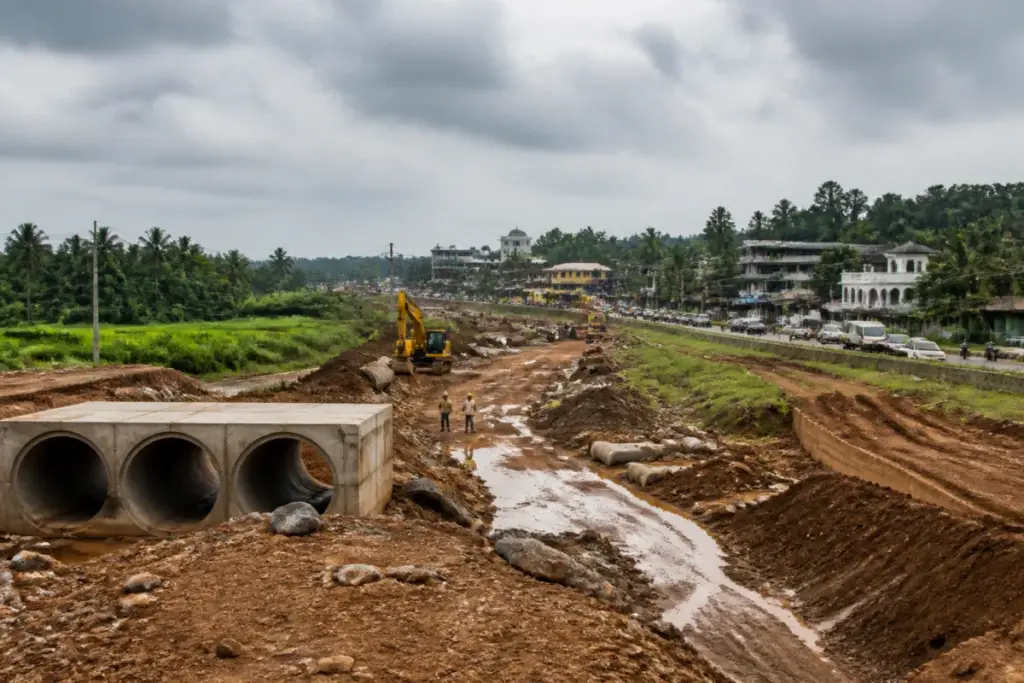
According to a report by Mathrubhumi – Kochi, work on the first 1.5-kilometre phase began in November 2024 and is officially expected to be completed by April 2027. However, the pace of work on the ground has raised doubts about whether that deadline can be met. The report says only a small number of workers are present, with work taking place on one or two days a week.
The project has been discussed for about two decades and was presented as a major development initiative when construction began. Its first phase runs from Maruthukavala on the Aluva–Munnar Road to near the Kanjiramukku bridge on the Old Muvattupuzha Road. The four-kilometre bypass is planned as a four-lane road with a width of 25 metres, crossing paddy-field areas and connecting several important road corridors around the town.
The project’s immediate difficulty is not simply a shortage of labour. The first phase includes five culverts, of which four have been completed. The fifth requires a revised design after the soil was found to contain a high proportion of clay. The redesign is expected to require approximately ₹4.5 crore in additional funding. The amount has reportedly been sought from the Kerala Infrastructure Investment Fund Board, or KIIFB, but delays affecting KIIFB projects could slow the release of money.
This sequence illustrates how infrastructure timelines can be disrupted after construction has already begun. A road may have a sanctioned alignment and a publicly stated completion date, yet ground conditions can force redesign, additional expenditure and a fresh wait for financial approval. Until the revised design and funds are cleared, the first phase cannot move at the pace implied by its official schedule.
The second phase presents an even more fundamental challenge. It is planned to run from Kanjiramukku, across the MC Road, to Palakkattuthazham on the AM Road. Land acquisition for this section has not begun, even though land belonging to 60 people has been identified for the proposed road. As a result, the bypass is not yet a continuous project in implementation terms: the first phase is under construction while the land and alignment requirements of the second phase remain unresolved.
The distinction matters because the bypass’s usefulness depends on the functioning of the entire route, not only on the completion of its first segment. A partial road can provide a limited connection, but it cannot deliver the full traffic-distribution effect promised by a network that links the Aluva–Munnar Road, the Old Muvattupuzha Road, the MC Road and the AM Road. The available report does not establish what traffic volume the first phase alone is expected to carry or whether it has an independently defined operational purpose.
### A bypass cannot substitute for a citywide traffic plan
The report also records a long-standing local concern that the project may not significantly reduce congestion in Perumbavoor even after completion. The argument is that the MC Road, where traffic has increased, needs a bypass more urgently. That demand was raised from the beginning of the project but did not determine the final scheme.
This is a classic urban-planning problem. A bypass is often judged by the length of road built or the number of structures completed. Drivers, however, experience a road network rather than a single project. If traffic is diverted from one corridor but still enters a crowded town centre through another approach, congestion may shift rather than disappear. The outcome depends on how the new road connects to existing routes, where vehicles are permitted to turn, and whether junctions can process the additional movement.
Perumbavoor’s planned road network has already moved through several competing ideas. The AM Road is proposed for widening to four lanes, but the plan is intended to avoid the town centre and use the bypass instead. Earlier discussions also considered a ring road around the town. Those discussions are continuing, according to the report. The absence of a settled, integrated network strategy makes it difficult to assess the bypass as an isolated investment.
The project therefore raises an institutional question: which agency or combination of agencies is responsible for ensuring that separate road projects operate as one mobility system? Construction may be divided into phases and funded through different decisions, but congestion does not follow those administrative boundaries. A bypass, a road-widening project, a ring road and junction controls must be aligned if they are expected to produce a common traffic benefit.
### Junction management is the missing short-term intervention
While the bypass remains under construction, Perumbavoor’s immediate congestion problem is visible at the vegetable market junction. A yellow box was painted there three years ago to prevent vehicles from entering the junction when they cannot move forward. The marking is intended to keep the intersection clear, but the report says vehicles frequently enter the box, either because drivers are unaware of the rule or because enforcement and public education are inadequate.
The resulting blockage begins at the junction and spreads to the AM Road and KSRTC Road, eventually affecting traffic across the town. This is important because it shows that congestion is not only a question of road capacity. The way existing capacity is managed can determine whether a road network functions at all.
A yellow-box marking is a relatively low-cost traffic-management measure compared with a four-kilometre bypass. But it requires consistent enforcement, clear lane discipline and public communication. If those supporting measures are absent, the marking remains a painted surface rather than an effective junction-control system. The report says authorities have not made sufficient efforts either to educate road users about the rule or to enforce it strictly.
That gap creates a mismatch between long-term capital construction and short-term urban management. Large infrastructure projects may take years, particularly when they involve paddy-field construction, soil problems, redesigns, additional funding and land acquisition. Junction enforcement can be implemented much faster, yet weak day-to-day management continues to impose costs on residents, businesses, public transport users and emergency movement.
### The project’s real test is coordination
The Perumbavoor bypass has a clear physical proposition: a four-kilometre, 25-metre-wide road intended to create an alternative route around the town. But the evidence in the Mathrubhumi report shows that its delivery depends on several unresolved conditions. The first phase faces a design and funding issue at its fifth culvert. The second phase has not entered land acquisition. The wider road strategy includes an AM Road widening plan and continuing discussions about a ring road. At the same time, a junction-level traffic rule is not being effectively implemented.
These are not separate inconveniences. Together, they determine whether the project becomes a functioning part of Perumbavoor’s transport system or remains a delayed road segment whose benefits are difficult to realise. The central urban question is not only when construction will finish, but whether the authorities are coordinating construction, finance, land acquisition and traffic operations around a single mobility objective.
The available report does not provide a revised completion date for the fifth culvert, a confirmed timeline for the additional ₹4.5 crore, or a schedule for acquiring the land required for the second phase. It also does not establish how traffic will be redistributed after each phase. Those milestones will be essential to judging whether the bypass can meet its stated purpose.
For now, Perumbavoor’s experience shows the limits of treating congestion as a road-building problem alone. The bypass may still become an important link, but its success will depend on whether the incomplete project, the surrounding road proposals and basic junction enforcement are brought together into one implementable plan.


