

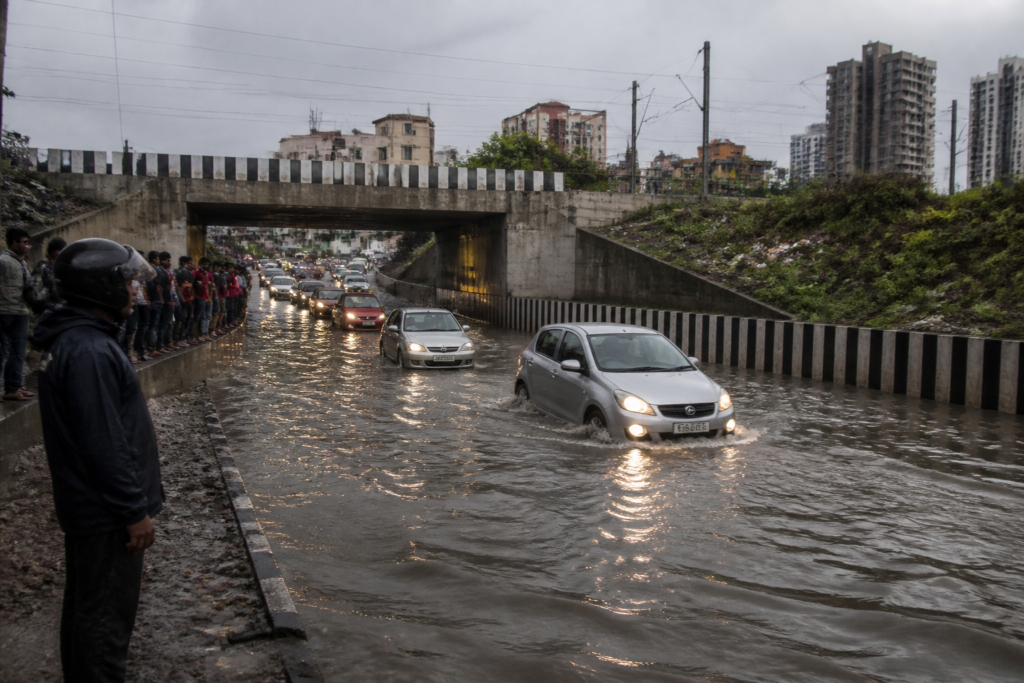
Rain on October 16 again flooded Bengaluru’s Panathur Railway Underbridge, leaving commuters stranded and partially submerging four-wheelers. The immediate event was a familiar monsoon disruption, but the recurrence points to a larger urban systems problem: a key road connection in east Bengaluru remains vulnerable because road levels, drainage capacity and maintenance have not been resolved together.
The flooding occurred as the northeast monsoon began making its presence felt in the city. According to India Meteorological Department data cited in the report, Bengaluru HAL airport recorded 10.5 mm of rainfall between 8.30 a.m. and 5.30 p.m., while Kempegowda International Airport recorded 8.8 mm. Bengaluru city recorded 1.2 mm during the same period. The figures indicate that the disruption occurred during a rainfall episode that was measurable but not described in the report as an extreme city-wide event.
That distinction is important. The Panathur incident was not presented simply as a case of unusually heavy rain overwhelming an otherwise functioning network. Residents said the underbridge has flooded repeatedly for years. The report identifies poor road infrastructure, drainage constraints and the road gradient around the railway underbridge as persistent factors. Water and blockages reportedly remained for several hours, disrupting daily movement.
Panathur’s vulnerability is closely connected to the role of the surrounding roads. The Varthur-Gunjur Road links Gunjur and Varthur with the Outer Ring Road, making the affected stretch part of an important east Bengaluru connection. When the underbridge floods, the impact is not confined to a short road segment. Commuters face delays at a point where local residential and employment-area movement converges with a larger metropolitan corridor.
The report also recorded rain-related congestion from Thubarahalli towards Marathahalli, as well as in areas around Chamarajapet, Seshadripuram and M.G. Road. These locations are geographically dispersed, so the supplied evidence does not establish that one drainage failure caused all the congestion. It does show, however, how rainfall can expose weaknesses across multiple parts of Bengaluru’s road network at the same time.
The most significant evidence in the Panathur case is its repetition. A one-off inundation can be linked to an unusual weather event, an isolated obstruction or an emergency maintenance failure. A problem that residents say has continued for years raises a different question: whether the underbridge was designed, upgraded and maintained as part of an integrated drainage and road system.
Madhu M.S., a resident, said the underbridge had flooded repeatedly for years and disrupted daily commutes. He identified the road gradient and drainage constraints around the railway underbridge as challenges. Latha Ashok, another resident, said resident welfare associations had repeatedly approached the local MLA’s office but had not received satisfactory clarity on corrective measures or timelines.
Those accounts reveal an administrative gap as well as a physical one. Residents are not only reporting water on the road; they are also seeking clarity on who is responsible for fixing the problem, what work is proposed and when it will be completed. The supplied report does not identify a confirmed corrective project, a sanctioned cost, an implementing agency or a completion schedule. That absence limits what can be established about the government’s response, but it also explains why the issue continues to generate frustration each time it rains.
Urban flooding at an underbridge is rarely solved by removing water after it accumulates. The road gradient determines where runoff moves. Drainage capacity determines whether that runoff can be carried away. Blockages can reduce the effective capacity further. The underbridge itself can become a low point where water collects faster than it can be discharged. The report’s reference to all three conditions—gradient, drainage constraints and blockages—suggests that repeated flooding cannot be understood only as a question of rainfall intensity.
The Panathur case also shows why road and drainage planning cannot be treated as separate tasks. A road that connects residential areas to the Outer Ring Road may support daily commuting, but its performance depends on surrounding drains, culverts, approach roads and maintenance arrangements. If one component fails, the road’s practical capacity collapses even when the pavement remains physically present.
The institutional picture is less clear. The report refers to residents approaching the local MLA’s office, but an elected representative’s office is not necessarily the same as the agency responsible for road construction, storm-water drainage, railway coordination or traffic management. The supplied material does not specify which authority controls the Panathur Railway Underbridge or which agency is accountable for the drainage constraints described by residents. That uncertainty is itself relevant to the functioning of urban infrastructure: citizens may know where a failure occurs without knowing which institution can formally resolve it.
The rainfall data provides another layer of context. The IMD forecast cited in the report said light to moderate rainfall was very likely in parts of Bengaluru Urban and Bengaluru Rural, along with parts of south interior Karnataka, until October 22. The minimum temperature fell to 21.4 degrees Celsius, bringing relief from the unusual heat Bengaluru had been experiencing. Rain therefore produced two contrasting effects: it reduced heat stress while exposing transport and drainage vulnerabilities.
This contrast matters because urban infrastructure is tested by ordinary weather as much as by extreme events. If a relatively limited rainfall total can make an important underbridge unusable, the question is not only whether the city can respond to exceptional storms. It is whether critical road links can remain operational during recurring seasonal rain. The supplied report does not provide the engineering threshold for the underbridge, so no conclusion can be drawn about its formal design capacity. It does establish that the present arrangement has not prevented repeated disruption.
The social cost is experienced first by commuters. Partially submerged vehicles can be damaged, pedestrians may be forced to wait or take longer routes, and traffic queues can spread to approach roads. The report does not quantify travel delays, vehicle losses or the number of affected commuters. Even without those figures, the repeated nature of the disruption shows that the costs are borne by ordinary daily movement rather than by a single exceptional incident.
The Panathur flooding also illustrates the difficulty of judging infrastructure by its existence rather than its performance. A railway underbridge may complete a physical connection between two sides of a corridor, but if waterlogging repeatedly closes it, the connection is unreliable during a predictable season. Similarly, a drainage system may exist on paper while remaining ineffective because of inadequate capacity, poor gradients or blockages.
What remains unestablished is as important as what the report confirms. There is no identified official explanation for the flooding in the supplied material, no documented repair plan, no confirmed budget and no stated timeline. There is also no evidence here to determine whether the problem is controlled by a municipal body, a road agency, a railway authority or multiple institutions working together. These gaps should be resolved before any claim about responsibility or promised action is made.
For Bengaluru, the immediate test is whether the next rainfall forecast through October 22 produces another closure at Panathur and whether authorities communicate a specific response. The longer administrative test is more basic: whether repeated complaints can be converted into an identified agency, a technically defined intervention and a public timeline. Until that happens, the Panathur Railway Underbridge will remain a recurring point where the city’s road, drainage and accountability systems fail together.


