

The Nilgiris has spent decades identifying sickle-cell disease among its tribal communities, yet the district still cannot say with confidence how widespread the inherited blood disorder is. That gap reveals a larger weakness in public-health infrastructure: screening has expanded faster than the systems needed to maintain records, ensure follow-up and connect diagnosis with long-term care.
Researchers documented the first case of sickle-cell disease in India in the Nilgiris in 1952. More than seven decades later, district health data show that 340 people have been identified with the disease and another 1,650 people, including non-tribal residents, have been found to carry the sickle-cell trait. These numbers are important, but they are not a prevalence estimate. They represent people reached by screening programmes, not the total population living with the condition.
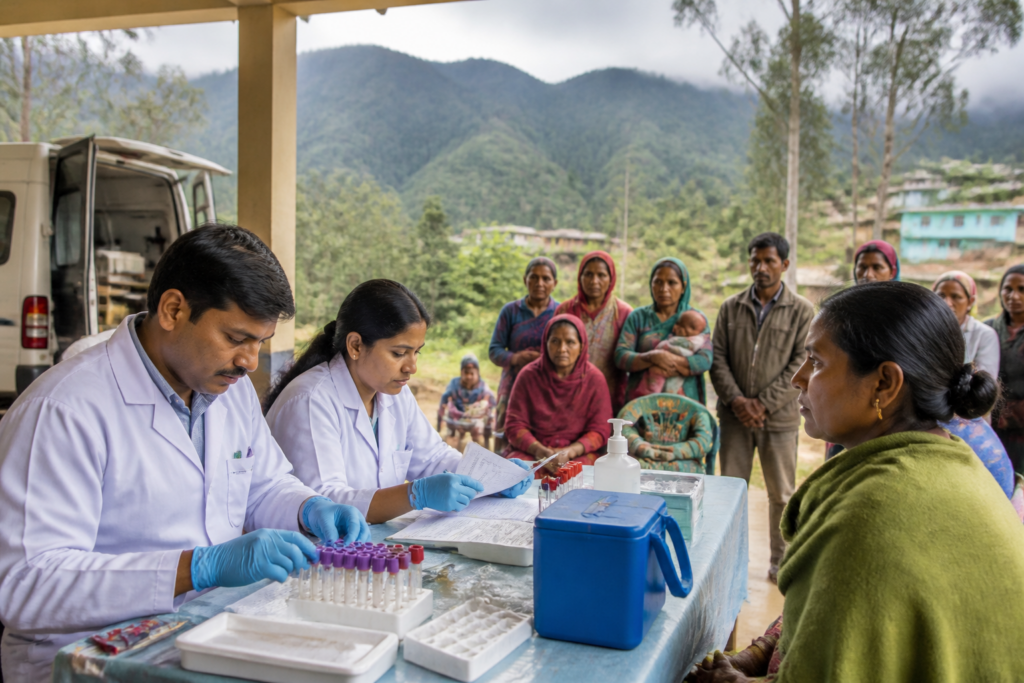
That distinction is central to understanding the Nilgiris’ sickle-cell challenge. Public-health authorities have screened 61,393 members of tribal communities over the past eight years through various National Health Mission programmes, according to Dr D Somasundaram, deputy director of public health. The district is home to about 35,000 tribal people, according to the 2011 Census, across communities including the Toda, Kota, Kurumba, Irula, Paniya and Kattunayakan.
The available evidence therefore describes the reach of government and community health activity more clearly than it describes the disease itself. A person who has not been screened is absent from the official count. A person diagnosed but not followed up may appear in a register without the health system knowing whether medication, counselling or emergency care was received. Without a representative population survey and a functioning patient-tracking system, the difference between identified cases and actual burden remains unresolved.
The limits of the evidence are also visible in recent research. A 2026 paper published in the Journal of Haematology and Allied Science concluded that sickle-cell disease in the Nilgiris and neighbouring Wayanad is generally milder than in several central Indian tribal populations. However, the review, by Kanjaksha Ghosh, former director of the National Institute of Immunohaematology at KEM Hospital, Mumbai, noted that much of the available research is hospital-based and may not represent the wider population.
The paper called for larger studies to examine how fetal haemoglobin and alpha-thalassaemia, as well as nutrition, infections, climate and occupation, influence disease severity. It did not establish the prevalence of sickle-cell disease in the region. This is a significant institutional distinction: understanding why symptoms may be milder in one population is not the same as knowing how many people require diagnosis and continuing treatment.
The geography of the Nilgiris makes that distinction harder to address. Tribal settlements are distributed across remote and hilly areas, and healthcare access depends on the ability of public agencies and partner organisations to reach dispersed communities repeatedly. Earlier initiatives used mobile medical vans that visited remote settlements once a fortnight, offering outpatient care, maternal services, vaccinations and laboratory tests. The Tamil Nadu Health System Project also provided screening, treatment cards, genetic counselling, hydroxyurea and emergency transfusions, while appointing tribal peer counsellors at several healthcare centres.
These arrangements show that sickle-cell care is not only a hospital function. It requires a chain linking community-level awareness, testing, counselling, clinical treatment, emergency response and records that follow a patient over time. If any link is weak, screening can produce a list of cases without producing consistent care. For people living in remote settlements, a diagnosis is useful only when it leads to accessible treatment, regular monitoring and support during painful episodes or complications.
Community organisations have become important parts of that chain. In Gudalur and Pandalur taluks, the Association for Health Welfare in the Nilgiris, or Ashwini, works across 320 hamlets in eight areas, with many field staff drawn from tribal communities. It has focused on people of reproductive age and is implementing newborn screening. Dr Mridhula of Ashwini has said that health education alone is insufficient because families also need to understand how the disease is inherited and what it could mean for their children.
The emphasis on reproductive-age adults and newborns reflects the way sickle-cell disease moves through families. Sickle-cell disease is caused by an abnormal form of haemoglobin known as haemoglobin S. Red blood cells can become stiff and crescent-shaped, obstructing blood flow and breaking down prematurely. The resulting anaemia and reduced oxygen delivery can affect vital organs. Sickle-cell trait usually does not cause the disease’s symptoms, but people carrying one copy of the gene can pass it to their children.
In communities where marriages between relatives occur, the probability of two carriers having a child affected by the disease can increase. But the health-system response cannot be reduced to a cultural explanation. Counselling, voluntary testing, confidentiality, treatment access and accurate information are all required if families are to make informed decisions. The reporting from the Nilgiris also records persistent myths that the disease is contagious, a divine curse or the result of black magic, certain foods or abandoning traditional ways of life. Such beliefs can deepen stigma and discourage people from seeking screening or care.
Dr R Laxman Bharathi of the Nilgiri Adivasi Welfare Association, or Nawa, said many community members are aware of sickle-cell disease but do not fully understand it. Nawa reports that it has screened about 11,000 people from the Badaga community in the Kotagiri, Coonoor and Ooty blocks since 2021. About 30 people are receiving treatment through Nawa, while some have chosen private treatment. The organisation also follows patients and supports monthly check-ups.
The district’s screening strategy is now widening beyond the communities that were initially prioritised. Earlier screening focused mainly on tribal settlements, with some random screening in non-tribal areas. The public health department says it is now covering new pockets, including the indigenous Badaga community and other populations. Patients identified with sickle-cell disease are being followed up through Nawa, Ashwini and Ooty Government Medical College Hospital, where 49 patients are currently under follow-up.
This expansion matters because the condition is not confined to one administrative or social category. Tamil Nadu has reported around 500 cases, with about 70% in the Nilgiris. Sickle-cell disease and the trait have also been reported in hill areas of Salem, Kallakurichi, Dharmapuri and Villupuram. The state has identified 30 tribal blocks in 14 districts as vulnerable to sickle-cell anaemia, placing the Nilgiris within a wider regional health system rather than treating it as an isolated local problem.
The national policy framework has set an ambitious scale for this work. The National Sickle Cell Anaemia Elimination Mission, announced in the Union Budget 2023–24, aims to screen seven crore people aged up to 40 across 17 states between 2023 and 2026, with the stated goal of eliminating sickle-cell disease as a public-health problem by 2047. The programme includes digital cards recording whether individuals are unaffected, carriers or affected by the disease.
The fact that these digital cards have yet to be issued in the Nilgiris points to the administrative gap between programme design and local implementation. A digital record is not merely a technological convenience. If maintained accurately and linked to care, it can help health workers distinguish between a carrier and a patient, identify people who need follow-up, reduce repeat testing and support counselling across generations. Without that record, data remain scattered across screening camps, hospitals and non-governmental organisations.
Technology may improve the speed of diagnosis, but it cannot solve the problem of incomplete coverage. A 2025 study by Maria Sheeba and K Sarojini, published in the International Journal of Electronics and Communication Engineering, developed an artificial-intelligence system that uses red-blood-cell images to classify sickle-cell anaemia among Nilgiris tribal communities. Using records from 300 patients obtained through Nawa and 14 disease-related attributes, the system achieved 98% accuracy.
That result suggests a possible role for AI in early identification, especially where specialist diagnostic capacity is limited. But the researcher also made the critical distinction that identifying cases and measuring prevalence are different tasks. An AI model trained on available patient records cannot establish how many people in the wider population have the disease unless screening reaches a representative sample. In other words, better classification does not compensate for incomplete population coverage.
The same principle applies to estimates reported for specific communities. Bharathi has estimated disease prevalence at 1% among the Badaga community and between 1% and 2% among tribal communities, with trait prevalence of about 8% and 10%, respectively. He has also estimated disease prevalence at 5% and trait prevalence at 10% among the Thoraiyar community. These figures are useful indicators of concern, but the available report does not establish whether they come from representative population-wide surveys. They therefore need to be interpreted as estimates rather than definitive district-wide measurements.
The Nilgiris case shows why public-health missions must be judged on more than the number of people screened. Screening is the visible activity, but the less visible infrastructure determines whether it changes outcomes: representative coverage, reliable classification, digital records, genetic counselling, medication supply, referral systems and follow-up in remote settlements. Community workers who understand local languages and social networks can help build trust, but they need sustained institutional support and a clear connection to public hospitals.
The district’s central question is no longer simply how to find more cases. It is how to convert screening into a durable care system without confusing programme reach with disease prevalence. The evidence confirms that the Nilgiris has a continuing burden, a network of public and community organisations and promising diagnostic research. It also confirms that the scale of the problem remains incompletely measured, that digital patient records are still pending and that long-term follow-up is the harder task. The next important milestones will be the expansion of representative screening, issuance of digital cards and evidence that people identified through the programme continue to receive treatment and counselling.


