

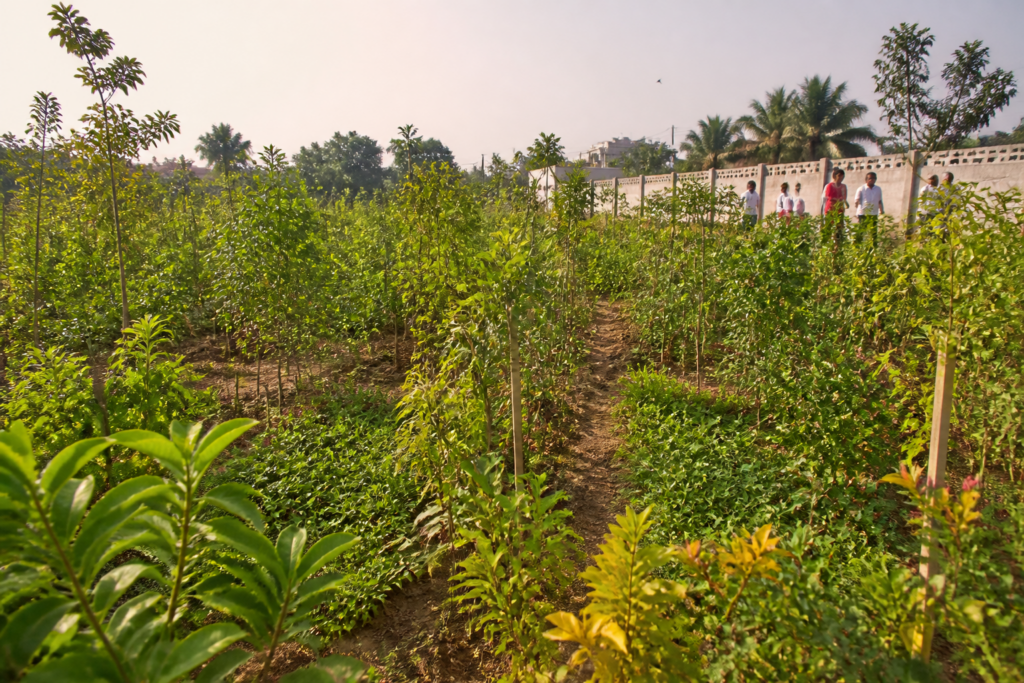
Namakkal Corporation has created two Miyawaki mini forests with 14,000 saplings at Thummangurichi, in a municipal effort to expand urban green cover, support biodiversity and improve local environmental conditions.
The plantations are part of the corporation’s ‘Green Namakkal, Clean Namakkal, Prosperous Namakkal’ initiative. Corporation commissioner S Selva Balaj said the first mini forest contains 6,200 saplings, while the second has 7,800.
Both sites use the Miyawaki technique, which is designed to create dense plantations in compact urban spaces. According to the commissioner, the method is intended to produce ecosystems resembling natural forests and allow a greater number of plants to grow within a limited area.
The plantations follow a four-tier model. Shrubs account for 35% of the planting, helping preserve ground moisture and providing habitat for insects and other small organisms. The corporation has also included medicinal plants such as tulsi and aloe vera. Aloe vera can store water and survive in dry conditions, while tulsi is valued for its traditional healing properties.
Sub-tree varieties make up another 35% of the plantations. This middle layer is intended to provide vegetation and shelter for birds and small animals. Trees in the main layer account for 20% and are expected to absorb carbon dioxide, capture dust, improve air quality and help reduce urban heat.
The remaining 10% comprises canopy species. These taller trees are expected to develop broad crowns that provide shade, preserve soil moisture and regulate ground temperatures. The corporation said the canopy layer would also create habitats for birds and other organisms.
The project’s environmental objectives extend beyond increasing tree cover. Selva Balaj said the mini forests are expected to lower surrounding temperatures, improve rainwater absorption, support biodiversity and strengthen soil conservation. Organic matter from fallen leaves and other plant material is also expected to enrich the soil and improve water retention.
The four-tier arrangement places different ecological functions within the same compact plantation. Lower vegetation supports moisture retention and small organisms, the middle layer provides shelter, and the taller trees contribute shade, dust capture and carbon absorption. This makes the sites more than conventional roadside planting, although their long-term performance will depend on how consistently they are maintained.
The corporation said regular maintenance is expected to help the plantations develop into dense green ecosystems. The initiative therefore places continued care at the centre of its intended environmental benefits, including the establishment of healthier soil, improved water retention and stronger habitats within the urban area.
The two mini forests at Thummangurichi are the corporation’s current intervention under its green-city initiative. Their development and maintenance will determine how effectively the 14,000 saplings mature into the dense ecosystems described by the municipal administration.


