

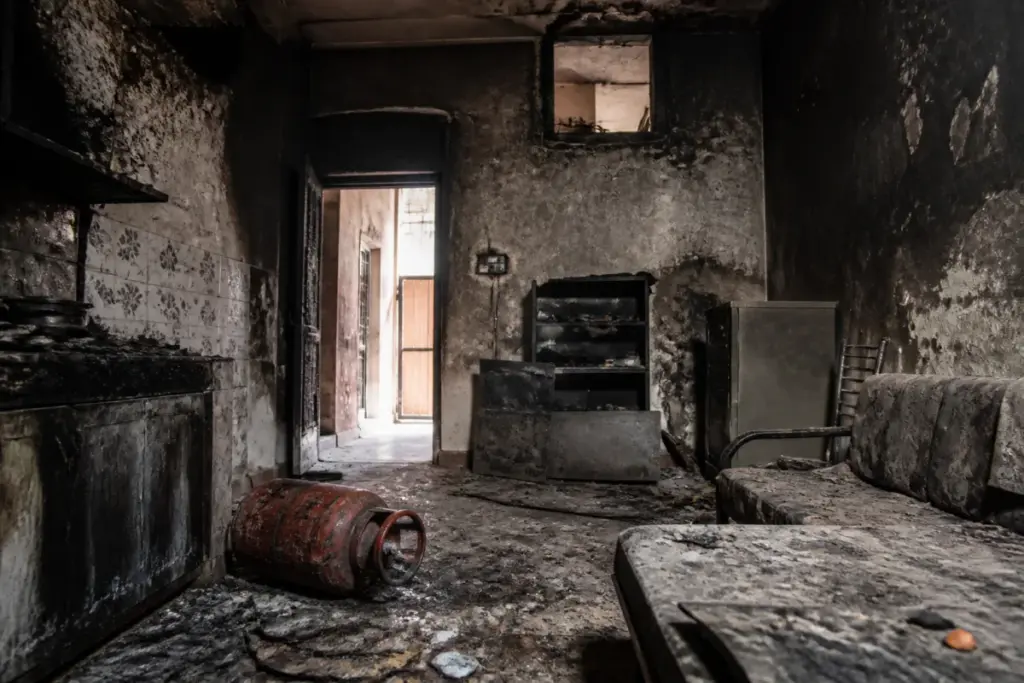
The Najafgarh LPG blast was not only a household fire tragedy. It was also a warning about how a gas leak inside a poorly ventilated room can transform an everyday domestic risk into a fatal built-environment failure. Four members of one family died over 12 days after the explosion in Ranaji Enclave, while two children survived with minor injuries. The incident has raised questions about household ventilation, emergency awareness and the enforcement of safety responsibilities around combustible fuel.
The explosion took place at about 10:30 pm on September 22 in Delhi’s Najafgarh police station area. According to the police’s preliminary investigation, cooking gas leaked from a domestic LPG cylinder and accumulated inside a closed room. The report said the room did not have another ventilation opening or escape route. When the gas came into contact with a spark, it caused a blast and fire.
Six people were injured in the incident and were initially taken to Indira Gandhi Hospital before being shifted to Safdarjung Hospital. The injuries were severe enough that four people died during treatment. Monika, 29, died on September 28. Her brother Keshav, 25, died on October 1, followed by Keshav’s wife Sonam, 24, on October 3. Kamlesh, 50, the wife of Ramji Lal, died on October 4.
The deaths over nearly two weeks show why the urban impact of a fire cannot be measured only by the moment of ignition. In dense neighbourhoods, a domestic accident can become a prolonged medical, financial and social crisis. Families may face hospitalisation, loss of income, funeral expenses and the breakdown of caregiving arrangements. In this case, the report said one newborn child was left without parents, while a four-year-old girl lost her mother. The two children who survived were reportedly sleeping near a wall and were not directly reached by the flames.
The police have registered a first information report under Section 287 of the Bharatiya Nyaya Sanhita, relating to negligence with fire or combustible material, and Section 106(1), relating to death caused by negligence. The investigation is continuing. These sections indicate that the authorities are examining the incident as a potential case of negligence rather than treating it only as an unavoidable domestic accident. The available report does not establish whether the leak resulted from the cylinder, the regulator, the hose, a cooking appliance or another component of the household gas system.
That distinction matters. LPG safety is often discussed as a matter of consumer behaviour, but the Najafgarh incident shows that risk is shaped by the physical arrangement of the home as well. A gas leak in a ventilated kitchen may disperse differently from a leak in a sealed room. The police’s preliminary account specifically links the absence of ventilation and an additional exit to the rapid spread of gas and flames. The room’s configuration therefore forms part of the central evidence, not merely background detail.
The report does not provide the room’s dimensions, the location of the cylinder, the condition of the regulator or hose, the type of ignition source, or whether the premises met any local building or fire-safety requirements. It also does not state whether the household had received a recent inspection or safety advisory from the LPG distributor. Those unanswered questions limit what can be concluded about the immediate cause. They also identify the evidence that the ongoing investigation would need to examine before responsibility can be assigned.
The case highlights a recurring difficulty in urban safety governance: responsibility is divided across several institutions and rarely visible to residents until something goes wrong. Police investigate negligence and criminal liability. Hospitals manage burn treatment and rehabilitation. Fire authorities respond to emergencies and may examine fire-prevention conditions. LPG distributors and oil marketing companies operate within the domestic fuel-supply system. Local authorities regulate aspects of the built environment, while landlords, homeowners and occupants control or use the individual premises. A serious incident can therefore expose gaps between fuel safety, building design and emergency response.
The available evidence points to three connected layers of risk. The first is the fuel system itself: a leak allowed combustible gas to accumulate. The second is the room: police said it was closed and lacked adequate ventilation or another route. The third is the household’s ability to escape or limit exposure once ignition occurred. The two children’s survival, according to the police account, was linked to where they were sleeping in relation to the flames. That detail underlines how quickly survival can depend on room layout during an indoor fire.
The incident also demonstrates why ventilation cannot be treated as a minor design preference in homes using LPG. Ventilation is part of the safety system because it affects how leaked gas behaves before ignition. Yet the report offers no indication that the room had been assessed for this risk. In many urban homes, cooking, sleeping and storage functions overlap because of limited space. When combustible fuel is kept or used in such compact environments, a failure in one component can affect the entire room before occupants recognise the danger.
There is also an institutional question about what happens before and after a cylinder reaches a home. The report confirms the police case and the hospital transfers, but it does not mention any inspection of the installation, any distributor response or any municipal assessment of the premises. The absence of that information should not be treated as proof that no inspection occurred. It does, however, show why public understanding of domestic fire incidents often remains incomplete: the criminal investigation may proceed while the wider safety chain remains undocumented.
The timing of the deaths adds another dimension. The explosion occurred on September 22, but the four deaths were recorded between September 28 and October 4. A household fire therefore creates a risk that extends beyond the first emergency response. Burn injuries can require prolonged treatment, specialist care and repeated transfers. The report does not provide the severity of each injury, treatment costs or the support available to the surviving children. Those details would be necessary to assess the full social and public-health burden of the incident.
The case should not be used to draw a general conclusion about every LPG installation in Delhi. It does establish, on the police account, that a leak inside a closed room preceded a powerful explosion and that four injured family members later died. It also establishes that the room’s lack of ventilation was considered relevant in the preliminary investigation. What remains uncertain is whether the physical condition of the equipment, the design of the room, human action or a combination of factors caused the leak and ignition.
That distinction is important for accountability. A safety response based only on warning residents to be careful could miss failures in equipment maintenance, inspection, housing conditions or emergency access. Conversely, assigning blame to a supplier, landlord or occupant without the investigation establishing the chain of events would be premature. The registered offences provide the legal framework for examination, but they do not by themselves determine liability.
For Delhi’s expanding and densely occupied residential areas, the larger urban question is how household safety is incorporated into ordinary housing oversight. The Najafgarh incident occurred inside a home, but its causes and consequences crossed into public systems: hospitals, police, fuel distribution, fire response and child welfare. A domestic LPG blast can therefore be understood as a small-scale infrastructure failure, where energy supply, building design and emergency protection meet at the level of a single room.
The next stage is the police investigation into the leak, ignition source, room conditions and possible negligence. The available report confirms the four deaths, the survival of the two children, the hospital treatment and the legal provisions invoked. It does not yet establish the precise equipment failure or assign responsibility. Those findings will determine whether the Najafgarh LPG blast remains a tragic household incident or becomes a documented case of wider failures in residential safety management.


