

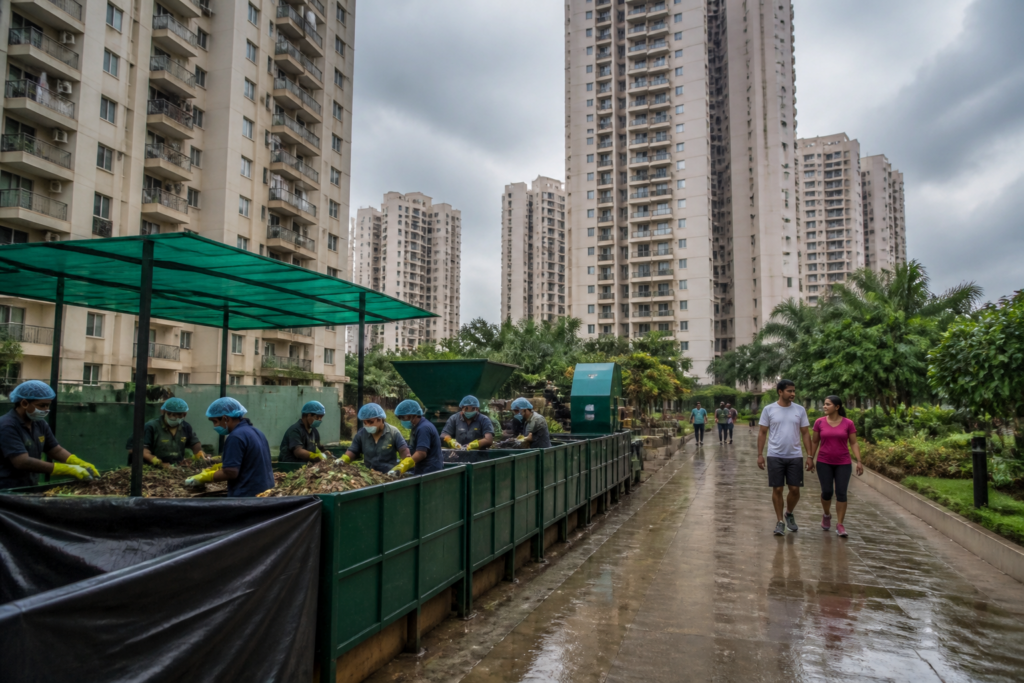
Mumbai’s proposed flat-wise waste processing charge could turn residential housing societies into the primary financial test case for the city’s struggle to manage wet waste closer to where it is generated. The Brihanmumbai Municipal Corporation is considering a monthly charge on each flat in bulk waste generator societies that receive permission to send wet waste to the civic system instead of processing it on their premises. The proposal has not yet been finalised, but it signals a shift from treating waste collection as a routine municipal service to enforcing a specific responsibility on large residential premises.
The plan is linked to the Solid Waste Management Rules, 2026, and an Extended Bulk Waste Generator Responsibility framework. According to the proposal described by the BMC, the charge would not be a conventional user fee. It would be intended to recover the cost of processing waste handed over by bulk generators that are exempted from on-site treatment. That distinction matters because the proposed payment is being framed not simply as a charge for collection, but as a financial consequence of a housing society not meeting the preferred obligation of processing wet waste within its own premises.
The BMC’s definition of a bulk waste generator covers premises that meet any one of three thresholds: a floor area of at least 20,000 square metres, daily water consumption of at least 40,000 litres, or daily waste generation of at least 100 kilograms. A senior civic official told the Times of India that meeting any one threshold is sufficient for a premises to qualify. This brings a substantial number of large housing societies within a compliance framework that is based on the scale of their operations rather than their formal use as residential buildings.
The civic body’s stated preference is for wet waste to be processed on-site wherever possible. Where that is not feasible, a bulk generator can meet its obligation through a prescribed certificate mechanism, according to the official cited in the report. The proposed charge would apply to societies that obtain an exemption from on-site processing and hand their wet waste to the BMC. In practice, the framework therefore creates two connected questions: whether a society is genuinely unable to process its wet waste on-site, and whether the waste it claims to generate and transfer is accurately recorded.
That verification problem is central to the proposal. The BMC is working on mechanisms to check whether claims about waste processing are backed by records showing the quantity generated, collected and processed. Without such records, the city would struggle to determine whether a society has fulfilled its obligation, secured an exemption appropriately, or simply shifted its waste burden to municipal infrastructure. The proposed documentation system could therefore become as important as the charge itself, because it would establish the administrative evidence on which exemptions, payments and enforcement action are based.
The scale of Mumbai’s waste system provides the financial context for the debate. The city generates around 7,000 tonnes each of solid waste and construction and demolition waste, according to officials cited by the Times of India. The BMC spends nearly Rs 3,500 per tonne on solid waste management. Of this, about Rs 2,500 is attributed to collection and transport, while Rs 893 is spent on processing. These figures show why the civic body is looking at bulk generators not only as waste producers but also as institutions whose decisions affect the cost and capacity of the wider municipal system.
For a housing society, however, the proposed flat-wise structure could make the financial responsibility visible at the household level. The levy would be imposed on each residential flat rather than only on the society’s managing committee or a common facility. The report does not specify the proposed monthly amount, the method for calculating it, or whether the charge would vary according to the quantity of waste generated. Those details will determine whether the measure functions as a direct cost-recovery mechanism, a compliance penalty, or a broader incentive for societies to invest in local processing.
The distinction is important because residential societies do not all have the same physical or administrative capacity. The supplied report establishes that the BMC is considering exemptions for societies that do not process wet waste on-site, but it does not set out the criteria by which feasibility would be assessed. It also does not explain whether limitations such as inadequate space, building design, odour concerns, maintenance capacity or the absence of trained operators would qualify a society for an exemption. Until those rules are specified, the administrative burden could fall unevenly across different types of residential developments.
The proposal also places the BMC’s own role under scrutiny. Rajkumar Sharma of the Chembur-based Advanced Locality Management and Networking Action Committee questioned why citizens should pay a processing charge when solid waste management is a municipal function. Sharma, who is also a member of the six-member court-appointed panel monitoring conditions at the Deonar dumping ground, argued that the civic body should instead consider a model to compensate bulk generators that process waste themselves and encourage more establishments to treat their own waste.
That position identifies a different policy route. The BMC’s proposal is based on making societies pay when they rely on municipal processing after securing an exemption. Sharma’s suggestion would reward societies that reduce their dependence on the civic system by processing waste on-site. Both approaches seek to move responsibility closer to the generator, but they distribute the financial incentive differently. A charge treats municipal processing as a cost to be recovered. Compensation would treat decentralised processing as a service that could be supported by the civic system.
The current proposal appears to combine financial responsibility with stronger enforcement. Before taking steps towards imposing the charge, the BMC will have to inform bulk waste generators about the consequences of non-compliance with the Solid Waste Management Rules, according to the official cited in the report. These consequences could include temporary disconnection of water or electricity supply until waste handling conforms to the guidelines. The report presents these measures as part of the compliance framework, but does not indicate how often they have been used, what procedural safeguards would apply, or which authority would approve such action.
This makes the enforcement design a significant part of the policy. A charge can be administered through billing and records, but temporary disconnection of essential services raises a different level of administrative intervention. For the system to be credible, societies would need to know the precise violation, the period allowed for correction, the evidence required to demonstrate compliance and the process for challenging an order. The supplied material does not establish those details, and the proposal remains under consideration.
The involvement of the state government adds another institutional layer. State environment minister Pankaja Munde was briefed on the proposal during a visit to BMC headquarters earlier in the week to review waste management projects. The report does not state that the minister approved the levy. Her briefing indicates that the proposal is being discussed within a wider review of waste management projects, but the authority for finalising and implementing the charge, as well as any necessary approvals, is not specified in the available information.
Mumbai’s waste challenge is therefore not limited to how much waste the city generates. It also concerns where responsibility is located, how that responsibility is recorded and who pays when waste moves from a private premises into a public processing chain. Large housing societies are visible points of intervention because they generate waste at a concentrated scale and have collective management structures. They are also places where a civic rule can be translated into a society-level decision about infrastructure, contracts, segregation, processing and household charges.
The numbers cited by the BMC show the pressure behind that intervention, but they do not by themselves settle the question of who should bear the cost. Collection and transport account for the largest component of the stated solid waste management expenditure, while processing accounts for Rs 893 per tonne. The proposed levy, however, is being discussed specifically in relation to processing wet waste from societies that do not handle it on-site. The eventual design will need to clarify whether the amount reflects actual processing costs, administrative expenses, enforcement costs or a broader responsibility charge.
The proposal also exposes a potential tension between compliance and capacity. If the BMC expects societies to process wet waste on-site wherever possible, then the rules must distinguish between unwillingness and genuine inability. If it permits exemptions, the verification mechanism must establish that the exemption is justified and that the waste handed over to the civic body is measured accurately. If it charges societies flat-wise, it must explain how the amount relates to the waste generated by individual buildings and whether households can avoid or reduce the charge through verified processing.
At this stage, the evidence confirms only that the BMC is considering the levy, is developing verification mechanisms and is examining stronger consequences for non-compliance. The amount of the charge, the final eligibility rules, the exemption process, the enforcement procedure and the implementation timeline remain unspecified in the supplied report. Those details will determine whether Mumbai’s proposed waste charge becomes a transparent cost-recovery measure, a compliance instrument for bulk generators, or a contested addition to housing society expenses.


