

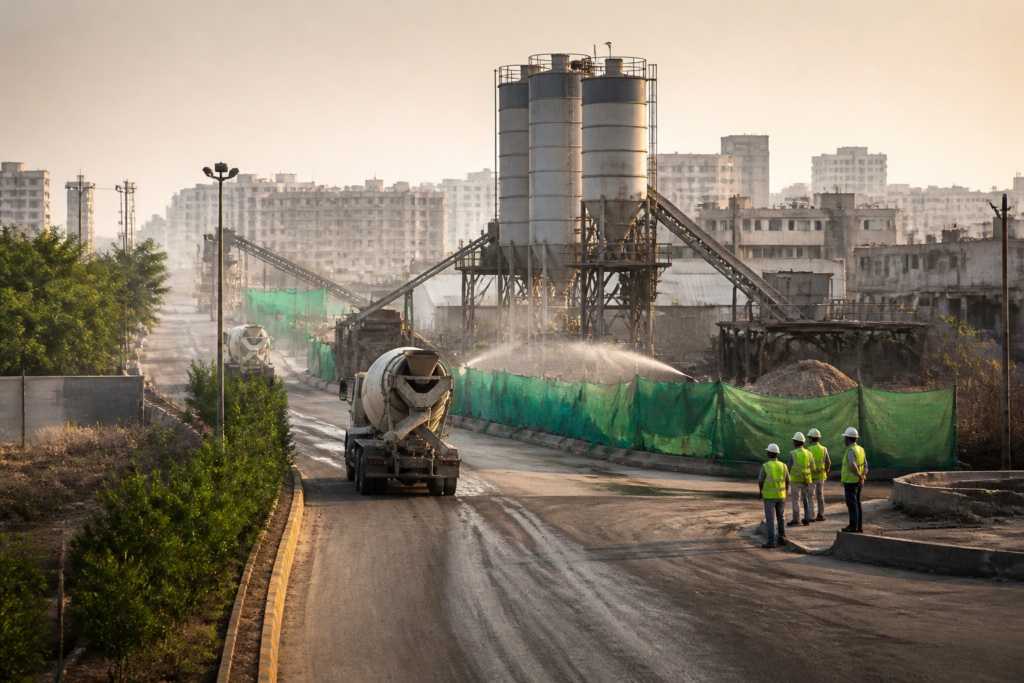
Ahmedabad’s new RMC policy allows ready-mix concrete plants at or near construction sites, but the decision arrives amid poor air quality, a rapidly expanding construction economy and a substantial record of fatal crashes involving heavy vehicles. The policy creates a formal framework for plants that previously operated without a dedicated municipal policy, yet it also shifts the central question from permission to enforcement.
The Ahmedabad Municipal Corporation’s Town Planning Committee approved the policy at its Wednesday meeting, according to Gujarat Samachar – Ahmedabad. Under the new framework, an onsite ready-mix concrete plant can be established within a plot measuring up to 7,500 square metres. For plots larger than 7,500 square metres, the plant may be located within the plot or within a one-kilometre radius of the construction site.
The policy is intended to regulate the production of concrete used in construction projects. For an onsite plant, the annual licence fee has been fixed at Rs 25,000. Concrete produced at such a plant must be used only for the relevant project and cannot be supplied elsewhere. The operator must obtain the required no-objection certificate from the Gujarat Pollution Control Board, secure a structural safety certificate and provide safety arrangements at the site.
The policy also prescribes measures intended to reduce dust from plant operations and the movement of mixers, dumpers and trucks. Green netting and sprinklers are required at onsite plants. Licences to use both onsite and offsite plants will remain valid for one year, with renewal applications required 30 days before expiry. Existing RMC plants operating within the corporation’s limits must apply under the guidelines within 60 days of their publication.
For commercial, or offsite, RMC plants, the annual licence fee is Rs 50,000 and the security deposit is Rs 5 lakh. These plants may be established in industrial general zones, general agricultural zones, prime agricultural zones and logistics zones. The policy requires offsite plants to install air-quality monitors, high-resolution cameras and anti-smog machines. Insurance must also be provided for the plant, workers and other employees.
The access road between an offsite plant’s entrance and the public road must be made of reinforced cement concrete or asphalt. The source report states that the responsibility for this work will lie with the relevant zonal office. This provision links the plant licensing system to the condition of roads used by heavy construction vehicles, rather than treating pollution control as an issue confined to the plant boundary.
The municipality has also prescribed penalties. An offsite plant operating without a licence may be sealed and fined Rs 1 lakh. If the violation continues, a daily penalty of Rs 10,000 may be imposed. An unlicensed onsite plant may attract a daily fine of Rs 1,000. The policy therefore distinguishes between the two categories in both their operating conditions and enforcement consequences.
The need for such a framework is underscored by the scale of construction activity in Ahmedabad. The Town Planning Committee chairperson said that the corporation previously had no policy for establishing RMC plants. Around 19 RMC plants are currently operating within the corporation’s limits, according to the report. The new policy is consequently not only a mechanism for approving future plants; it is also an attempt to bring existing operations into a licensing system.
That transition will determine whether the policy becomes a functioning regulatory instrument or remains a set of conditions on paper. The rules specify green nets, sprinklers, air-quality monitors, cameras and anti-smog machines, but the report does not provide an inspection schedule, staffing plan, monitoring results or details of how violations will be detected and recorded. The absence of those operational details is important because construction pollution is produced across an entire chain: batching, loading, vehicle movement, road access, material storage and site activity.
The timing is particularly significant because the policy has been approved amid continuing concern over Ahmedabad’s air quality. The report says that, in 2026, the city had not recorded a single day of clean air. It states that the Air Quality Index ranged from 72 to 168 over 286 days, with 179 days classified as moderate, 60 as poor, 44 as unhealthy and two as the worst category mentioned in the report. The source also says that air quality was at its worst in January and that winter conditions produced the most severe pollution.
The figures in the report show why a policy permitting additional or more closely located concrete-production capacity needs to be assessed through actual monitoring rather than licensing numbers alone. An onsite plant may reduce some trips between a distant batching facility and a construction site, but the source material does not establish whether the new arrangement will reduce total dust, emissions or traffic exposure. It also does not provide comparative data on pollution from offsite transportation and onsite production.
This creates a measurable policy question. The municipality has set conditions for where plants may operate and what equipment they must install. The next stage should reveal whether those conditions produce a verifiable change in air quality around construction sites, access roads and nearby neighbourhoods. The source report, however, records that the committee chairperson did not provide a clear answer when asked whether the policy could increase pollution amid the city’s air-quality concerns.
The policy’s safety implications extend beyond air pollution. Ahmedabad’s construction sites depend on dumpers, trucks and ready-mix concrete mixers, and these vehicles share roads with pedestrians, two-wheelers and other traffic. The report states that between 2021 and July 2026, heavy vehicles linked to construction and logistics caused 521 road accidents in the city. These incidents resulted in 270 deaths and left 182 people with permanent disabilities or serious injuries, according to the data cited.
Dumpers accounted for 241 of those accidents and 131 deaths. Goods trucks were involved in 212 accidents, with 106 deaths and 74 serious injuries. Ready-mix concrete mixer vehicles were linked to 68 accidents, including 33 fatal, 26 serious and nine ordinary accidents. These figures do not establish that the new RMC policy will cause more crashes, but they show that plant regulation cannot be separated from the movement of the vehicles that supply construction sites.
The location rules therefore matter for more than land use. Allowing a plant within a construction plot or within one kilometre of a large site may alter the distance travelled by mixers and other vehicles. At the same time, it may bring industrial activity closer to residents and workers if the site is located near occupied areas. The policy’s effectiveness will depend on how the corporation applies zoning permissions, road-access requirements, safety certificates, traffic controls and pollution conditions together.
The framework also illustrates the divided institutional responsibility behind urban construction impacts. The municipal corporation controls local permissions, licensing and enforcement within its jurisdiction. The Gujarat Pollution Control Board is responsible for the required pollution-related no-objection certificate. Zonal offices have responsibilities related to road surfacing. Developers, plant operators, contractors and vehicle owners control day-to-day compliance at the project level. A gap between these authorities could make it difficult to identify who is accountable when dust, unsafe access or unlicensed operations continue.
The policy’s annual licensing cycle provides a possible administrative checkpoint. Existing plants have 60 days to apply, while future operators must meet the prescribed requirements before starting. However, the source does not state how many applications are expected, how many existing plants currently possess pollution permissions, or whether inspection reports will be made public. Those details will be necessary to judge whether the system improves transparency and compliance.
Ahmedabad’s RMC policy is therefore best understood as a regulatory test created by the city’s construction growth. It recognises that ready-mix concrete plants require land-use, environmental, structural and safety controls, but it does not by itself demonstrate that urban residents will experience cleaner air or safer roads. The policy confirms the rules, fees, deposits and penalties; the unresolved issue is whether municipal and pollution-control authorities can inspect, measure and enforce them consistently.
The first milestones to watch are the publication of the guidelines, applications by the city’s existing 19 plants, the grant of GPCB no-objection certificates, and evidence of inspections after licensing. Air-quality readings near plants, records of violations, enforcement actions and heavy-vehicle crash data will show whether the new framework is reducing the costs associated with construction or merely regularising them.


