

Mumbai’s groundwater problem is no longer only about how much water lies below the city. A Central Ground Water Board assessment has found that nearly 35 per cent of Mumbai’s area is highly vulnerable to seawater intrusion, raising a more difficult urban question: whether some groundwater sources can remain usable even when overall extraction levels are not considered high.
The finding is part of the CGWB’s 2025 Aquifer Management Plan, which mapped aquifers across 603 sq km covering Mumbai city and suburban districts. The assessment identified saline groundwater in Fort, Shivaji Park in Dadar, Mulund East and Mahim, while warning that excessive pumping could reduce freshwater pressure and allow seawater to move into freshwater aquifers.
That distinction matters for Mumbai because groundwater is no longer the city’s principal source of drinking water, but it remains an important supplementary source for local users, institutions and activities that draw from wells and borewells. The city’s formal drinking-water system depends primarily on seven surface-water reservoirs, which are replenished by the southwest monsoon between June and September. Groundwater therefore operates as a secondary layer of urban water security, particularly when local supply is constrained or when users seek alternatives to the municipal network.
The CGWB findings show why measuring extraction at the district level may not be enough to understand the condition of individual aquifers. The groundwater extraction stage was recorded at 46 per cent in Mumbai city district and 26 per cent in the suburban district. These levels are not considered high overall. Yet the report cautions that apparently safe aggregate extraction levels do not rule out localised seawater intrusion, especially in coastal and creek-adjacent areas.
Mumbai’s physical geography makes this risk uneven. Shallow aquifers along the western and southern coasts are particularly vulnerable, while deeper aquifers in the eastern zone near creeks face a higher risk. Saline intrusion was observed especially during the pre-monsoon period, when the seasonal replenishment from rainfall has not yet restored groundwater conditions after the dry months.
Electrical conductivity readings provide one measure of the problem. The study recorded levels above 10,000 microsiemens per centimetre in highly saline groundwater zones, including Fort, Mulund East and Shivaji Park. Electrical conductivity indicates the concentration of dissolved salts in water; higher readings can signal water quality conditions that limit usability. In this case, the readings are not simply an environmental indicator. They determine whether a local well or borewell remains a viable source for urban use.
The underlying mechanism is closely linked to groundwater pressure. Freshwater stored in coastal aquifers can resist the movement of seawater when it is adequately replenished and not excessively pumped. If extraction lowers the freshwater pressure, saline water can move inland or upward into the aquifer. Once salinity enters a groundwater system, restoring usability is more difficult than reducing pumping alone, particularly in densely built areas where recharge space is limited and the aquifer is connected to a heavily altered surface environment.
This is why the CGWB recommendations focus on local management rather than a single citywide extraction figure. The report recommends restricting groundwater development in Fort to depths of up to 60 metres. It calls for a complete prohibition on groundwater development in Shivaji Park, where highly saline water was found at shallow depths. These recommendations imply that groundwater regulation in Mumbai may need to be location-specific, based on aquifer conditions, depth, salinity and proximity to the coast or creeks.
The report also recommends recharge structures, including filtered recharge pits, recharge shafts and percolation tanks or ponds. Parks and gardens in vulnerable areas are identified as potential locations for such infrastructure. The purpose is not merely to store rainwater. Recharge can help replenish freshwater aquifers and maintain the pressure needed to resist the movement of saline water.
That approach introduces a significant planning challenge. Mumbai’s most vulnerable areas are also among its most intensely developed. Creating recharge infrastructure requires suitable land, functioning drainage connections and maintenance systems that prevent contaminated surface runoff from entering the aquifer. The supplied assessment does not establish how many recharge structures would be required, how much recharge they could create or which agency would be responsible for their long-term operation. Those details will determine whether the recommendation remains a technical prescription or becomes an effective municipal programme.
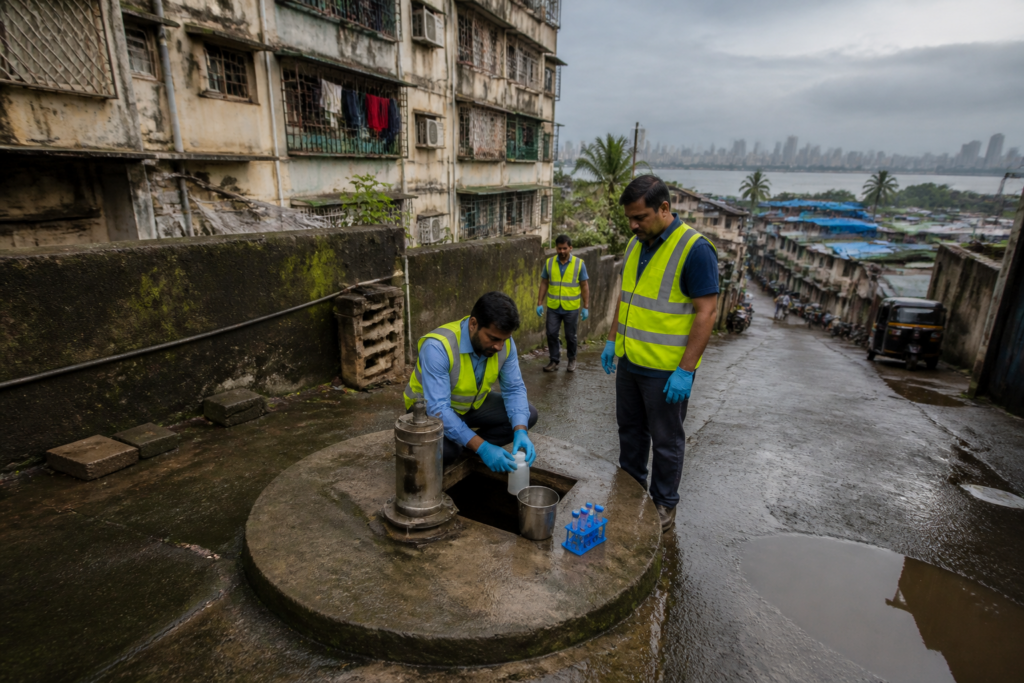
The city’s water governance is also divided across different responsibilities. The CGWB provides the aquifer assessment and groundwater-management recommendations, while the Brihanmumbai Municipal Corporation has commissioned the All India Institute of Local Self Government to study salinity levels in Mumbai’s groundwater. The agency will collect samples from wells across the city to assess the extent of salinisation.
That municipal study could provide the next layer of evidence needed for implementation. The CGWB assessment maps vulnerability and records saline conditions in selected locations, but a citywide sampling exercise can help establish how widespread the problem is across individual wells. Regular monitoring of electrical conductivity in coastal observation wells, another recommendation in the report, would also make it possible to track changes over time rather than treating salinity as a one-time measurement.
The need for monitoring is particularly important because groundwater conditions can vary sharply over short distances. Fort, Shivaji Park, Mulund East and Mahim do not represent one uniform aquifer environment. They reflect different relationships between coastal margins, built-up land, drainage, creeks, geological formations and local extraction. A single district-level extraction number can therefore conceal serious stress in a smaller area.
The report’s recommendation on deep borewells reflects the same concern. New borewells tapping fractured rock zones should be permitted only after detailed hydrogeological and geophysical investigations. This would shift approvals away from a purely administrative process towards one based on the characteristics of the specific site. It would also require better coordination between groundwater authorities, the municipal corporation, property owners and agencies involved in construction and redevelopment.
Mumbai’s dependence on monsoon-fed reservoirs adds another dimension. The city’s main water system is designed around surface storage replenished during a defined rainy season. Groundwater is not a substitute for that network, but it can become more important when local users face supply interruptions or when demand grows in areas where formal supply is uneven. At the same time, drought-like conditions in parts of Maharashtra increase pressure to examine every available water source, even as coastal areas face the separate threat of salinisation.
This creates a policy tension: water scarcity can encourage greater groundwater extraction, while greater extraction can worsen the quality of coastal groundwater. The CGWB findings indicate that the question is not simply whether Mumbai has unused groundwater capacity. It is whether extraction in a particular location is compatible with maintaining the freshwater conditions of that aquifer.
The larger urban issue is the limited visibility of groundwater in a city dominated by large reservoirs and centralised water infrastructure. Reservoir levels, rainfall and municipal supply schedules are visible parts of the water system. Aquifers beneath roads, housing clusters, institutional properties and open spaces are less visible, even though their condition can affect local resilience and construction decisions.
The evidence currently confirms three things: saline groundwater has been recorded in multiple Mumbai locations; nearly 35 per cent of the mapped area is considered highly vulnerable to seawater intrusion; and aggregate extraction figures do not eliminate the possibility of localised aquifer damage. It does not yet establish the full extent of salinisation across the city or the likely effectiveness of proposed recharge measures.
The next important step is the BMC-commissioned sampling study by the All India Institute of Local Self Government. Its findings, alongside regular electrical-conductivity monitoring and site-specific investigations for new borewells, will determine whether Mumbai can move from broad vulnerability mapping to enforceable, location-based groundwater management.


