

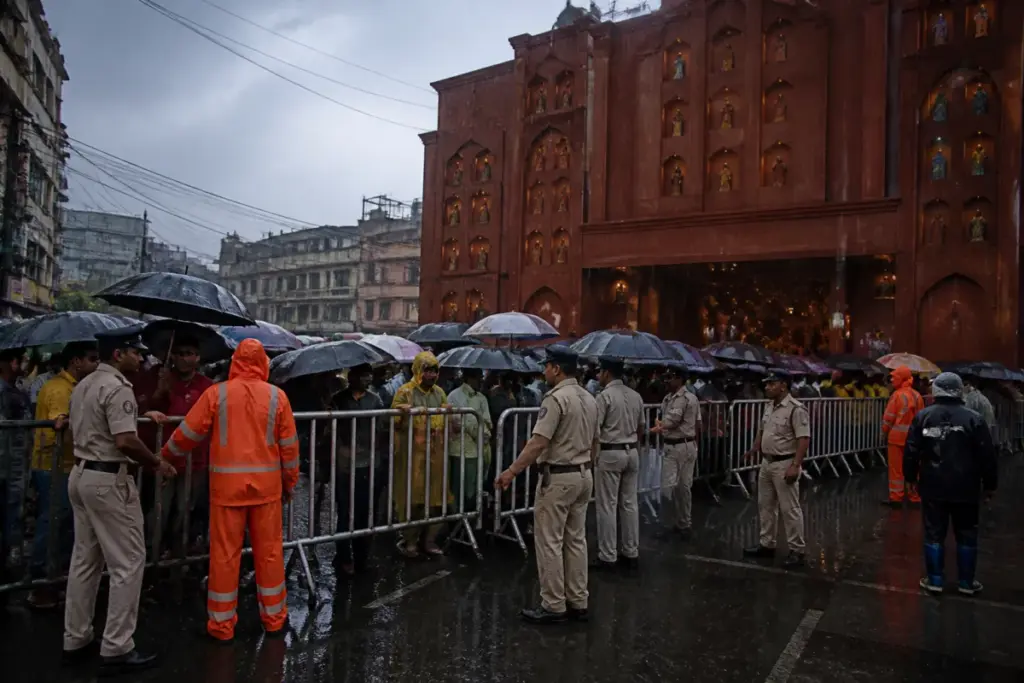
The Kolkata stampede that killed at least 19 people and injured around 25 at the Chorbagan Sarbojanin Durga Puja pandal has triggered competing political allegations over crowd management, administrative responsibility and the conduct of the police. The incident occurred on a Saturday evening amid heavy rain, according to a report by The Indian Express, but the supplied account does not independently establish how the crowd surge began or which safety protocols were in place.
The political response has centred on whether the tragedy resulted from an administrative failure or from shortcomings by the organisers. CPI(M) leader Shatarup Ghosh blamed the government for what he described as a complete failure of crowd management. He alleged that police personnel were not deployed for their proper duties and demanded that all facts be brought to light. These are allegations attributed to Ghosh and have not been independently established in the supplied material.
Kunal Ghosh, identified in the report as an MLA from the Mamata Banerjee faction of the Trinamool Congress, also described the incident as a complete failure of the administration. At the same time, he said the puja organisers should be held accountable. His immediate demands included treatment for the injured, assistance for victims’ families, completion of post-mortem examinations and arrangements to ensure that families were not inconvenienced during funeral rites.
The competing claims point to the overlapping responsibilities involved in large public gatherings. A pandal event can involve organisers, police, municipal authorities, emergency medical services and local administration. The supplied report does not provide details of the event’s approved capacity, entry and exit arrangements, barricading, emergency lanes, rainfall-related precautions, police deployment or the number of people present when the crowd surge occurred. Without those details, it is not possible to determine whether the failure was primarily organisational, administrative or a combination of factors.
The location and timing are significant for understanding the operational challenge. The incident occurred at a Durga Puja pandal during heavy rain, when pedestrian movement can become more concentrated and visibility and access may be affected. However, the report does not state whether the rain directly caused the surge, whether waterlogging was present, or whether any infrastructure at the venue failed. Those facts would be necessary for a reliable reconstruction of the event.
The political dispute has also introduced conflicting descriptions of responsibility. Ritabrata Banerjee, described by The Indian Express as a rebel Trinamool Congress leader and Leader of the Opposition in the Assembly, criticised political parties for engaging in a blame game and urged them to focus on those affected. He said he was ashamed of the combative response from political parties. His intervention reflects a call for restraint, but it does not resolve the operational questions surrounding the stampede.
The report also attributes a statement to Suvendu Adhikari, who urged political parties to work together in an atmosphere of mourning. He said he had met the victims’ families and apologised to them. Adhikari referred to earlier accidents and disasters, including incidents at Majherhat, Taratala and Panihati, as well as deaths from electrocution before the Puja and a flash flood in north Bengal. The supplied account presents these remarks as part of the political exchange, but it contains apparent inconsistencies regarding political offices and the government in power. Those inconsistencies require correction against primary records before publication.
The reference to earlier incidents broadens the issue beyond one festival venue. Each public gathering disaster may have a specific immediate cause, but the institutional question is whether authorities systematically convert lessons from earlier incidents into enforceable safety requirements. That would include checking crowd density, keeping escape routes clear, planning for adverse weather, maintaining communication between organisers and police, and ensuring that medical response teams can reach a congested site. The current report does not establish whether any such measures were mandated or implemented at Chorbagan.
Ghosh also alleged that police demolished a book stall in the early hours following the incident and called the move insensitive. The report does not provide an official response to that allegation, identify the authority that ordered the action, or explain whether the stall was connected to evidence preservation, access requirements or another administrative decision. The claim should therefore remain attributed and should not be treated as an established fact without further documentation.
Congress president Mallikarjun Kharge conveyed condolences to the victims’ families and called for prompt medical treatment, adequate compensation and a thorough investigation. These demands address the immediate response as well as accountability. The report does not specify the compensation announced, the hospitals treating the injured, the status of the investigation, or whether any arrests, suspensions or formal inquiries have been ordered.
The available figures — at least 19 deaths and around 25 injuries — indicate a severe mass-casualty incident. Yet the distinction between confirmed and provisional numbers is not explained. The report also does not identify the deceased or injured, state whether all bodies had been identified, or clarify whether the injury count could change. Official casualty bulletins, hospital records and police statements would be needed to establish the final toll.
For cities, the central lesson is that festival safety cannot be assessed only through the presence of a police force or the existence of a permission process. The quality of crowd management depends on how responsibilities are divided before an event and how quickly agencies respond when conditions change. Rain, restricted movement, temporary structures and high visitor volumes can combine to create risks that are not visible during routine inspections. The supplied account establishes that heavy rain was present, but it does not show whether authorities had activated a weather contingency plan.
The incident also raises questions about the transparency of post-disaster investigations. Families and the wider public need clarity on the sequence of events, the condition of the venue, the deployment of personnel, the instructions issued to visitors and the decisions taken after the crowd surge. A credible investigation would need to distinguish between verified evidence and political allegations, while preserving records and identifying the responsibilities of every agency and organiser involved.
At this stage, the supplied report confirms a major stampede at a Kolkata Durga Puja pandal, a reported death toll of at least 19, around 25 injuries and a political dispute over accountability. It does not provide enough verified information to establish the precise cause, the adequacy of safety arrangements or the official findings. Those gaps should be addressed through police records, municipal permissions, organiser documents, hospital updates and a formal investigation before the incident is presented as evidence of a specific institutional failure.


