

Jugnoo, a new climate education tabloid developed by IISER Pune, is trying to address a problem that increasingly shapes life in Indian cities and regions: children are exposed to floods, heatwaves, pollution and ecological loss, but are often given few accessible ways to understand what those changes mean. Its intervention is modest in format—an eight-page, full-colour publication—but significant in intent. It treats climate education not as a specialised subject reserved for experts, but as part of how young people learn to interpret the environments in which they live.
The tabloid was launched by Dr Shalini Sharma, an Associate Professor at the Indian Institute of Science Education and Research, Pune, in collaboration with the Chhattisgarh Regional Science Centre. Developed under IISER Pune’s CARE, or Communicating Action and Resilience for Environmental Health, Project, Jugnoo is aimed at readers between eight and 14 years of age. Its first rollout targets government schoolchildren in Chhattisgarh, while the project also identifies Maharashtra, Kerala and Karnataka as important areas of focus because of the environmental pressures affecting the Western Ghats.
That geography matters. The initiative does not present climate change as a distant global subject. Instead, it connects climate and environmental learning to places where ecological degradation, rising heat, health risks and livelihood concerns are already part of local experience. The source material does not provide a quantified assessment of those risks or an evaluation of the tabloid’s educational outcomes. But its stated focus points to an important institutional question: how can climate communication reflect the specific environmental realities of different regions rather than rely only on abstract warnings?
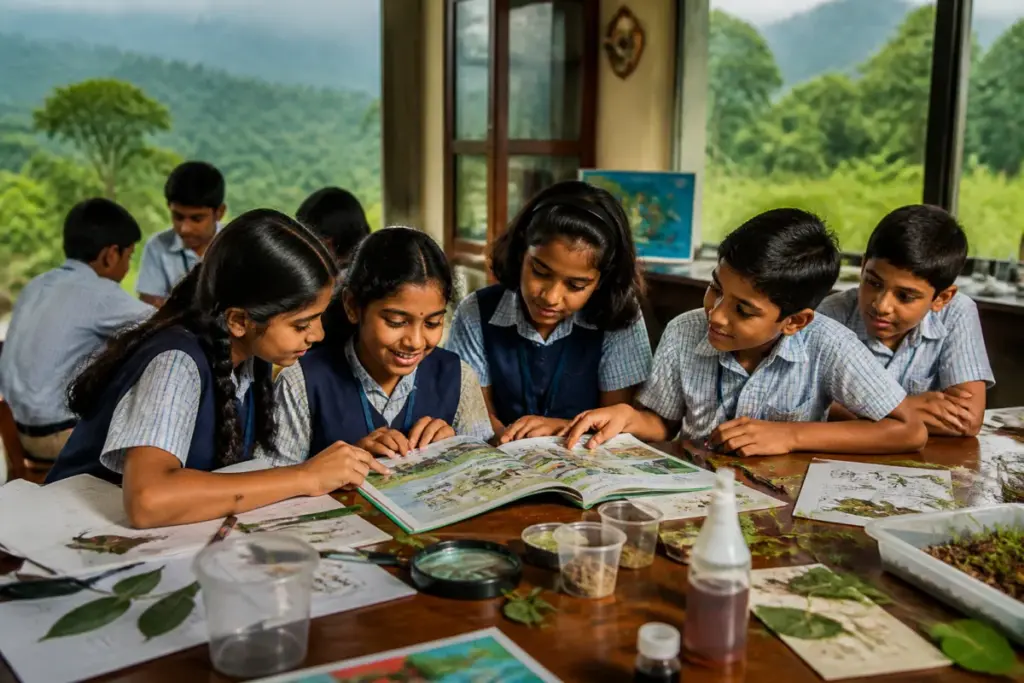
Jugnoo’s answer is to change the form and tone of the conversation. The publication uses stories, comics, puzzles, hands-on experiments and interactive mystery-solving activities to explain climate science, biodiversity loss, local forest wisdom and public health. It is named after the firefly, an image that reflects its effort to make a difficult subject engaging without diminishing its seriousness.
Dr Sharma told The Indian Express that the publication is designed for children in a world where climate issues and news are shaped by adults. She described climate as an everyday reality in which children are often left behind, and said Jugnoo aims to replace eco-anxiety with eco-agency. That distinction is central to the initiative. Children are not only recipients of information about environmental damage; they are also residents of neighbourhoods, towns and rural regions where heat, pollution, flooding and changes in natural systems affect daily life.
For urban institutions, this is a relevant distinction. Climate resilience is often discussed through infrastructure, early-warning systems, drainage, water management, public health capacity and land-use planning. Those systems are necessary, but their effectiveness also depends on whether residents understand the risks around them and can relate them to their own surroundings. A child who encounters climate only through alarming headlines receives a very different kind of education from one who learns to connect heat, forests, health and local environmental change through familiar stories and experiments.
The bilingual model adopted by Jugnoo is another important part of that approach. The tabloid combines Hindi and English and incorporates culturally familiar linguistic nuances. According to Dr Sharma, this is intended to make climate concepts accessible without distancing young learners from their native tongues or local environmental realities. The source does not describe the publication as a replacement for formal classroom teaching. Rather, its design suggests an attempt to create a bridge between scientific concepts, school learning and the language children use to understand their surroundings.
That bridge is particularly important when climate communication crosses institutional boundaries. Scientific organisations may generate knowledge, schools may deliver education, and science centres may support public engagement, but children encounter environmental change outside all three settings. They experience heat in homes and schoolyards, pollution along roads, changes in access to nature and disruptions caused by extreme weather. A publication that brings these subjects together can make the relationship between environmental systems and everyday life more visible.
The collaboration behind Jugnoo also shows how climate education is being positioned as a shared responsibility. IISER Pune brings the project’s science and research context, while the Chhattisgarh Regional Science Centre is a partner in the rollout and public engagement process. Prashant Kawishwar, Scientist and Director General of the science centre, said meaningful engagement with science, nature and local environmental issues can help children understand challenges, express their experiences creatively and turn concern into hope and constructive action.
This institutional arrangement is significant because environmental learning cannot be reduced to the distribution of information. The tabloid’s stated purpose includes curiosity, creativity and environmental responsibility. Those goals require a communication system that allows children to ask questions, test ideas and connect general scientific knowledge with local conditions. The inclusion of experiments and problem-solving activities indicates an effort to make learning participatory rather than purely instructional.
At the same time, the available evidence establishes the initiative’s design and stated objectives, not its impact. The supplied report does not provide circulation figures, the number of schools involved, teacher feedback, learning assessments or evidence that the material has changed children’s behaviour or understanding. It also does not specify how the publication will be distributed across Maharashtra, Kerala or Karnataka, or whether editions will be adapted to different ecological and linguistic contexts. These are important measures for judging whether a promising communication model can operate at scale.
The first rollout in government schools adds another dimension. Public education systems bring the initiative into contact with children who may not have regular access to specialised science resources or climate-focused extracurricular material. But the report does not establish how Jugnoo will be integrated into classroom schedules, who will facilitate the experiments, or what support teachers will receive. The distinction matters because a well-designed publication can have limited effect if it reaches schools without the time, materials or institutional support needed to use it meaningfully.
The project’s focus on the Western Ghats also raises the question of how environmental knowledge should be localised. The region is not treated in the source as a generic backdrop. Maharashtra, Kerala and Karnataka are identified as areas where environmental degradation and rising heat pose risks to health and livelihoods. Jugnoo’s stated use of local forest wisdom and localised environmental realities could therefore help connect scientific vocabulary with knowledge that children encounter through families, communities and landscapes.
That approach is relevant to the wider built environment because urban and rural systems are not separate climate worlds. Cities depend on surrounding ecological regions for water, food, labour, climate regulation and livelihoods, while environmental changes in those regions can affect urban health and infrastructure pressures. The supplied material does not quantify these links, but the project’s geographic emphasis makes them visible as an educational question: children need to understand environmental change as a connected system rather than a series of isolated disasters.
Jugnoo’s most important contribution, based on the evidence available, is therefore conceptual. It reframes climate education from a warning mechanism into a way of building agency and environmental literacy. That does not remove the need for stronger infrastructure, public-health planning or policy action. Nor does it establish that a tabloid alone can influence resilience outcomes. It does, however, address a gap between the complexity of climate science and the age, language and lived experience of its intended readers.
The next test will be implementation. The initiative’s significance will depend on whether its bilingual format, locally grounded content and activity-based methods can reach children consistently, support teachers and adapt to different environmental contexts. For now, the evidence confirms the launch of a focused IISER Pune and Chhattisgarh Regional Science Centre collaboration, while its longer-term educational and resilience impact remains to be established.


