

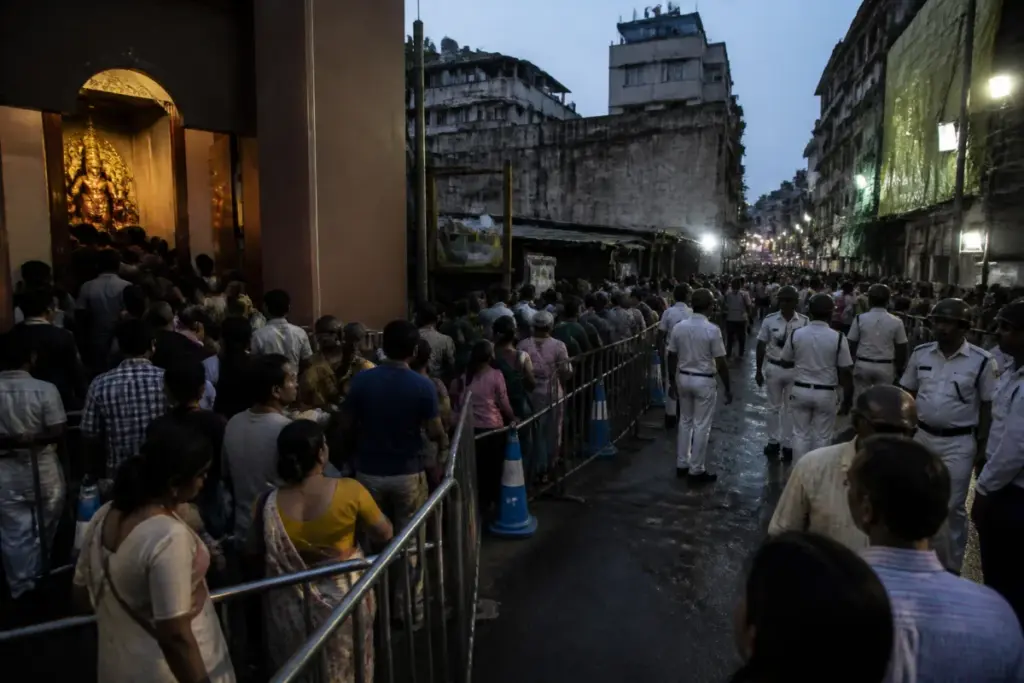
The reported stampede at the Chorbagan Sarbojanin puja pandal in Kolkata has triggered arrests and raised questions about lighting, access control, crowd movement and emergency response. A report by Bartaman Patrika – Kolkata said seven people had been arrested after the incident, while also stating that the initial account identified four arrests and later attributed the remaining three to crowd-control and decoration personnel.
According to the report, the incident took place on Saptami night at the Chorbagan puja pandal. The report attributed the investigation findings to Lalbazar, the headquarters of the Kolkata Police, and said investigators were examining several possible causes of the disaster. These included insufficient lighting near the idol, a narrow public entry and exit route, and alleged failures to follow police instructions.
The account said the arrested people included the secretary and vice-president of the puja committee, two employees of a private security agency, two people responsible for crowd control and one employee of a decorator company. However, the same report first stated that four people had been arrested and subsequently referred to three additional arrests. The exact number and identity of those arrested should therefore be established through an official police statement or court record.
The report said the lighting inside the pandal, particularly near the idol, was extremely poor. It further stated that the puja committee had allegedly been asked to arrange additional lighting but did not comply. In a high-footfall festival venue, inadequate lighting can affect both pedestrian movement and the ability of security personnel to identify congestion or distress. The supplied report does not provide an official inspection note, measurement of illumination levels or details of the instruction allegedly issued to organisers.
Access design is another issue identified in the account. Some people reportedly blamed the public entrance and exit route, describing it as narrower than the VIP gate. The report also attributed to police the claim that organisers had been asked to widen the gate but allegedly failed to do so. It does not establish the approved layout, the dimensions of the gates, the number of visitors present at the time or whether the route was intended to function simultaneously as an entry and exit passage.
These details matter because crowd safety at temporary festival structures depends on more than the strength of the pandal itself. It also involves the separation of incoming and outgoing movement, the visibility of escape routes, the deployment of trained personnel, the ability to prevent crowd accumulation and the availability of emergency access. The report identifies each of these areas as a potential point of failure but does not yet establish which factor directly caused the stampede.
The incident has also brought the emergency response under scrutiny. According to Bartaman Patrika – Kolkata, angry visitors alleged that they received little assistance from the Kolkata Police after the disaster and that ambulances were not available to transport the bodies to hospital. These are serious allegations, but the supplied material does not include a police response, ambulance deployment records, hospital statements or an official account of the number of injured or deceased people.
The reported arrests indicate that investigators are examining responsibility across several layers of the event: the puja organisers, private security personnel, crowd-control workers and the decorator. That approach reflects the way temporary public venues are managed in practice, where safety depends on coordination between event organisers, contractors, security agencies, police and municipal authorities. The available report does not specify the charges filed, the investigating agency’s case number, or whether the arrested individuals have been produced before a court.
The central question is therefore not only who has been arrested, but whether the venue’s crowd-management plan was properly approved, communicated and enforced. The answer will depend on documents and records that are not included in the supplied report, including permissions, site plans, police advisories, inspection reports, deployment details and emergency-response logs.
The investigation is continuing, according to the report. Official confirmation of the arrest count, the casualty figures, the cause of the stampede and the response of the puja committee and Kolkata Police remains necessary before responsibility can be conclusively established.


