

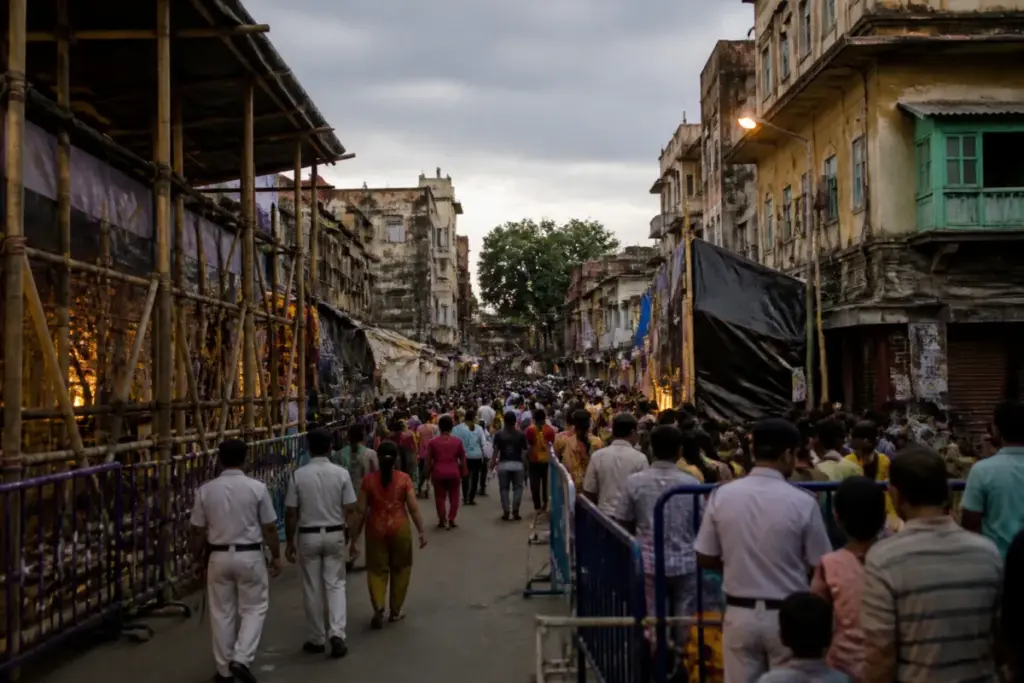
The Chorbagan incident has prompted Kolkata Police to examine crowd-control arrangements, private security qualifications and emergency access after allegations that stalls occupied 15 feet of a 25-foot-wide road near the puja venue. The development has also led to arrests, seizure of CCTV footage and restrictions on gatherings in the area.
Lalbazar, Kolkata Police headquarters, is investigating the cause of the incident at the Chorbagan Sarbojanin puja pandal, according to a report by Bartaman Patrika. The report said the police were examining the role of the private security agency responsible for managing the crowd at the venue.
Questions have been raised over whether the security guards deployed at Chorbagan had received adequate training for crowd management. The experience and eligibility of the agency engaged for the assignment are also being examined, the report said. Following the concerns, Lalbazar directed authorities to review the training, experience and qualifications of private security personnel deployed at different puja pandals.
The review will focus on whether the guards have the preparation and operational ability required to manage large gatherings. The move places private security arrangements under scrutiny at a time when major festival venues attract dense pedestrian movement and require coordinated entry, exit and emergency-response systems.
As part of the investigation, police have seized CCTV footage from the Chorbagan site. The footage is expected to form part of the inquiry into what happened at the venue and whether crowd-control arrangements were followed. The police have also imposed restrictions under Section 163 of the Bharatiya Nyaya Sanhita in the area. The order prohibits gatherings of five or more people, as described in the report.
Seven people have been arrested on preliminary allegations of dereliction of duty, the report said. Those arrested include the puja committee’s secretary and vice-president, two officials of a private security agency and several others. The arrests indicate that the investigation is examining responsibility across both the event organisers and the contracted security arrangement.
The use of road space for stalls has emerged as a separate concern. According to the report, stalls occupied around 15 feet of a road that was approximately 25 feet wide, leaving only about 10 feet available for movement. The arrangement has raised questions about how a substantial portion of an important road was allowed to be occupied during a high-footfall event.
The report also questioned why the police did not instruct the puja committee to remove the stalls and keep the road clear after the encroachment came to notice. A narrowed access route can affect the movement of pedestrians and emergency responders, making the allocation of road space a central part of public-safety planning around large temporary gatherings.
The Chorbagan case has therefore brought three operational issues into focus: the preparedness of private security personnel, the effectiveness of police supervision and the protection of emergency access routes around puja pandals. The immediate administrative response is the ongoing investigation, the review of security personnel deployed at other venues and the enforcement of restrictions in the affected area.


