

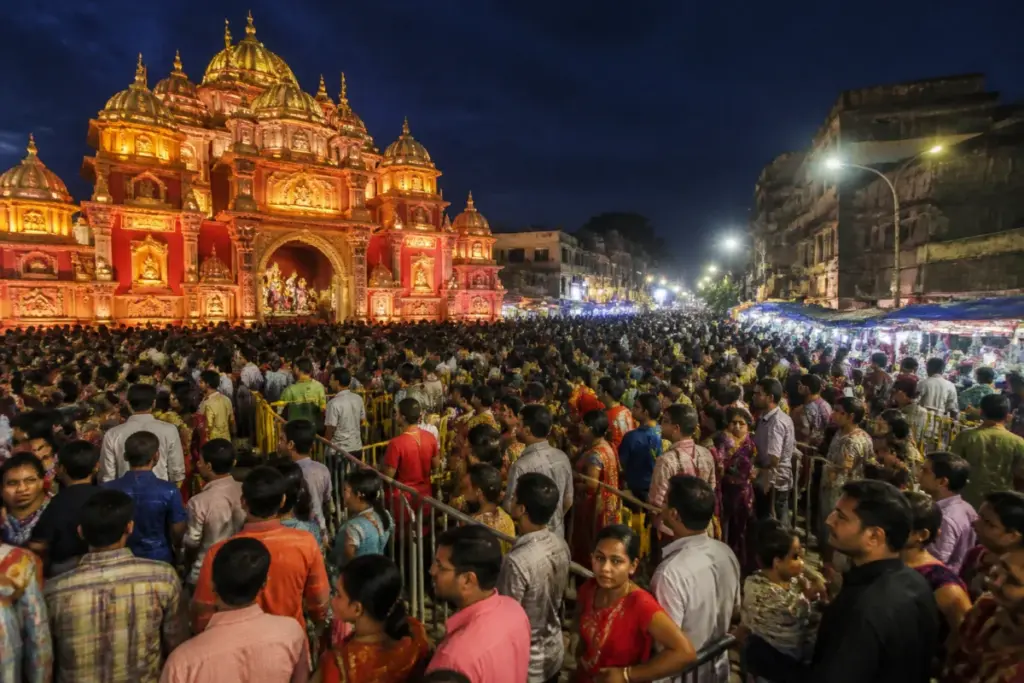
Kolkata saw heavy crowds at Durga Puja pandals on Maha Navami evening, with thousands of revellers queuing for hours across the city despite the recent death of 19 people in a stampede at a north Kolkata puja venue.
The crowds increased through the evening as visitors moved between illuminated streets and community marquees to see the idols before the festival concludes with Vijaya Dashami on Wednesday. People of different age groups visited pandals, sampled food at temporary roadside stalls and attended rituals at venues across the city.
The Statesman reported that almost all major puja pandals drew large gatherings. Children and families formed a significant part of the crowds, while long queues were seen at several prominent marquees. The festival atmosphere was also marked by sadness following Saturday evening’s stampede at the Chorbagan puja pandal in north Kolkata, where 19 revellers were killed and several others were injured.
According to Kolkata Police sources cited in the report, Durga Puja is being held at 3,319 venues this year, with nearly 400 venues added to the list. The scale of the festival has placed large parts of the city’s public realm under temporary crowd pressure, with roads, neighbourhood streets, food stalls and access points around pandals serving as the main movement corridors for visitors.
Maha Navami rituals began at 10.51 am on October 19 after the conclusion of Sandhi Puja, which is performed at the transition between Maha Ashtami and Maha Navami. The report said Navami ended at 12.50 pm on Tuesday, October 20, marking the beginning of Dashami according to the puja almanac.
Several high-profile pandals attracted particularly large crowds. Santosh Mitra Square in Kolkata’s Bowbazar area received the ‘Serar Sera’ or Best of the Best award under the West Bengal government’s Devi Durga Samman 2026. Its pandal was themed around Vande Mataram and commemorated the 150th anniversary of the national song.
Other prominent venues included Kashi Bose Lane in Hatibagan, which presented the theme Adim, meaning The Primitive Origin, and Ajeya Sanhati in southern Kolkata, whose theme Sarvangsaha represented endurance, patience and strength. Traditional pujas at ancestral homes, including Hatkhola Dutta Bari, Chatubabu-Latubabu’s residence, the Laha family home and the Mullicks’ house in Bhowanipore, also remained part of the city’s festival circuit.
Community celebrations were accompanied by bhog distributions at pandals. The food served to devotees included luchis, khichuri, vegetables, fish and mutton. Residential complexes across Kolkata also held their own pujas, adding to the number of neighbourhood-level gatherings during the festival.
Durga Puja began with Shashthi and is scheduled to conclude on Dashami, when idols will be immersed in rivers and ponds. This year’s observance extended over six days, with both Saturday and Sunday marked as Maha Saptami according to the puja almanac.
Wednesday’s immersion processions will bring the celebrations to a close. The final stage will follow several days of intense public movement across Kolkata, after the city’s streets and public spaces hosted crowds visiting thousands of temporary and permanent puja venues.


