

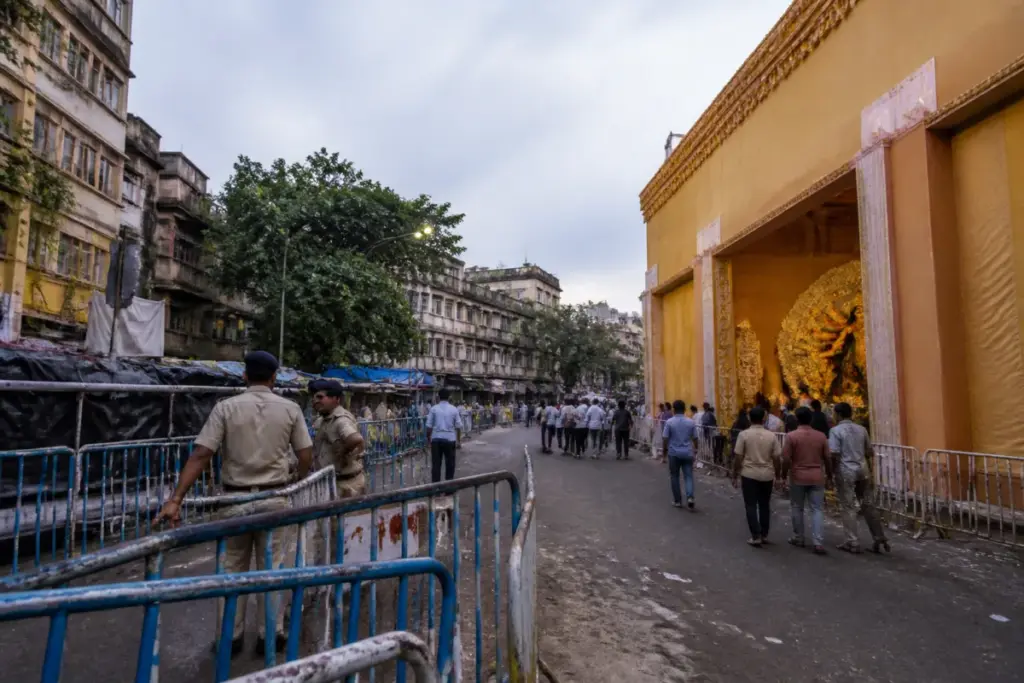
The Chorbagan stampede, in which 19 people died at a Durga Puja pandal in north Kolkata, has moved from a mass-casualty event to a test of how public institutions respond to families after an urban gathering turns fatal. West Bengal Chief Minister Suvendu Adhikari’s visits to the homes of two victims in Hooghly district, along with compensation and additional assistance, have provided immediate support. But the state has also announced an investigation under the supervision of a retired High Court judge, placing the circumstances of the incident and the responsibilities of the institutions involved under formal scrutiny.
According to The Statesman, Adhikari visited the families of Piyali Pramanik in Arambagh and Sriparna Poddar in Baidyabati. Both women were among those killed in the stampede at the Chorbagan Sarbojonin Durga Puja pandal on Saturday. The visits took place after the deaths and focused on compensation, family support and the investigation promised by the government.
The response illustrates two different obligations that follow a public disaster. The first is immediate relief: financial assistance, employment support and help with dependants. The second is institutional accountability: establishing what happened, how the crowd was managed, whether the venue and access arrangements were adequate, and whether warnings or operational failures contributed to the deaths. Compensation can address some of the financial consequences for surviving families, but it cannot answer those questions. The announced investigation is therefore the more important mechanism for understanding the event as a public-safety failure rather than only as a family tragedy.
The available account establishes the scale of the incident but does not provide details of the pandal’s layout, the size of the crowd, the number of entry and exit points, the presence of barricades, emergency access arrangements or the deployment of police and volunteers. It also does not state whether the venue had an approved crowd-management plan or whether any warnings had been issued before the stampede. These are not minor operational details. In any high-footfall public gathering, the movement of people depends on the relationship between the physical site and the systems controlling entry, circulation and exit.
That gap in the public account is significant because temporary religious and cultural venues are also pieces of urban infrastructure. They may be built for a limited period, but they attract large numbers of visitors, alter traffic and pedestrian movement, and require coordination between organisers, municipal authorities, police, emergency services and local representatives. Their temporary nature does not reduce the need for planning. It makes advance coordination more important because the site, access routes and crowd flows may change rapidly during the festival period.
The Chorbagan incident also highlights the difference between a city’s ability to host large gatherings and its ability to manage them safely. A popular pandal is not merely a cultural installation. It becomes a public destination, drawing visitors from neighbourhoods and, in some cases, from outside the immediate area. Once that happens, the public authorities must account for conditions beyond the structure itself: approaching roads, pedestrian bottlenecks, vehicle movement, emergency access and the possibility that visitors will arrive in waves rather than at a steady rate.
The government’s announced measures show how the response has been organised around individual households. Each bereaved family received a compensation cheque of Rs 25 lakh. Sanatan Pramanik, Piyali’s husband, said the chief minister also assured the family of a job, support for the child’s education and continuing assistance. Adhikari asked the Goghat and Arambagh MLAs to remain in contact with the family and address its needs.
For Sriparna Poddar’s parents, Sambhunath Poddar and Swapna Poddar, the announced support includes pension assistance. The government also offered a job to Swapan Poddar in the municipal health department and said arrangements would be made for the elderly couple to stay at the Ramakrishna Mission or another religious or social welfare organisation if they felt emotionally distressed. These measures reflect the different vulnerabilities created by a death: loss of income, the care of children, the needs of elderly parents and the psychological isolation that can follow the loss of a family member.
Yet the structure of the assistance also raises a wider governance question. Relief is often easier to announce and administer than prevention. A cheque can be handed over to a family and a job or pension can be promised through an identifiable administrative decision. Crowd safety is more dispersed. It requires multiple authorities and organisers to perform their responsibilities before an event, maintain communication during it and document decisions afterwards. The investigation will need to establish how those responsibilities were divided and whether the arrangements were sufficient for the number of visitors present.
The source report does not identify the agencies responsible for the pandal’s permissions, site inspection, traffic management or emergency response. Nor does it provide the government’s terms of reference for the inquiry under a retired High Court judge. Those details will be important in determining whether the investigation examines only the immediate cause of the stampede or the full chain of planning and supervision behind the event. A narrow inquiry may explain the final moments without revealing how the conditions for dangerous crowd movement developed.
The incident is especially relevant to municipal administration because public safety at temporary events cuts across institutional boundaries. The municipal system may deal with the site and health-related arrangements, the police may manage security and movement, event organisers may control the internal layout, and elected representatives may become the point of contact for affected families. When an incident occurs, the public needs to know not only who is offering relief but also which authority was responsible for each preventive measure.
This is where the promised investigation becomes central to the urban meaning of the Chorbagan stampede. Its outcome can establish whether the deaths resulted from a specific failure at the venue, a breakdown in coordination, insufficient capacity for the crowd, or a combination of factors. The supplied report does not establish any of these causes, and they should not be treated as facts before the inquiry reaches its findings.
The event also demonstrates why crowd management should be understood as a built-environment issue. People do not move through festivals in an abstract space. They move through gates, lanes, barricades, ramps, temporary structures and intersections. A change in one part of that system can affect the entire crowd. If entry and exit routes overlap, if a narrow passage receives more people than it can discharge, or if emergency vehicles cannot reach the site, the risk is created through the interaction between design and behaviour. The source material does not say whether any of these conditions existed at Chorbagan, but the investigation will need to examine the site in those terms.
For families, the immediate priority is support. For the city, the priority is learning whether the event exposed a preventable weakness in the way large temporary gatherings are approved and supervised. The two priorities are connected: a credible investigation can determine whether the state’s response stops at compensation or leads to changes in the systems that govern public events.
The announced compensation and family assistance provide a documented first response to the deaths of Piyali Pramanik and Sriparna Poddar. The larger facts remain with the investigation: what happened at the Chorbagan pandal, how the crowd was managed, which authorities and organisers had responsibility, and what steps will follow from the retired High Court judge’s inquiry. Until those findings are made public, the incident confirms the human cost of a stampede but not yet the institutional cause.


