

Karnataka generated 2.04 crore person-days of employment under the Viksit Bharat-Guarantee for Rozgar and Ajeevika Mission (Gramin), or VB-G RAM G, between July 1 and October 13, state Rural Development and Panchayat Raj Minister Eshwar Khandre said on Wednesday. The figure is higher than the 1.71 crore person-days generated under the Mahatma Gandhi National Rural Employment Guarantee Scheme during the corresponding period last year.
VB-G RAM G was implemented in Karnataka from July 1 after replacing MGNREGA. Khandre said the increase came as the state faced a rainfall deficit attributed to the El Nino effect, leading to employment being provided to a larger number of rural poor, Dalits, disadvantaged unskilled workers and landless labourers.
Raichur district in the Kalyana Karnataka region recorded the highest employment generation, with 24 lakh person-days during the period. Bidar followed with 21 lakh person-days, while Koppal recorded 18 lakh person-days, according to the minister’s statement.
The increase was particularly pronounced in several districts. Employment generation rose by 340 per cent in Vijayanagara compared with the previous year, followed by increases of 257 per cent in Kalaburagi, 207 per cent in Koppal, 175 per cent in Ballari and 173 per cent in Bidar, Khandre said.
The state has also begun e-KYC verification of job cards issued under the earlier employment guarantee programme and is organising job card camps to distribute new cards. Khandre said these measures had helped hundreds of families obtain work in their villages instead of migrating in search of employment. A total of 87,164 new job cards have been issued in Karnataka this year, he added.
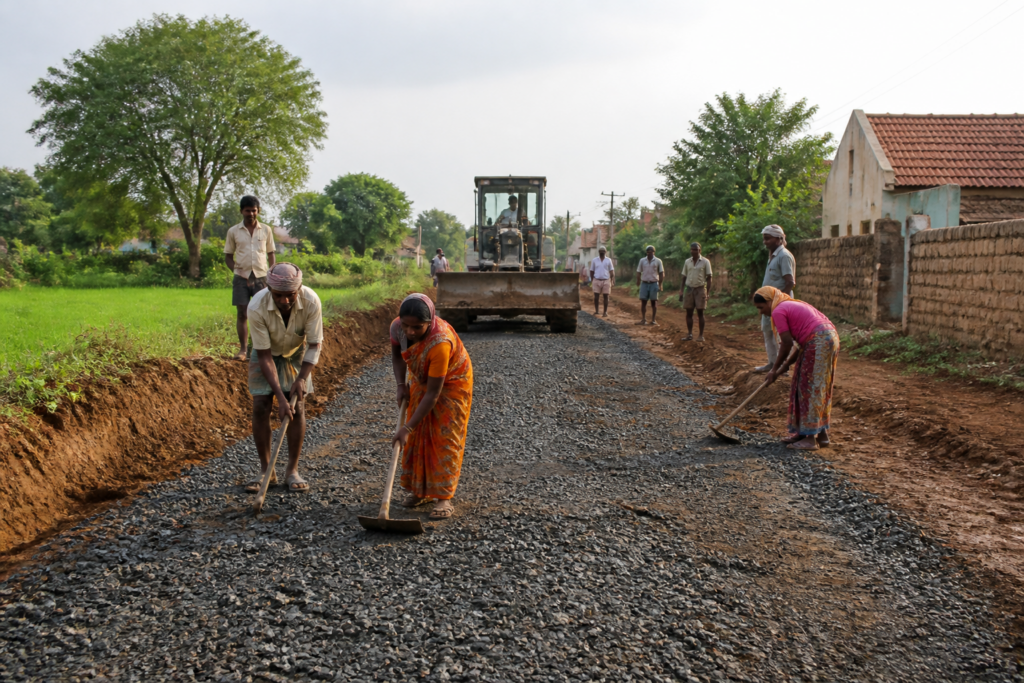
Works being undertaken under the scheme include desilting lakes, social forestry, rejuvenation of canals, lakes and ponds, construction of cattle sheds and farm ponds, soil-erosion prevention measures on hill slopes, compost pits and rural connectivity roads. The scheme has also been expanded to cover construction of houses under housing schemes, community halls and rural bus stands.
The expansion gives the programme a wider role in village-level asset creation alongside wage employment. The works listed by the state span water systems, land management, local transport access, housing and community infrastructure. However, the statement did not provide district-wise spending, the number of households that received work or details of project completion.
Under VB-G RAM G, each eligible family can receive up to 125 days of employment a year. The wage has been fixed at Rs 382 per day for both men and women, without gender discrimination. A rural household receiving the full entitlement could earn up to Rs 47,750 annually, Khandre said. The state’s current implementation will therefore determine how consistently households receive work and how the employment is linked to durable village assets.


