

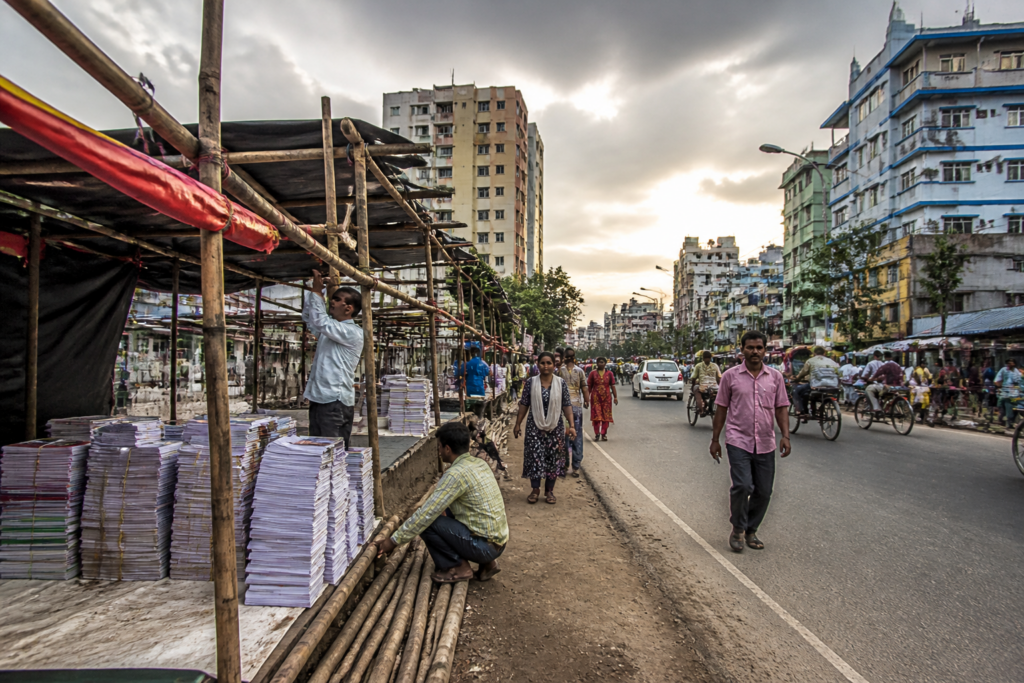
The Calcutta High Court has sought a detailed police report on the permissions and construction status of temporary bookstalls planned during Durga Puja in the Bongaon-Naihati and Jessore areas, after the Communist Party of India (Marxist) alleged that it was being denied permission while another organisation had been allowed to build a temporary structure at the same location.
Justice Saugata Bhattacharyya directed the police to submit the report by Thursday. The report must state how many stalls are being set up, whether construction work has started and whether the Public Works Department has granted the necessary permission. The court also sought details of which organisations have received permission from the department to establish bookstalls.
The case concerns a practice followed for several years, according to the submissions made on behalf of the CPI(M). Temporary bookstalls are set up in the area during the Durga Puja period. The party approached the court after claiming that police permission was not being granted this year, while the Hindu Jagaran Mancha had allegedly been permitted to create a temporary structure at the same location.
During the hearing, the CPI(M)’s lawyer told the court that bookstalls had been allowed in the area for many years but that permission had suddenly been withheld this time. The lawyer also referred to the alleged permission granted to the other organisation.
The state government’s Advocate General, Surjitonath Mitra, responded that the CPI(M) had applied to the sub-divisional magistrate for permission. Since the land falls under the Public Works Department, he questioned how the sub-divisional magistrate could grant the required approval. He argued that an application should instead have been made to the Public Works Department for setting up the bookstall.
The exchange brought the permissions process for temporary structures into focus. The court’s direction requires the authorities to clarify not only whether stalls are being erected, but also which agency is responsible for approving them and whether the same standard has been applied to different applicants.
Justice Bhattacharyya questioned the distinction between bookstalls and other temporary commercial structures commonly seen during public festivities. “If balloon-and-toy gun stalls can be set up, why can’t a bookstall be set up? You are not going to set up a lottery shop there. It will be a bookshop,” the judge observed, according to the report. The court also asked what difficulty there was in allowing such a stall.
The immediate issue before the court is therefore not a final ruling on the bookstall’s continuation, but the factual and administrative basis for granting or refusing permission. The police must now place the requested information before the court, including the number of structures, their construction status and the Public Works Department’s approvals.


