

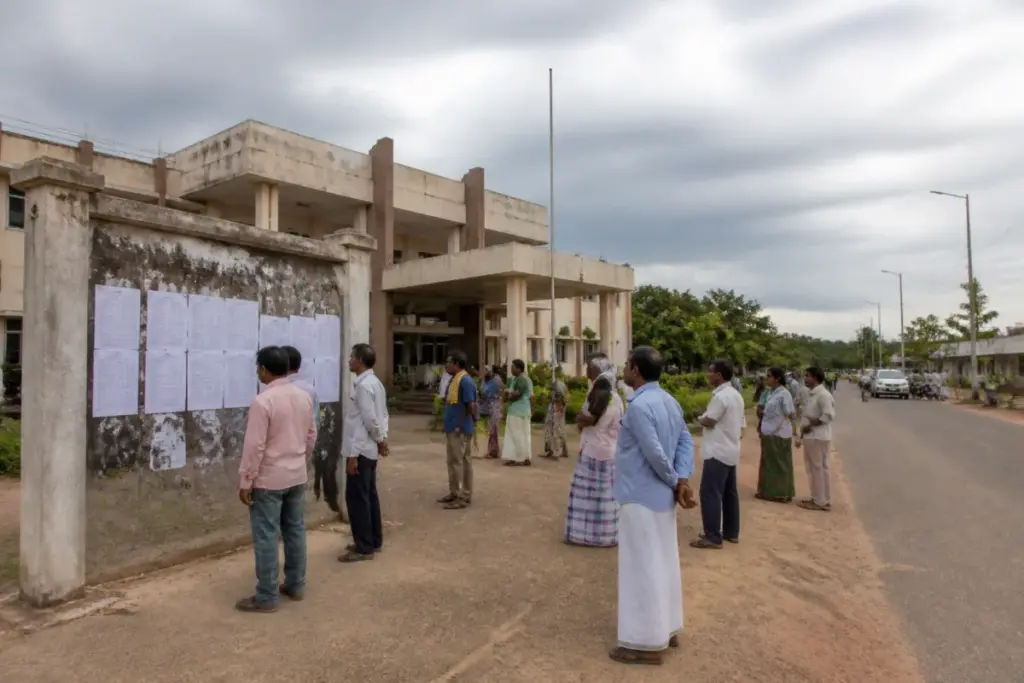
A demand for higher Other Backward Classes (OBC) reservation in Karnataka’s local-body elections has brought an unresolved administrative question back into focus: how should political representation be distributed when the population data and evidence of past representation remain contested? At a press conference in Davangere, G.B. Vinaykumar, founder-president of the Swabhimani Balaga, alleged that OBC communities were being denied fair representation because reservation allocations had been made without a scientific survey.
The figures cited at the press conference show the scale of the dispute. Of Karnataka’s 1,229 Zilla Panchayat constituencies, 226, or about 18 per cent, have been reserved for OBC communities, according to Vinaykumar. At the Taluk Panchayat level, he said, only 630 of 3,566 constituencies, or about 16 per cent, had been allocated to OBC candidates.
Vinaykumar argued that these shares do not correspond to the population estimates cited by OBC groups. He referred to the 2022-23 report of the Kantharaj Commission, which he said estimated Karnataka’s OBC population at 44 per cent. He also cited estimates from other commissions placing the OBC population between 50 and 55 per cent. On that basis, he demanded 33 per cent reservation for OBC communities in local-body elections.
The figures, however, are part of a political and legal demand rather than an independently established finding in the supplied report. The report does not provide the full text of the Kantharaj Commission’s findings, the methodology used for the other estimates, or the government’s explanation for the current allocation. That absence is central to the dispute: the political argument is about representation, while the administrative process depends on what data is officially collected, accepted and applied.
## The data question behind the reservation dispute
Vinaykumar alleged that governments were not conducting the scientific study needed to determine OBC representation. He also said that no scientific or practical assessment had been carried out on OBC representation over the past 75 years, referring to directions of the Supreme Court. The report does not specify the exact judicial order or explain the legal chronology behind that claim. It does, however, identify the broader institutional problem: local-body reservation cannot be separated from the quality and availability of population and representation data.
The demand for a scientific survey therefore has two dimensions. First, it concerns the size of the OBC population in Karnataka. Second, it concerns whether OBC communities have received representation in proportion to their population and whether the existing distribution has corrected or reproduced political disadvantage. These are related questions, but they are not identical. A population estimate alone does not establish how seats should be allocated, while a seat allocation without a transparent evidentiary basis can invite allegations of arbitrariness.
The report also says that the Supreme Court’s “triple test” is mandatory for providing OBC reservation in local-body elections. Vinaykumar alleged that courts had rejected additional reservation because governments had failed to provide the required data. He accused successive governments of delaying the reservation process and creating technical obstacles that could postpone elections.
Those allegations are attributed to Vinaykumar and are not independently confirmed in the supplied material. The report does not identify the specific cases in which additional reservation was rejected, the courts that passed those orders, or the data that governments allegedly failed to submit. These details will matter if the controversy moves from a political demand to judicial scrutiny.
## Why local-body reservation has wider consequences
The dispute concerns Zilla Panchayats and Taluk Panchayats, institutions that sit close to the delivery of public services and local development decisions. The report does not list specific schemes or functions affected by the reservation allocations. It does establish, however, that the contested seats are within Karnataka’s rural local-government structure and that the question is about access to elected political office at that level.
Local elections are also an administrative exercise involving delimitation, reservation notifications and the scheduling of polls. When the reservation process is challenged, the dispute can affect more than the distribution of tickets among political groups. It can raise questions about whether constituencies were identified through a consistent method, whether the notification reflects updated data and whether the process can withstand legal examination.
Vinaykumar alleged that political leaders interfere in reservation allocation in some taluks and alter reservations to suit their interests in particular constituencies. He specifically accused legislators of changing reservations in ways favourable to them in their constituencies. The report does not provide examples, documents or responses from the legislators concerned. The allegation nevertheless points to the importance of a process that is publicly explainable and insulated from constituency-level pressure.
For residents, the immediate issue is not simply the percentage printed in a reservation notification. It is whether the notification can be understood: what population base was used, what historical representation was assessed, how rotation was determined and which authority approved the final allocation. Without that information, affected communities are left to contest the outcome through political mobilisation or litigation rather than through a transparent administrative record.
## The Karnataka figures remain contested
The contrast between the cited OBC population estimates and the notified seat shares is the strongest numerical argument presented at the press conference. Vinaykumar cited an OBC population estimate of 44 per cent from the Kantharaj Commission and estimates of 50 to 55 per cent from other commissions, against reservation shares of about 16 to 18 per cent in the local bodies mentioned.
But the comparison requires careful interpretation. The source report does not establish whether the population estimates refer to the entire state population, the population eligible for a particular category of reservation, or a population measured using the same administrative units as the local-body constituencies. It also does not state whether the 16 and 18 per cent figures include any legal ceiling, exclusions, rotation rules or adjustments for other reserved categories.
This lack of comparable information is why the demand for a new survey has administrative significance. A credible process would need to clarify the population base, the unit of measurement and the method used to translate the findings into constituency-level reservation. The supplied report does not say whether the state has announced such a study or whether a new data-collection exercise is under consideration.
The report also refers to Tamil Nadu, where total reservation was raised to 69 per cent and protected under the Ninth Schedule of the Constitution. Vinaykumar cited this as an example of a different approach to reservation. The report does not explain the constitutional history, legal conditions or applicability of that example to Karnataka. It is therefore best understood here as part of the political argument being made by the OBC representatives, not as a settled template for Karnataka.
## A possible legal challenge
Virupakshappa, president of the Davangere District Kuruba Vidyavardhaka Sangha, said an application would be filed before the High Court seeking directions to correct alleged injustice to OBC communities in the reservation notification. He demanded that 10 to 12 of Davangere’s 29 Zilla Panchayat constituencies be reserved for OBC communities.
That proposed litigation could shift the issue from a general demand for representation to a challenge involving a specific district and notification. The report does not provide the text of the notification, the legal grounds of the proposed petition or the date on which it will be filed. It also does not state whether the High Court has already admitted any case on the issue.
The proposed petition makes the documentary record especially important. The court would need to examine the basis on which the reservation was calculated, the data available to the authorities, the process followed in assigning constituencies and the relationship between state-level estimates and district-level allocations. None of those records is included in the supplied report.
## What the dispute leaves unanswered
The controversy currently rests on a combination of official-looking reservation figures, population estimates cited by OBC representatives and allegations about the absence of scientific data. The figures for Zilla Panchayat and Taluk Panchayat seats are specific, but the source does not reproduce the government notification from which they were drawn. The population estimates are attributed to commissions and other assessments, but the underlying methodology is not supplied. The legal claims refer to the Supreme Court’s triple-test requirement without identifying the relevant orders.
These gaps do not make the issue insignificant. They define the questions that must be answered before the dispute can be assessed conclusively. The state’s position, the reservation notification, the relevant court directions and the underlying population and representation data will determine whether the current allocation reflects a lawful methodology or whether it requires revision.
For now, the central urban-governance lesson is that local democracy depends not only on holding elections but also on making the allocation of political opportunity transparent. Karnataka’s OBC reservation dispute shows how quickly a reservation notification can become a wider test of data quality, institutional accountability and confidence in local-government processes. The next significant developments will be the state’s response to the allegations and whether the proposed High Court petition is filed and taken up.


