

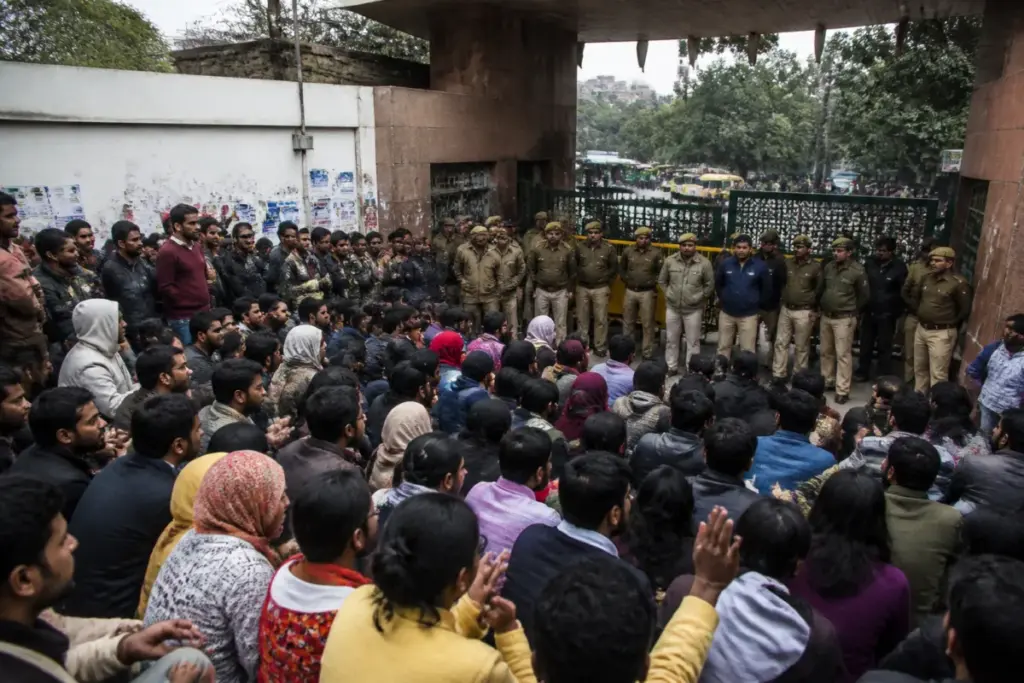
Jamia protest tensions escalated on Saturday after students staging a hunger strike demanding the restoration of student union elections alleged that they were forcibly removed from the protest site, while the university denied using force and said they had been asked to vacate an unauthorised location.
The students had been on hunger strike since October 12 at Jamia Millia Islamia in New Delhi. They are seeking the restoration of student union elections, which were last held in 2006. On Saturday, Ebin Basil, the university’s National Students’ Union of India unit general secretary, said he received a one-year rustication notice. Jasim Ali, a postgraduate student, was issued a six-month campus ban order.
The Jamia unit of the NSUI alleged that around 60 security guards, accompanied by the chief proctor and security adviser, reached the protest site at about 5.30 a.m. and dragged away the students. The administration rejected the allegation of force, saying the students had been asked to vacate the location because they were protesting outside the designated area.
The episode led to another demonstration at the university gate. Students alleged that at least 12 protesters were detained by the police while protesting against the removal. A senior police officer said the protesters were removed from the campus gate for allegedly destroying public property. The officer said they were released in the evening without charges.
The university also announced that the campus would remain closed for five days for upcoming festival holidays. The closure comes as the administration and student groups remain at odds over the permitted location and scope of protests on campus.
Jamia has not conducted student union elections since 2006, when the process was discontinued after campus violence. A university spokesperson said the administration had received no written representation on the issue. The spokesperson said department-level student elections had developed over the years and were serving the campus.
The present dispute follows a series of restrictions on campus demonstrations. In October last year, the university earmarked a location near Gate No. 18 as the designated protest site and declared other parts of the campus out of bounds for protests. The move followed earlier confrontations over demonstrations against alleged administrative restrictions on democracy and freedom of speech.
In February last year, 14 students were detained from inside the campus while protesting against what they described as administrative clampdowns. Police had alleged that the students vandalised public property and disturbed law and order.
The Jamia dispute is also unfolding amid wider concern among Delhi student groups and activists over the narrowing space for public protest. They have cited the recent denotification of Jantar Mantar as a protest site, daily detentions and the imposition of Section 163 of the Bharatiya Nagarik Suraksha Sanhita in parts of the capital. The immediate next steps will depend on the university’s disciplinary action, the students’ response and the reopening of the campus after the announced five-day closure.


