

Delhi’s three newly designated protest sites reveal a problem that cannot be solved merely by marking alternative grounds on a map. Ramlila Maidan, CBD Ground in Shahdara and Burari Ground offer space for demonstrations after Jantar Mantar was denotified, but their distance, physical condition, availability and relationship with the city’s political core will determine whether they function as genuine public forums or only as formally approved locations.
The practical gap between designation and usability is visible at all three venues. Ramlila Maidan is the closest to Jantar Mantar, at about 3–4 km, but it is heavily used for religious celebrations, fairs, political rallies, marches, parking and other events. CBD Ground, a roughly 12-acre Delhi Development Authority property in east Delhi, is around 13 km from Jantar Mantar and was reported to have tall grass, muddy patches and scattered garbage. Burari Ground, also known as Nirankari Ground, is the largest site at around 50 acres but is approximately 23 km away and has restricted access, uneven terrain and limited basic infrastructure.
This makes the issue an urban planning question as much as an administrative one. A protest venue is not simply an open plot with enough carrying capacity. It must also be reachable by participants, visible to the public, connected to transport and equipped to handle sanitation, shade, crowd movement, traffic and emergency access. The three sites show how a venue can satisfy the spatial requirement for gathering while failing to provide the wider urban conditions that make a public gathering workable.
Jantar Mantar’s importance developed from its location as much as from its designation. Situated in central Delhi, it placed demonstrations close to Parliament, government offices, media organisations and the everyday movement of residents and workers in the capital. The site had hosted more than 600 demonstrations for free over the past decade, according to the report. Its proximity meant that a protest could be seen and heard within the institutional geography where many demands were directed.
The three replacement venues change that relationship between dissent and the city. Ramlila Maidan remains relatively central, but its location amid dense neighbourhoods and busy roads creates traffic-management pressures. It is managed by the Municipal Corporation of Delhi, which charges around ₹50,000 a day, apart from a refundable security deposit, and requires a no-objection certificate from the Delhi Traffic Police. The ground can accommodate around 50,000 people, but its event calendar and commercial terms may limit how regularly or easily it can be used.
The venue’s physical condition also matters. During The Hindu’s visit, parts of Ramlila Maidan were occupied by conical tents, a giant wheel, amusement rides and food stalls as Dussehra celebrations continued. Puddles made movement across portions of the 12-acre site difficult. These details do not establish that the ground cannot host demonstrations, but they show that availability and readiness are variable rather than permanent conditions.
CBD Ground presents a different problem. Its location in Shahdara places demonstrations closer to east Delhi’s residential colonies, markets, hotels and commercial establishments, but farther from the central political district. One section has a reported capacity of around 15,000 people. The ground is also used for community events and weddings, while portions observed during the visit were occupied by Ramlila celebrations and a fair.
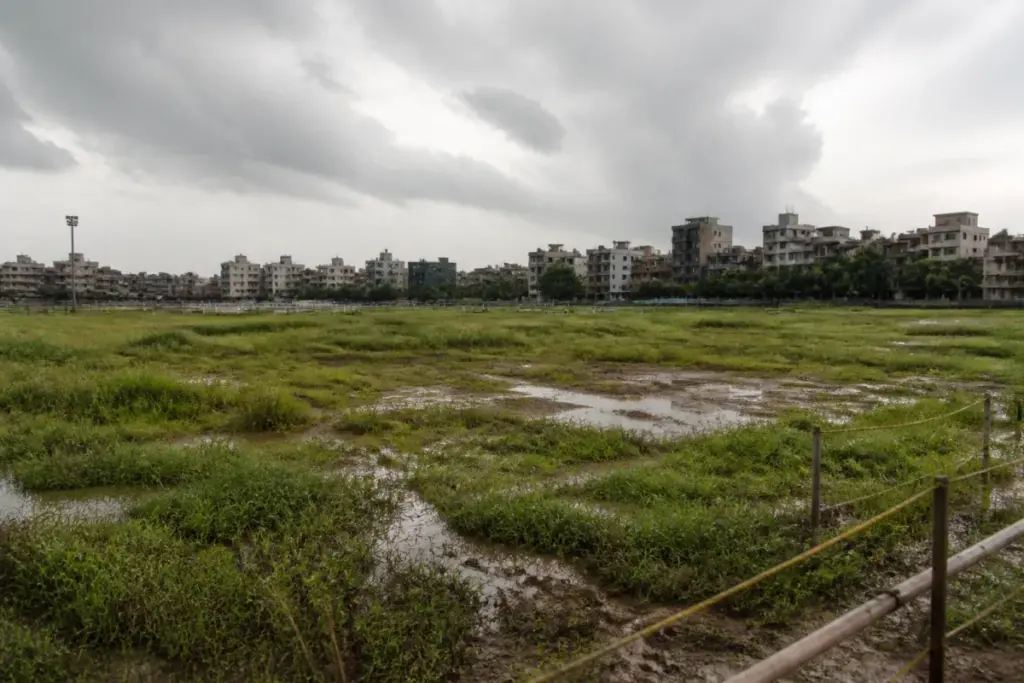
The condition of the site raises questions about preparation. Grass reportedly reached six feet in parts of the ground, with muddy patches and scattered garbage. A venue that is physically open but not maintained for regular public use can transfer the cost of basic readiness to organisers and participants. The available material does not establish whether a maintenance schedule, permanent public amenities or a dedicated event-management system has been put in place for CBD Ground.
Burari Ground has the greatest area but the weakest connection to the central city. It lies along the Outer Ring Road and includes waterlogged stretches, green patches, tarred tracks and unpaved routes. The ground has no shade, making temporary tents necessary for prolonged demonstrations. Wire fencing ran around the perimeter, while wide pits at entry points prevented vehicles from entering during the reported visit.
The site’s existing relationship with local residents is also significant. Locals told The Hindu that the ground had been used informally for cricket, football and other sports. Driving learners practised there, and cattle grazed across the open expanse. That suggests the land already functioned as a loosely shared urban space before being considered as a protest venue. Converting such a space into an organised demonstration ground would require decisions about access, scheduling, safety and the competing uses of the land.
Distance is not only a matter of travel time. It affects who can participate, how easily journalists and observers can reach a gathering, and whether a demonstration enters the visual and political life of the capital. Burari’s distance from Jantar Mantar is especially relevant because the venue is removed from the institutions and public spaces that protesters may seek to address. During the 2020–21 farmers’ agitation, farmer unions rejected a government proposal to shift their demonstration to Burari, describing it as an “open jail”.
That earlier description is not proof that every future demonstration at Burari would face the same conditions. It does, however, show that the question of location has been contested before. The central issue is whether a large, peripheral ground can provide public visibility and meaningful access in the same way as a smaller venue near the administrative centre. The source material indicates that this remains unresolved.
The legal and administrative context has also shaped the change. Delhi Police formally denotified Jantar Mantar as a designated protest venue on October 12, 2026, following mass agitations demanding the resignation of the Chief Election Commissioner, according to the report. Police told the Delhi High Court that the denotification was based on a Supreme Court order. Activists and Opposition parties criticised the decision, alleging that it restricted citizens’ right to protest.
The dispute has therefore moved beyond the question of which ground is available. It concerns the administrative design of public assembly: who approves a demonstration, what infrastructure must be provided, how costs are imposed, how traffic and security are managed, and whether the location allows a protest to remain visible to the institutions and citizens it seeks to reach. These responsibilities are divided among the police, civic bodies, the DDA and venue managers, creating the need for clear operating procedures.
Delhi Police said revised standard operating procedures for the three venues would be issued. Those procedures will be important because the current evidence points to different conditions at each site. Ramlila Maidan has higher centrality but costs and scheduling constraints. CBD Ground has an urban location in east Delhi but reported maintenance and capacity limitations. Burari Ground offers the largest area but is the farthest away and lacks the physical infrastructure associated with a developed public venue.
The comparison also shows why capacity alone is an inadequate measure. Ramlila Maidan’s reported capacity of around 50,000 people is larger than the approximately 15,000-person capacity cited for one section of CBD Ground, while Burari spans around 50 acres. Yet the ability to host a gathering depends on more than the number of people who can stand on the land. Routes to the site, entry points, shade, ground conditions, sanitation, traffic management, booking costs and availability all influence whether the capacity can be used in practice.
The reported locations also reveal a distributional question. Ramlila Maidan is closest to the established protest centre but may be expensive or unavailable. CBD Ground shifts the venue to east Delhi, while Burari places it on the northern edge of the city’s established protest geography. Protesters travelling from across Delhi would face different burdens depending on where they live, how long they can remain away from work or home, and whether they can absorb transport and event-related costs. The source does not provide travel-time or demographic data, so the scale of that burden cannot be quantified from the available evidence.
What can be established is that the transition away from Jantar Mantar has created a mismatch between formal designation and operational readiness. The three grounds are not equivalent substitutes. They differ in size, centrality, maintenance, availability, cost and the nature of the surrounding urban fabric. Treating them as interchangeable would overlook the infrastructure that allows public assembly to function.
The next decisive step is the release of the revised standard operating procedures. Those rules will clarify how demonstrations are to be organised at the three venues and may indicate how the authorities intend to address access, booking, traffic, site preparation and competing uses. Until then, Delhi has designated replacement grounds, but the evidence from the sites suggests that the city has not yet demonstrated that they can collectively perform the civic role once associated with Jantar Mantar.


