

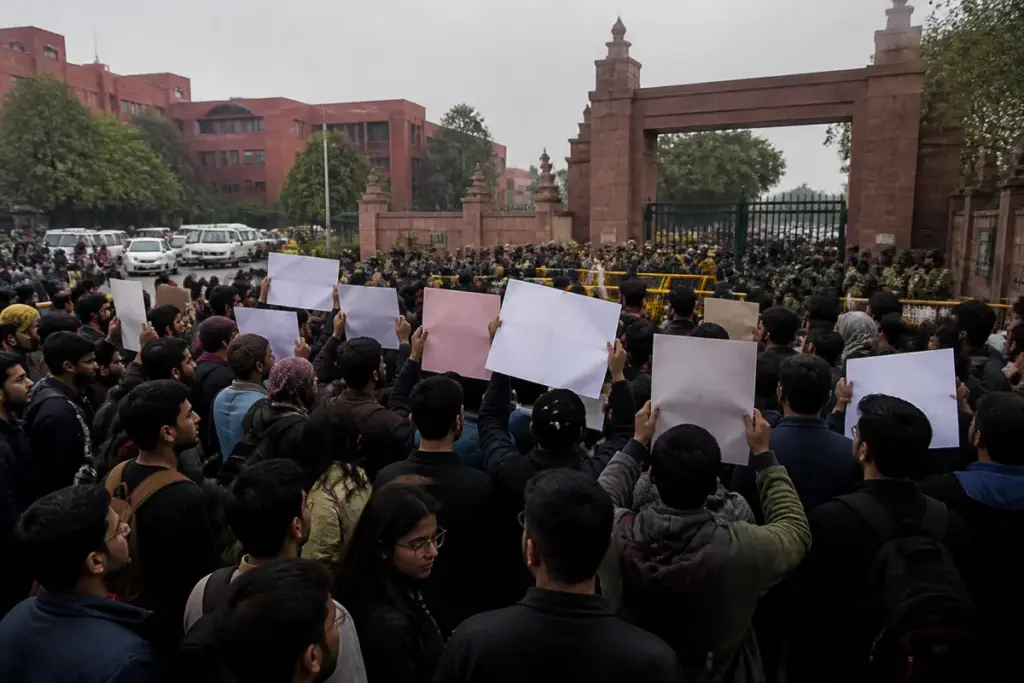
A Jamia protest over the restoration of the student union intensified on Saturday after students sitting on hunger strike were removed from their demonstration site, prompting allegations of assault, university disciplinary action and a fresh mobilisation at Gate 7 of Jamia Millia Islamia in New Delhi.
The students had been protesting near Gate 7 of the Gulistan-e-Ghalib Lawn since the evening of October 12. Five students were on hunger strike when they were removed from the site at about 5:30 am on Saturday, according to a report by Jagran – New Delhi. The students alleged that security personnel dragged them towards Gate 7 and assaulted them. They claimed that six students suffered minor injuries.
The university administration rejected the allegations as baseless. It said two students had been sent to hospital after their health deteriorated. The report identified Mohammad Jasim and Evin as among those whose condition worsened. Students alleged that security personnel pulled their hair and struck them in the abdomen, while videos of the incident were circulated on social media. The report did not independently establish the allegations or the authenticity of the videos.
The dispute later moved beyond the original protest site. Students resumed demonstrations at Gate 7 in the afternoon, and about 300 students gathered by evening to attempt entry into the campus. Some protesters entered the university premises, after which they marched towards the Vice-Chancellor’s gate while carrying posters of the Vice-Chancellor and registrar.
Security personnel detained several students and handed them over to the police, according to the report. Police and paramilitary personnel were deployed at all campus gates as tensions continued late into the night. The university also shut electricity across the campus as a precautionary measure, the report said.
The protest is centred on the demand to restore the student union. The immediate confrontation has raised questions about how universities manage prolonged demonstrations, hunger strikes and access to campus facilities while maintaining security and disciplinary control. In this case, the competing accounts concern both the treatment of protesting students and the administration’s response to alleged misconduct and unauthorised entry.
Jamia’s disciplinary action targeted three students. Mohammad Jasim was barred from entering the campus for six months. The administration accused him of entering the campus without permission on October 12, misbehaving with security personnel, using abusive language and violating discipline, among other charges. It also cited absence from classes.
Evin, a student of the BA LLB (Honours) programme, was barred from campus for one year and suspended. Another student, Rehan, was also suspended. The report did not provide the students’ responses to these disciplinary orders or details of any formal appeal process.
Students have demanded an independent investigation into the entire episode. The administration’s position, the students’ allegations and the disciplinary measures now form the central points of the dispute. The next publicly reported development will depend on whether the university orders or agrees to an independent inquiry and how the student protest is handled on campus.


