

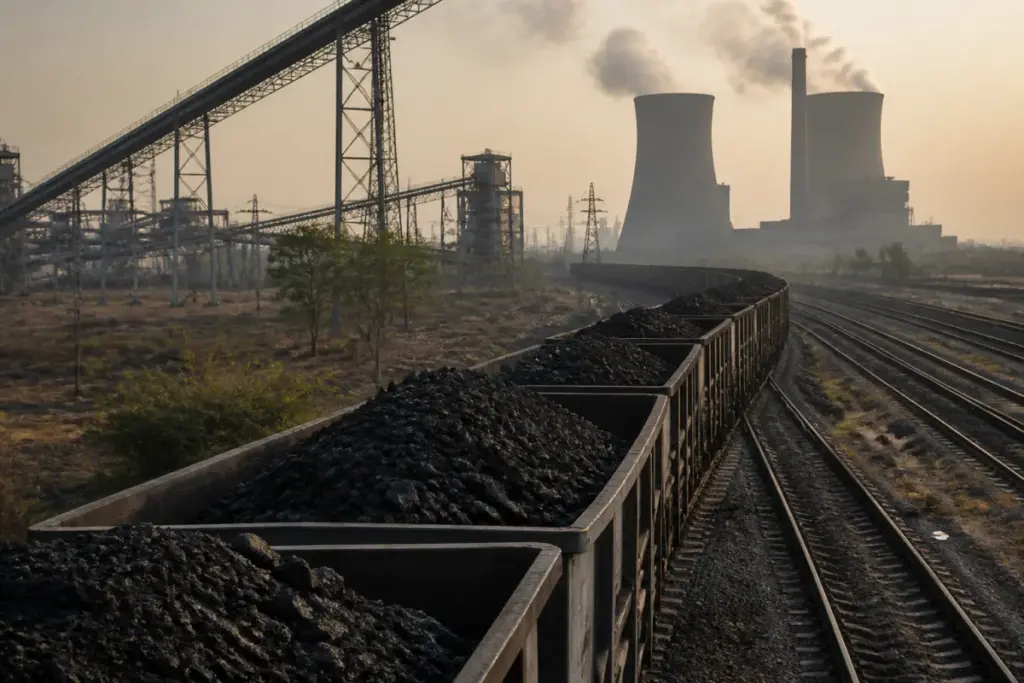
India’s decision to shelve a proposal requiring power plants to import coal is more than a short-term response to expensive overseas fuel. It reveals how tightly the country’s electricity security remains linked to domestic mining, railway capacity, monsoon conditions and the cost of keeping coal-fired generation available when other sources weaken.
The proposal was considered after coal inventories at Indian power plants fell to their lowest level in nearly five years, according to the report by Times of India, citing Bloomberg and people familiar with the discussions. The plan would have asked power plants to blend imported coal with domestic supplies to ease the shortage. It was put on hold after elevated international coal prices and a weaker rupee made overseas purchases more expensive.
Instead, policymakers have asked state-owned Coal India Ltd to raise production and the railways to ensure that coal reaches power stations on time. That choice places the immediate burden of stabilising electricity supply on the domestic fuel chain rather than on international procurement. It also means that the effectiveness of the response will depend not only on how much coal is mined, but on whether it can be loaded, transported and delivered at the required pace.
The immediate pressure has come from a combination of demand and supply conditions. Higher electricity consumption, reduced hydropower generation and temperatures that remained elevated beyond the summer months have increased the dependence on coal-fired plants. Below-normal rainfall reduced hydropower output, while demand for cooling and irrigation continued to place pressure on the electricity system.
The result was a sharp deterioration in power availability during September. The report said India’s electricity deficit in that month was the worst for September in nearly a decade. At the same time, coal reserves at generating stations declined rapidly. Nearly half of India’s power plants had critically low inventories as of October 17, with stocks below a quarter of their required levels.
That figure needs to be read carefully. The coal ministry has said that a plant classified as having critical stock is not necessarily about to run out of fuel or shut down. The classification is an early warning measure. The ministry also said that plants with low inventories were being monitored and that supplies were being redistributed to support uninterrupted generation.
Still, the inventory data shows the scale of the operational challenge. Central Electricity Authority data cited in the report showed that 87 of 190 coal-fired power plants had critical stocks as of October 8, up from 50 in the first week of September. These plants held 20.6 million tonnes of coal, equivalent to 33 per cent of the recommended stock of 61.2 million tonnes.
The numbers point to a system operating with limited room for disruption. A power plant’s security of supply is not determined only by the total amount of coal available nationally. It depends on the location of the mine, the plant’s distance from the mine, railway loading capacity, wagon availability, route congestion and the plant’s ability to maintain a buffer. A national supply improvement can therefore coexist with acute shortages at individual stations.
This is why the decision has shifted attention to transportation. The coal ministry said daily supplies to the power sector had increased by around 36 per cent from September levels and that the pace of inventory depletion had moderated. Railway loading averaged more than 465 rakes a day in October, while the target of 470 rakes was achieved on three consecutive days. Supplies moved by road and other modes had also improved.
The report said sustained transportation of 465 to 475 rakes a day should help stabilise inventories and support stock rebuilding ahead of festive-season, winter and subsequent summer demand. That objective is significant because coal logistics must respond to a changing demand pattern rather than only to the shortage visible at a particular moment.
The slowdown in stock depletion during October suggests that the situation was not moving in the same direction as it had in September. Bloomberg’s calculations based on power ministry data showed that domestic coal-burning plants recorded an average daily inventory decline of about 48,000 tonnes during the first 17 days of October, around one-fifth of the rate seen in September.
However, slower depletion is not the same as adequate replenishment. The system still has to rebuild stocks while plants continue to generate electricity. The government expects consumption to ease as temperatures fall and coal inventories recover. Average temperatures are forecast to decline slightly over the following two weeks, although they are expected to remain above the 30-year normal, according to the European Centre for Medium-Range Weather Forecasts.
The import option was weakened by conditions outside the power sector’s direct control. Benchmark thermal coal prices were reported to be at their highest level in three years. A weaker rupee raised the domestic cost of buying fuel in dollars, while higher oil prices increased India’s overall energy import bill. Importing coal during a shortage can provide supply flexibility, but it also exposes power producers and the wider electricity system to currency and international commodity risks.
That cost pressure helps explain the preference for domestic production and improved transport. India has previously required power plants to import coal to supplement domestic supplies during shortages. In the current situation, however, policymakers appear to have judged that mandatory imports would impose too high a cost at a time when the currency and international fuel markets were working against the measure.
The decision also underlines the institutional division within India’s electricity supply chain. Coal India is responsible for increasing production, the railways must move the fuel, the coal ministry monitors supplies and the power ministry tracks plant inventories and electricity conditions. Power generators, meanwhile, must operate within the constraints created by fuel availability, demand and plant-level stock requirements.
A separate order requiring more than 100 captive coal-fired power plants to operate at maximum capacity from October 1 until the end of the year adds to this coordination challenge. The order was intended to meet an expected rise in electricity demand. Running plants at maximum capacity can support supply, but it also increases the importance of dependable coal deliveries and adequate reserve stocks.
The wider urban consequence is straightforward even when the policy mechanics are complex. Electricity shortages affect households, commercial establishments, water pumping, transport systems, public institutions and industrial operations. Higher fuel costs can also place pressure on electricity procurement and the operating costs of businesses. The supplied report does not establish a new round of outages or tariff changes, but it shows that the reliability of essential urban services remains connected to the movement of coal from mines to power stations.
The episode also demonstrates the limits of treating coal inventories as a single national number. The gap between recommended and actual stocks, the rise in the number of plants classified as critical and the dependence on daily railway loading all indicate that resilience is a question of distribution and timing. A plant with low reserves can face operational pressure even when national production is increasing.
For now, the evidence points to a strategy built around domestic supply, higher mine output and sustained rail movement rather than imported coal. The government’s own assessment is that supply conditions have improved and inventory depletion has slowed. The unresolved issue is whether those improvements will be sufficient to rebuild reserves before the next period of stronger electricity demand.
The developments that warrant monitoring are the daily movement of coal to power stations, the number of plants in the critical-stock category, the pace of stock rebuilding and the effect of lower temperatures on electricity consumption. Those indicators will show whether India’s decision to avoid expensive imports has produced a stable recovery or merely bought time for the domestic supply chain.


