

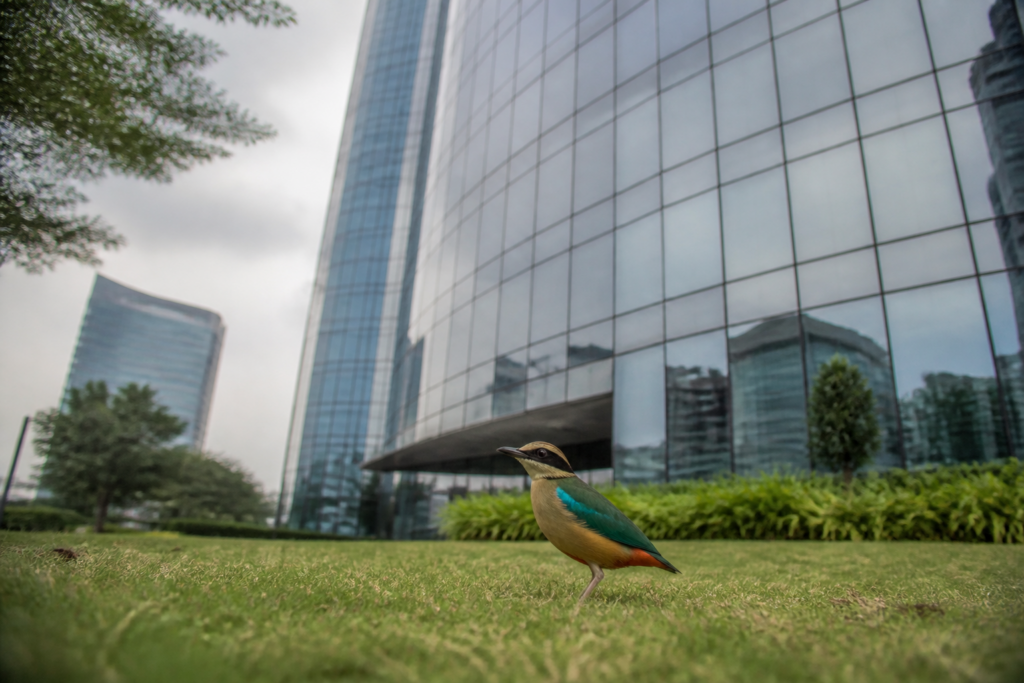
Hyderabad glass facades have become an unintended hazard for Indian Pittas arriving in the city during their winter migration, with seven birds rescued after collisions over 10 days and five of them dying. The incidents point to a wider built-environment problem: buildings designed as transparent or reflective surfaces can become invisible barriers for birds, while responsibility for preventing such collisions remains unclear in the evidence available.
The Indian Pitta is a colourful passerine that breeds in the Himalayan foothills of India, Nepal and parts of Pakistan. During winter, the birds move towards southern India to escape harsher conditions in the north. As they pass through and around Hyderabad, high-rise buildings with glass facades create a risk that is difficult for the birds to detect.
According to Telangana Today, the Animal Warriors Conservation Society rescued seven Indian Pittas at various locations in Hyderabad over the past 10 days. Five died after colliding with glass facades, while two survived and were recovering at the organisation’s rehabilitation centre from injuries sustained in the crashes. The figures represent only cases that reached the organisation, rather than a city-wide count.
That distinction is important. Santoshi Pradeep, a founding member of the Animal Warriors Conservation Society, told Telangana Today that the seven cases were those that had come to the organisation’s notice. She said many similar incidents could go unreported across Hyderabad and other parts of Telangana. The available account therefore establishes a documented cluster of collisions, but not the total scale of bird deaths linked to building facades.
The immediate cause described by wildlife activists is the difficulty birds have in recognising glass as an obstacle. Reflections can make a facade appear to be open sky, vegetation or an unobstructed flight path. Transparent sections can similarly fail to register as a solid surface. For a bird already undertaking a long seasonal journey, a collision with a hard building surface can cause fatal injuries even when the impact is not witnessed.
The urban design question is not simply whether a building uses glass. It is how glass is placed, what it reflects, and whether the facade includes visible patterns or other elements that allow birds to identify it as a barrier. Shiva Kumar, founder of the Voice of Nature Foundation, told Telangana Today that certain patterns on glass facades could help birds recognise obstacles and change direction, potentially preventing collisions.
This shifts the issue from wildlife rescue to building design. Rescue groups can treat injured birds after a collision, but they cannot remove the urban condition that produces the risk. The two surviving Pittas were receiving care, and the organisation has been responding to individual cases. Yet every rescue also represents a point at which prevention may have been possible through changes to the building surface.
The report says similar incidents were recorded in October last year. It also says that neither the Forest Department nor civic authorities had taken steps to prevent such collisions over the following year. The statement, as reported, identifies a continuity problem: the issue had previously surfaced, but no preventive response had been documented in the supplied material before the latest cluster.
That gap raises a question about how urban authorities deal with hazards that do not fit neatly into a single department. A building facade is part of private construction and architectural design. Bird protection falls within the concerns of wildlife and forest authorities. The public space around a building may be governed by civic agencies, while rescue and rehabilitation are being handled by a conservation organisation. The source does not identify a formal mechanism that brings these responsibilities together.
The absence of such coordination can make the problem easy to overlook. A collision is often a small, dispersed event rather than a major incident involving a road, bridge or public utility. There may be no central reporting system, no publicly available map of dangerous facades and no routine requirement in the reported account for building owners to review collision risks. Without consistent reporting, authorities may see isolated bird deaths rather than a recurring urban pattern.
The seven cases recorded in 10 days provide a limited but significant signal. Five deaths among the seven rescued birds amount to a high fatality share within this reported group, although the figure cannot be treated as a city-wide mortality rate. The number also excludes birds that may have died away from buildings, were not found, or were never reported to a rescue organisation. What can be established is that the danger is active during the current migration period and that it is not confined to a single reported incident.
The geography described in the report is also wider than one building. The Animal Warriors Conservation Society rescued the birds at various locations in Hyderabad. This suggests that the risk may be distributed across multiple high-rise sites rather than concentrated at a single facade, although the supplied report does not provide the names of the buildings, their locations, orientation, height, glass specifications or surrounding vegetation.
Those missing details matter for policy and design. A useful city response would need to identify collision-prone buildings, record when and where incidents occur, and establish which facade features are associated with repeated strikes. The source material does not provide such a database or say that one exists. It does, however, show why individual rescue reports are valuable: they can reveal a pattern that remains invisible in conventional building or municipal records.
The proposed remedy mentioned in the report is relatively specific. Patterns on glass could help birds recognise a surface and change direction. The report does not prescribe a particular pattern, spacing, product or technical standard, and it does not say whether any Hyderabad authority has adopted requirements for bird-safe glazing. These limitations should not obscure the institutional point. If a design intervention can reduce collisions, its use depends on whether it is considered during planning, facade approval, construction, retrofitting or building management.
That sequence involves different actors. Architects and developers determine facade concepts and materials. Building owners and facility managers control maintenance and may be able to apply films, markings or other treatments after construction. Civic authorities may influence approvals or building regulations, while the Forest Department may provide wildlife guidance. The report does not establish which of these bodies has a statutory duty to prevent bird collisions, leaving an important governance question unresolved.
Hyderabad’s experience also illustrates how environmental impacts can be produced by ordinary urban growth rather than by a single large infrastructure project. High-rise construction changes the vertical and visual field through which birds move. A facade that appears efficient, modern or open from inside a building can function very differently for wildlife outside it. The environmental performance of a building therefore extends beyond energy use and material efficiency to include its interaction with the surrounding urban ecosystem.
The evidence in this case remains narrow but concrete: seven Indian Pittas were rescued in 10 days, five died, two were recovering, activists believe the actual number of incidents is higher, similar incidents were reported in October last year, and no preventive steps by the Forest Department or civic authorities were reported during the intervening year. It is not enough to establish the full scale of the problem, but it is enough to show that the issue is recurring and that the current response is largely reactive.
The next meaningful development would be an official assessment of collision locations and a clear statement from civic and forest authorities on whether bird-safe facade measures will be required, recommended or monitored. Until then, Hyderabad’s glass towers will remain part of a migration route that the city has documented through rescue calls but has not yet visibly redesigned around.


